The Quick Read
- The PMFME Scheme has crossed the milestone of over two lakh credit-linked beneficiaries, according to the Ministry of Food Processing Industries.
- The scheme has leveraged project investments of over ₹20,300 crore and generated nearly 11 lakh direct and indirect employment opportunities.
- Nearly 90% beneficiaries are first-generation entrepreneurs, while 44% are women entrepreneurs.
- More than 75,000 supported enterprises have entered the formal economy through registrations such as Udyam Aadhaar, Udyam Assist, FSSAI and GST.
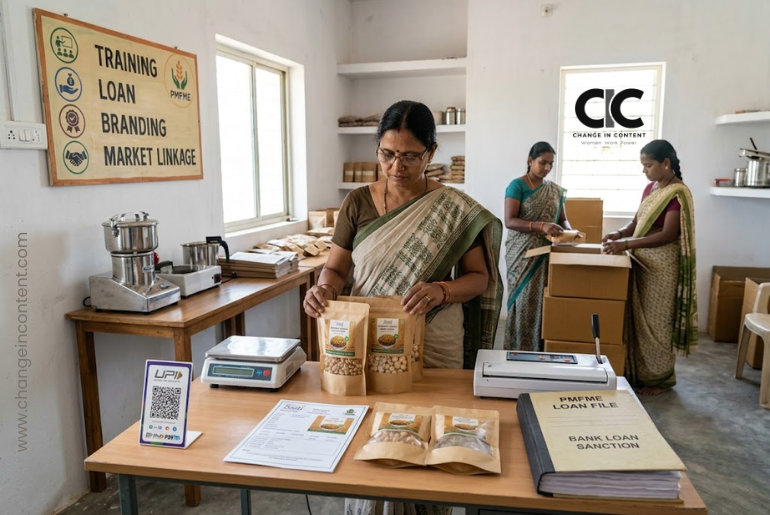
- The scheme supports micro food processing units through credit-linked subsidy, seed capital, training, handholding, branding, marketing and market linkages.
PMFME Scheme reaches a major milestone
The PMFME Scheme has crossed the landmark of more than two lakh loan sanctions for micro food processing enterprises, the Ministry of Food Processing Industries said in a PIB release dated 11 July 2026.
Union Minister for Food Processing Industries Shri Chirag Paswan presided over a special event in New Delhi to mark the achievement. According to the Ministry, the scheme has leveraged project investments of over ₹20,300 crore and generated nearly 11 lakh direct and indirect employment opportunities. Nearly 90% of beneficiaries are first-generation entrepreneurs, and 44% are women entrepreneurs.
That women make up nearly half the beneficiary base is an important policy signal. It shows that food processing, especially at the micro-enterprise level, can be a practical avenue for women’s entrepreneurship, local livelihoods, and income generation.
What is the PMFME Scheme?
The full name of the PMFME Scheme is Pradhan Mantri Formalisation of Micro Food Processing Enterprises Scheme.
It was designed to support unorganised micro food-processing enterprises and help them formalise, upgrade, access credit, improve branding, and connect better with markets. The scheme guidelines state that it was planned with an outlay of ₹10,000 crore over five years, from 2020-21 to 2024-25, with cost-sharing between the Centre and states.
The scheme follows the One District One Product approach. It means each district can focus on a product linked to local strength, such as millets, spices, makhana, fruit products, cereal-based products or other food items. The guidelines say ODOP helps create scale in procurement, common services and marketing.
In simple terms, PMFME tries to help very small food businesses become stronger and more formal.
A pickle maker, millet processor, spice grinder, bakery unit, makhana processor, papad maker, fruit pulp unit or local food entrepreneur may need better machinery, packaging, registration, branding, training, market access or bank credit. The scheme is meant to support that journey.
How does the PMFME scheme support entrepreneurs?
The PMFME Scheme has several components.
For individual micro food processing units, the scheme guidelines provide a credit-linked capital subsidy of 35% of the eligible project cost, with a maximum ceiling of ₹10 lakh per unit. The beneficiary must contribute at least 10% of the project cost, with the balance covered by a bank loan.
For Self-Help Groups, the scheme provides seed capital of ₹40,000 per SHG member for working capital and purchase of small tools. It also supports SHGs, FPOs, and producer cooperatives through credit-linked grants, common infrastructure, branding, marketing, and hand-holding support.
The Ministry’s latest update says PMFME provides end-to-end support, including financial assistance, training, hand-holding, branding, marketing, and market linkages. It also highlighted the scheme’s network of District Resource Persons, who help entrepreneurs at the grassroots.
Why formalisation matters
Many micro food businesses in India operate informally.
Some of them may be family-run. They may sell locally. Some may not have formal registrations, standard packaging, a bankable project report, food safety certification or access to larger markets. Formalisation can change that.
The Ministry says more than 75,000 PMFME-supported enterprises have entered the formal economy through registrations such as Udyam Aadhaar, Udyam Assist, FSSAI and GST.
It matters because formal businesses can access credit more easily, build buyer trust, sell through wider channels, improve packaging and quality, and participate in larger supply chains.
For women entrepreneurs, formalisation can also shift how their work is seen. A home-based or local food activity can become a recognised business. That can improve confidence, income visibility and bargaining power inside the household.
The Change in Content’s guide on women-centric schemes in India has previously explained why policy support must help women move from access to welfare to economic agency. PMFME fits into that wider conversation when women use it to build viable enterprises.
Training, incubation and women’s participation
The Ministry says more than 1.76 lakh beneficiaries have been trained under the scheme, and 77% of them are women. It also said more than 4.18 lakh SHG members have received seed capital support. This is an important detail.
Women often enter entrepreneurship through small, local, home-linked or group-linked businesses. Food processing is one of the sectors in which women already have skills, product knowledge, and community networks. But skills alone do not create a business. Training, packaging, credit, quality control, digital access, market linkages and registrations are needed.
The Ministry also highlighted 80 Common Incubation Centres approved across 27 states and Union Territories, of which 32 have been commissioned. These centres can help entrepreneurs access facilities for processing, testing, training, and product development without each micro unit having to invest in all of these alone.
Where the PMFME scheme must stay careful
The achievement is significant. But the next phase must focus on access quality.
Government schemes often fail not because the intent is weak, but because the last-mile process is difficult. Awareness remains a major challenge. Many eligible entrepreneurs may not know the scheme exists, how to apply, which documents are needed, or whom to approach.
The second issue is middlemen.
Whenever a scheme involves applications, bank loans, documentation and subsidies, there is a risk that beneficiaries may become dependent on informal agents. That can increase costs, confusion and exploitation. Direct access, transparent portals, trained official resource persons, and strong grievance redressal are essential.
The third issue is simplification.
A micro food entrepreneur should not need to understand complex policy language to apply. Forms, eligibility, subsidy flow, bank process, DPR preparation, training and compliance should be explained in local languages and through local support.
This lesson is important across welfare and entrepreneurship schemes. In a different context, Change in Content recently examined the Ladki Bahin Scheme beneficiary controversy, in which digital access, verification, and accountability became central issues. PMFME must continue to ensure that support reaches real entrepreneurs without unnecessary friction.
The Change in Content View
The PMFME Scheme, crossing two lakh credit-linked beneficiaries, is a meaningful milestone for India’s micro food processing sector.
Yes, the numbers show scale. The women’s participation shows potential. The formalisation figure shows movement towards stronger enterprise systems. And the training and SHG support show that the scheme is not only about loans but also about capacity building.
But the next test is equally practical.
- Can more entrepreneurs learn about the scheme?
- Can women apply without depending on mediators?
- Can banks process proposals smoothly?
- Can common incubation centres become useful on the ground?
- Can local food businesses move from survival to scale?
If those questions are handled well, PMFME can become more than a subsidy scheme. It can become a local engine for enterprise building in India’s food economy.
FAQs
Q: What is the PMFME Scheme?
A: The PMFME Scheme, or Pradhan Mantri Formalisation of Micro Food Processing Enterprises Scheme, supports micro food processing enterprises through credit-linked subsidy, training, handholding, branding, marketing and formalisation support.
Q: How many beneficiaries has the PMFME Scheme crossed?
A: The Ministry of Food Processing Industries says the scheme has crossed over two lakh credit-linked beneficiaries through loan sanctions to micro food processing enterprises.
Q: How much subsidy is available under PMFME?
A: For individual micro food processing units, the scheme provides a credit-linked capital subsidy of 35% of the eligible project cost, capped at ₹10 lakh per unit. The beneficiary must contribute at least 10% of the project cost, with the balance coming through a bank loan.
Q: How does PMFME help women entrepreneurs?
A: According to the Ministry, 44% of PMFME beneficiaries are women entrepreneurs, and 77% of trained beneficiaries are women. The scheme can help women upgrade food businesses, access credit, receive training and move towards formalisation.
Q: What is the ODOP approach in PMFME?
A: ODOP means One District One Product. Under PMFME, districts focus on specific food products to build local value chains, common services, branding, and market linkages.
Editorial Note and Sources
This article is based on official information from the Press Information Bureau and the PMFME Scheme guidelines issued by the Ministry of Food Processing Industries. It explains the scheme for a wider readership through the Change in Content lens of women, work, enterprise and policy access. The article is intended for editorial and informational purposes only and should not be read as legal, banking, subsidy, financial, tax or business advisory guidance. Applicants should refer to official scheme portals and authorised government channels before applying.
Sources used:
- Press Information Bureau, Ministry of Food Processing Industries: Union Minister Shri Chirag Paswan Hails PMFME Scheme’s Landmark Achievement of Over Two Lakh Credit-Linked Beneficiaries
- Ministry of Food Processing Industries: PMFME Scheme Guidelines