
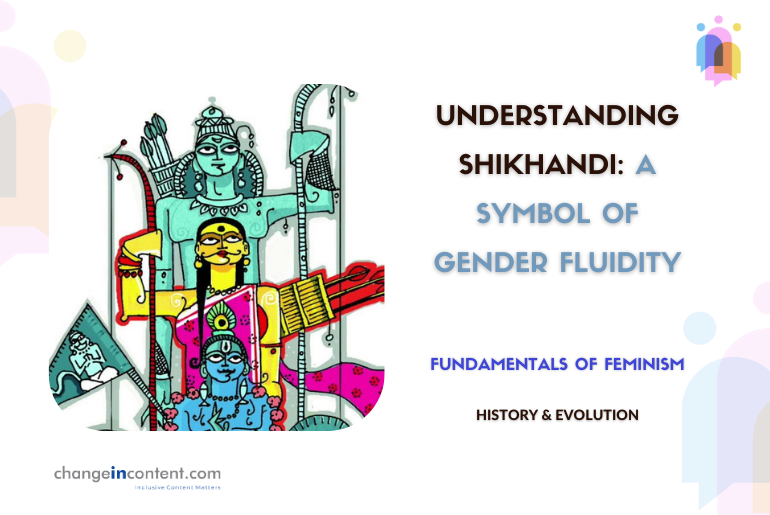
Have you ever encountered a story that challenges your very understanding of identity and respect? A story- that has been told over the years is that of Shikhandi. It is a testament to the discrimination that non-binary people face. Shikhandi is a nuanced and complex character in the Mahabharata. Their story is one of love, revenge, and discrimination.
Shikhandi’s story is relevant because of how society views an individual who is identified as a blend of male and female. Shikhandi is someone who can be called non-binary as their gender identity differs from the gender they were assigned at birth.
How society looks at the people who fall outside traditional gender categories of “man” or “woman” has not changed much. Who was Shikhandi? They could have been a transperson whose gender identity differed from the one assigned to them at birth.
If we bring in a contemporary parallel, Shikhandi may be an example of someone who identifies as a trans-man or trans-woman, irrespective of whether they have undergone procedures such as sex reassignment surgery, hormone therapy, laser therapy, or other forms of therapy. Additionally, they can be someone with intersex variation, a gender-queer individual, or those who identify with socio-cultural identities such as kinner, hijra, aravani, and jogta.
Shikhandi: The overview
Pitamaha Bhishma dies because of Shikhandi. Before the Kurushektra war began, Bhishma advised the Pandavas to send Shikhandi to fight him (some versions state that even though Shikhandi was a man by birth, Bhishma considered him to be a woman). Bhishma knew that he was invincible. That’s why he suggested the placement of Shikhandi as a warrior who would help the Pandavas take him down. It was on his suggestion basis that the Pandavas worked. The strategy was simple. Bhishma, the all-powerful patriarch, would relinquish his arms and ammunition before any person who is not a man/ or does not consider him to be a man.
Shikhandi’s tale transcends the battlefield, sparking a debate that continues to this day. Was Shikhandi a man seeking vengeance, a woman trying to dress as a man, a trans person or someone who was gender-fluid? Why did Bhishma not fight him? Why did Bhishma not look at Shikhadi as a man? In that context, Bhishma not fighting Shikhandi is kind of like ‘untouchability’- another societal stigma that is part of several narratives in our epics.
Shikhandi: The one who never got their dues
Shikhandi’s tale is about revenge and rejection. Some versions of Mahabharata state that King Drupada of Panchala, consumed by a desire for revenge against Bhishma, performed a powerful ritual to achieve his goal. The gods, impressed by his devotion, granted him a unique boon. The offering Drupada presented would be split in two, manifesting as both a son and a daughter. Thus, Shikhandi was born. Some other versions state that Drishtadumna and Draupadi were born out of this prayer. There are several Mahabharatas in India. The stories change, the interpretations change, but the crux remains the same.
Whether born from the male portion of the offering or born as a female, Shikhandi was raised as a boy. He goes through several experiences. One of them is being married to a same-sex person as part of a larger political ploy. Imagine a childhood filled with conflicting emotions. We do not read much about the conflicts Shikhandi experiences. Somewhere, their identity makes them fade into the background, to be spoken about again as an instrument or a pawn who manages to act as a front in a well-thought-through operation. An operation that helps the Pandavas inch towards victory. The sacrificial role of Shikhandi is indicative of strong prejudice against non-binary individuals and one that we know has not changed much.
Who was Shikhandi? The back story
To understand Shikhandi, we need to know Amba, a princess who vowed revenge on Bhishma after he kidnapped her. The three sisters, Amba, Ambika and Ambalika, were kidnapped from their Swayambhar by Bhishma as to-be brides for Vichitravirja, his brother. However, Amba refused to marry him as she was in love with another man.
Before her wedding, Amba expressed her love for the King of Salva to Bhishma, refusing to marry anyone else. Bhishma sent her to Salva, who rejected her, considering Bhishma her rightful husband. Amba then pleaded with Bhishma to marry her as per Kshatriya dharma, but he declined due to his celibacy vow. Disheartened, Amba retired to the forest to practice austerities. She sought help from Parashurama, but Bhishma refused, leading to a duel between Parashurama and Bhishma.
The Gods had to intervene to stop that fight. Therefore, after many tribulations, Amba received a boon from Shiva to be reborn as a man who would slay Bhishma. Overjoyed, she prayed for Bhishma’s death and self-immolated. Shikhandi was Amba reborn.
Many Mahabharats, many Shikhandis
In another iteration, Amba received a garland from Kartikeya that foretold Bhishma’s death. When no one supported her cause, she left the garland at King Drupada’s gates. Due to King Drupada’s prayers, a girl named Shikhandi was born who was destined to become a man. Raised as a boy, Shikhandi’s true identity was revealed later. Through the help of a yaksha, Shikhandi temporarily exchanged sexes to become a man.
Shikhandi: The underrated warrior
Shikhandi became a crucial figure in the Kurukshetra War. , eventually leading to Bhishma’s downfall. But it is not due to their strength or prowess. The conversation stops at gender. During the war, Shikhandi faced numerous challenges, including the loss of his son. The epic has very little space devoted to this tragedy. Ashwatthama killed Shikhandi on the 18th day of the war. In some versions, Ashwatthama also kills Shikhandi’s partner, adding to the complexity of Shikhandi’s story. But does Shikhandi get the same treatment as other characters like Ghatatkacha, Satyaki or Dhristadumnya?
On the other hand, we still refer to nominal heads in politics as Shikhandi- a persona non grata or a person who just stands doing nothing. Our question is, why have we not delved into the warrior Shikhandi? Or did their gender identity precede their reputation? The unfairness of treatment in the epic or in real life remains the same despite the gap of thousands of years in between.
The interesting angle: Amba and Shikhandi? Who is predominant?
Shikhandi was the reincarnation of Amba, carrying the princess’s fiery spirit within them. This belief suggests a deep-rooted female identity seeking revenge, further blurring the lines between masculinity and femininity in Shikhandi’s story.
Shikhandi’s life took a dramatic turn when he was married to a princess of the Panchala kingdom. While some interpret this as a political alliance, a common practice during that era, others view it as a further exploration of Shikhandi’s complex identity. Notably, Shikhandi even fathered a son, which strengthens arguments for his biological masculinity.
Ancient Indian texts do hint at the existence of individuals who identified differently from their assigned sex at birth. Shikhandi’s comfort in inhabiting both male and female forms throughout the narrative aligns with this idea of fluid gender identity.
Born a girl, raised as a boy or a man who identifies as a woman?
Ultimately, Shikhandi’s story transcends the limitations of a single label. Amba was a grief-stricken, jilted woman who was taking revenge against Bhishma. Shikhadi was a trans person or gender-fluid person facing rejection from society as a married man or as a son. On the other hand, he fathered a son and lost his same-sex partner on the battlefield. Their identity lies in the lack of a definitive answer, inviting us to explore the complexities of gender identity and the richness of human experience.
We need to separate two things: what Shikhandi was assigned at birth (sex) and how he felt inside (gender identity). Today, we know someone’s gender identity and their internal sense of being male, female, or something else might not always match their assigned sex.
Some believe Shikhandi was a man because of his birth story. King Drupada, desperate for revenge against the warrior Bhishma, performed a special ritual. The gods granted him a wish: to be the person who would cause Bhishma’s death. The rest of Shikhandi ceased to matter. Even his very gender identity.
The vengeful princess and a prince: Living in the same body
The legend of Amba, a princess who swore revenge on Bhishma after he rejected her proposal. Shikhandi was Amba reborn, carrying the princess’s fiery spirit within them. It adds another dimension to the debate: was Shikhandi indeed a person living in the present? Or is he just a body where the soul belongs to Amba, fueled by a deep desire for revenge, or something more complex?
Transgender: A possible answer
Perhaps Shikhandi was comfortable inhabiting both male and female forms throughout the story. It allows us to explore the complexities of gender identity and the importance of looking beyond labels. Shikhandi’s existence and Bhishma’s refusal to fight him/ her remind us that humans have not really changed. If your gender is not clearly defined, you become untouchable by the patriarch.
The final thoughts
The epic war of Kurukshetra is still relevant. We see references and examples of Mahabharata being relevant in our world. Mahabharata is a fusion of several tales- of families, power, love, devotion, treachery, and politics. In this complex tale, Shikhandi is a strategic implant. Bhishma had sworn a vow never to harm a woman and never to go against the throne. He suggested to the Pandavas that Shikhandi be brought to the forefront so that they could kill him, as he would give up his weapons. It was a strategic advantage that had a significant impact on the course of the battle, and the undefeatable Bhishma, who had the power to choose his death, left the battleground, paving the way for Drona to lead the Kauravas- another subtle dent in the power play.
Even by playing the part, Shikhandi never got the status of a warrior. His identity precedes him. Even Today. In a man’s world, anyone who does not identify as a ‘he’ is most often overlooked. Shikhandi is sometimes remembered as the raging princess or a woman dressed as a man or as a transperson, but mainly as a nominal figure who does not carry much of an identity.
Disclaimer: The views expressed in this article are based on the writer’s insights, supported by data and resources available both online and offline, as applicable. Changeincontent.com is committed to promoting inclusivity across all forms of content, which we define broadly to include media, policies, law, and history—encompassing all elements that influence the lives of women and gender-queer individuals. Our goal is to promote understanding and advocate for comprehensive inclusivity.
