
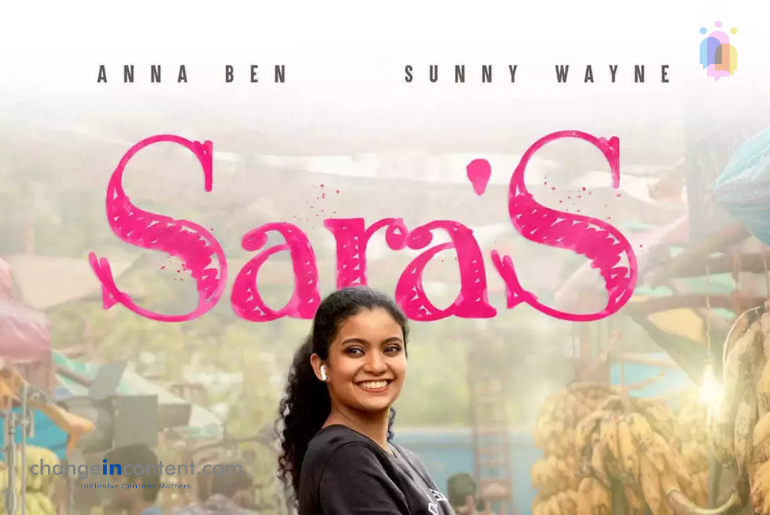
“Sara’s,” a thought-provoking Malayalam film, tackles sensitive social issues like women’s reproductive freedom, marital expectations, and the stigmas surrounding infertility. The story centres on Sara, a filmmaker determined not to have children, and her journey through societal pressure, misconceptions about fertility, and personal choice. This narrative challenges patriarchal norms and invites discussions on a woman’s right to control her own body. The movie Sara’s challenges social stigma, making it a timely movie with a deep-rooted message.
Sara’s challenges social stigma
Breaking free from motherhood stereotypes
The film “Sara’s” addresses the often-overlooked pressure society places on women to become mothers. The protagonist, Sara, firmly rejects this expectation, choosing instead to prioritise her dreams of becoming a filmmaker. Her candid refusal to have children challenges the age-old notion that a woman’s life is incomplete without motherhood.
The egg puff analogy: More than just a snack
Sitting side by side at school lunch, a teenage girl and a boy in a relationship discuss their future while eating egg puffs (yes, the egg puff detail is necessary). They dream of attending the same college, building careers, and getting married. The boy, with a smile, expresses his wish to have a daughter first, then a son. The girl’s smile fades as she firmly says she will never give birth. Her blunt declaration catches the boy off guard, and he stops mid-bite, causing the egg from his puff to fall out. In the next scene, he walks away, declaring, “Without the egg, the puffs are no good.”
This egg puff analogy raises the question: Will women ever be seen as more than egg-producing machines? It is just one of many thought-provoking moments in the Malayalam film Sara’s.
Sara’s delicate approach to reproductive freedom
Sara, played by Anna Ben, dreams of being a filmmaker and has always been certain that she does not want children. Sara turns down numerous marriage proposals because she knows how society ties a married woman’s worth or completeness to their role as a mother. But then, she meets Jeevan (Sunny Wayne), who shares her views of not wanting to have children.
They marry with this understanding, but a year later, an unplanned pregnancy disrupts their plans. Sara, focused on her directorial debut, immediately decides on an abortion. But when their families accidentally discover the pregnancy, they pressure Sara, accusing her of prioritising her career over everyone’s happiness.
Spoiler alert: Sara’s challenges social stigma as the character of Sara does not proceed with the pregnancy.
You might think the film is against the idea of having children. No, it’s not that at all. Instead, it questions the rush to do so before one is truly prepared. Is it to satisfy parental wishes for grandchildren? But let’s not forget that when parents become grandparents, the husband and wife themselves transition to the more demanding role of parents, which changes everything.
Fertility vs feminism: How Sara’s challenge social stigma
In one scene, amid a discussion where the couple expresses their decision against having children, everyone quickly jumps to assuming Sara might be infertile. But why isn’t the possibility of the husband being infertile questioned? This double standard is so ingrained that women in relationships often shoulder the blame for infertility, even when their health is perfectly fine.
When Sara asserts that she doesn’t have infertility issues, the aunties dismissively remark, “Oh, she doesn’t have infertility issues; she has feminism.” This dialogue shows how patriarchy pathologised feminism, treating it like a disease or a problem to be fixed.
Addressing taboo topics like abortion
The film avoids using the word “abortion.” Even Sara’s gynaecologist, Dr Hafees (Sidhique), doesn’t explicitly mention it. Instead, he discusses parenting. He emphasises that if one cannot be a good parent, one shouldn’t be a parent at all. This decision may have been to avoid controversy. Still, the film, without explicitly using the word, still stood up for women’s rights.
Sara being Christian adds to the irony. That is because it challenges the stereotype that only Muslim and Christian conservatives oppose abortion among Indian liberals. In fact, people from all religious backgrounds in India can hold religious beliefs against pregnancy termination.
The movie also cleverly shows that lack of support for a woman’s choice can even come from another woman, as seen with Sara’s mother-in-law. She strongly opposes her decision to have an abortion. However, one significant flaw is how the film completely overlooks her husband’s stance on abortion. The film portrays him as a conflicted figure who is sometimes supportive and sometimes condescending.
Sara’s challenges social stigma: The marital rape issue
Another character in the film, Lisi, is introduced as a victim of marital rape who has recently given birth to her fourth child. Instead of receiving counselling or information about birth control options, the gynaecologist looks down on her and scolds her for not standing up for herself. However, Lisi is not given the support she needs to make a stand. She is left to face her challenges alone.
Patriarchy teaches that a wife belongs to her husband, and it creates a culture where marital rape is kept silent and shamed. Many women are afraid to speak up against their husbands because they fear blame or social stigma. The legal system often fails to recognise or support survivors of marital rape, making the problem even worse.
It is also incredibly ironic. Society often criticises women who choose not to have children, yet it also stigmatises those who have more than three children. While this might have been more accepted in the past, today, having more than two children can lead to assumptions that the child was unplanned or speculation about the couple’s intimate relationship.
The final thoughts
“Sara’s” offers a refreshing, lighthearted look at the age-old tradition of viewing women as mere vessels for continuing the family line. The film doesn’t criticise motherhood or parenthood, nor does it advocate for abortion. Instead, it conveys a simple message: motherhood is a choice, not an obligation. It is a film about a woman’s autonomy over her own body. Women aren’t born just to reproduce and care for others. Each woman has the right to decide for herself, and the film respects this choice.
Disclaimer: The views expressed in this article are based on the writer’s insights, supported by data and resources available both online and offline, as applicable. Changeincontent.com is committed to promoting inclusivity across all forms of content, which we define broadly to include media, policies, law, and history—encompassing all elements that influence the lives of women and gender-queer individuals. Our goal is to promote understanding and advocate for comprehensive inclusivity.
