
We have all been there. You mention buying a new laptop; maybe you are on a call with a friend, texting about it, or just thinking out loud. Suddenly, your phone is flooded with laptop ads. Your social media, your search results, and even Amazon all scream, “Exciting laptop deals just for you!”
Naturally, the question pops up. Is my phone listening to me?
Fast forward to 2025, and the question is not just about your phone eavesdropping anymore. AI is not just passively listening. It’s actively monitoring, tracking, and predicting your every move. Officials insist it is all for “user experience,” which actually means “we are watching you but for your own good.“ AI has the power to track what a user buys, where they go, and even predict what they will need next.
Let us say AI is watching a woman’s phone. She could be a working professional in her 20s, a stay-at-home mom, or a woman in her late 50s. Here is what AI would likely track and, more importantly, what it would do with that information.
AI and Women – Scenario 1: The working woman in her 20s
The first thing AI notices? The alarm snooze pattern. Does she wake up immediately or hit snooze five times? AI takes notes. Maybe she needs an “Improve Your Sleep” app recommendation. Next, she checks messages, family group chat, work updates, and a couple of unanswered DMs from some guy who doesn’t understand boundaries. AI does not intervene here. Instead, it makes a mental note to push ads for “Find Your Soulmate” dating apps later.
She opens Google Maps to check traffic. AI knows where she is going. Meanwhile, she quickly Googles, “How to tell if someone is following you?” AI registers this but does nothing because, apparently, that’s not advertisable.
Later, she texts a friend: “That guy from work keeps making weird comments. Should I report it?” But AI won’t suggest legal aid, POSH support groups, or actual preventive measures. Instead, it will throw in an ad for pepper spray disguised as lipstick and self-defence keychains in pastel colours. In the AI world, women’s safety is a shopping problem, not a societal one.
AI and Women – Scenario 2: The stay-at-home mom
Her day starts with grocery list apps, kids’ school schedules, and a quick search for “how to get my child to eat more vegetables.” AI sees a golden opportunity. Her feed is soon full of organic meal plans and miracle picky-eater recipes.
Later, she checks a parenting forum. A Reddit thread on “staying financially independent as a stay-at-home mom” catches her eye. AI registers this but does not suggest financial literacy resources or career-building programs. Instead, her feed fills with ads for “How to Make Money From Home Without Neglecting Your Husband and Kids!” and “Be Your Own Boss (But Still Have Dinner Ready by 6)!”
In the evening, she asks, “Why do I feel exhausted all the time?” AI does not flag this as burnout, mental overload, or the crushing weight of unpaid labour. Instead, her feed is filled with ads for collagen gummies to “restore youthful energy” and multivitamins to “keep up with your busy life.” Of course, the problem isn’t that she’s overworked and undervalued. AI treats it as a simple consumer problem.
AI and Women – Scenario 3: The woman in her late 50s
At some point, she types, “Why do I feel hot all the time?” or “Am I suffering from brain fog?” into Google. AI should flag this as potential burnout, chronic fatigue, or even menopause-related symptoms. But it does not. Instead, her feed fills with ginseng supplements to “boost vitality” and yoga programs for hormonal balance.
But to be fair, can we really blame AI? With so little awareness, research, or conversation around menopause, it is no wonder its algorithm treats it like a minor inconvenience rather than a major life transition. After all, it is hard to program solutions for something society barely acknowledges.
Later, she searches “how to restart a career after 50.” AI does not provide networking opportunities, skill-building courses, or career transition programs. It assumes the problem is not discrimination but mindset. So instead of helping her re-enter the workforce, AI pushes “motivational” content about starting her own business, something like “You are never too old to start your own business!”
Siri or Alexa, how about we talk about ageism in hiring, too? Or is that not SEO-friendly enough for AI’s algorithm?
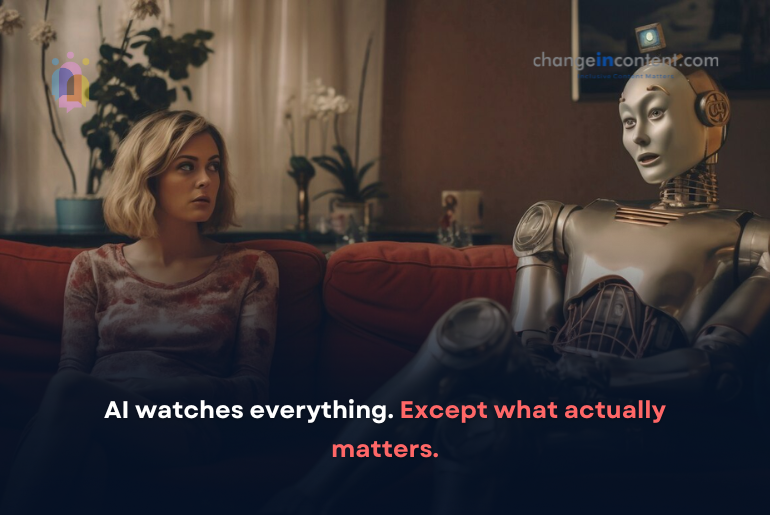
The AI that sees everything. Or does it?
If artificial intelligence is monitoring people so closely, then why does it seem to miss the things that actually matter? If AI can detect a casual chat about laptops and instantly flood her feed with ads, why doesn’t it pick up on far more urgent searches?
Think about the countless times women look up things like “What to do if someone follows you home?” or “How to report online harassment?” You would expect a system that tracks user behaviour so well to offer immediate, helpful resources. You would even think AI might compile all these searches and flag them for someone in power, which may spark a policy change or two.
But no, that is not happening. Instead, it just assumes she would like a limited-time offer on pink tasers and keychains with hidden knives.
Surveillance technology is marketed as a tool for convenience, but convenience for whom? For the corporations that profit from hyper-targeted advertising? For the developers refining their AI models? Because it is certainly not for the women who could use AI’s assistance in situations where it actually matters.
So, the next time your phone magically recommends something you casually mentioned in conversation, ask yourself: if AI can be that precise, why does it remain so conveniently oblivious when it comes to real issues?
Closing thoughts on AI and Women: What does AI choose to see?
AI does not just track. It curates, it watches, it analyses, and then it decides what is profitable to act on. So, while it might notice a woman’s search for help, support, or change, it rarely responds with anything more than a well-placed ad. Because, at the end of the day, AI’s job is not to make life easier. It is to make data more profitable.
Maybe AI is not the problem. It has just been programmed to prioritise profit over protection and gender equality. And it is time we question that biased programming.
Changeincontent perspective: The code we need to rewrite
Artificial Intelligence is only as good as the data it learns from. Unfortunately, that data is riddled with biases. From ignoring mental load to misinterpreting burnout, AI fails to understand women. It is not because AI lacks intelligence but because it mirrors a world that refuses to see women’s realities.
At Changeincontent, we believe this is yet another reason to say #NoWomensDay. If AI cannot see the struggles that matter, maybe it is time for us to rewrite the code of content, policies, and perception.
Also, read our article on Women in AI.
Disclaimer: The views expressed in this article are based on the writer’s insights, supported by data and resources available both online and offline, as applicable. Changeincontent.com is committed to promoting inclusivity across all forms of content. We broadly define inclusivity as media, policies, law, and history—encompassing all elements that influence the lives of women and marginalised individuals. Our goal is to promote understanding and advocate for comprehensive inclusivity.
