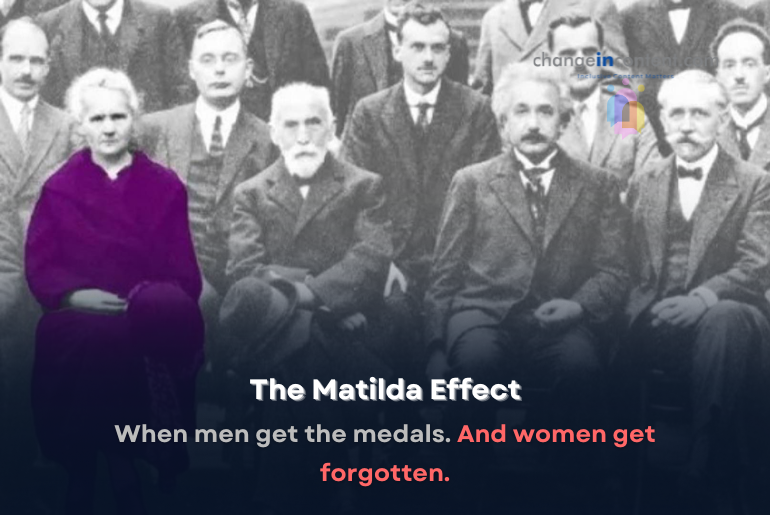
Gender bias in STEM is not exactly breaking news. It has been around for centuries. Despite all the talk about progress, women still find themselves sidelined in labs, tech firms, and boardrooms alike. The invisibility of women, especially in the STEM (Science, Technology, Engineering, and Mathematics) field, is known as the Matilda Effect.
The Matilda Effect refers to the repeated pattern of men claiming credit for intellectual work done by women. Women have consistently contributed to science, technology, and innovation, yet their names rarely appear in history books. Their work gets tucked away, erased, or worse, handed over to their male counterparts, who gladly soak up the applause.
Take any major scientific breakthrough, and there’s a good chance a woman had a hand in it. However, by the time the Nobel Prizes and accolades roll around, it’s often a man standing on stage, giving a charming speech, while the woman’s role dissolves into the background.
What is the Matilda effect?
The Matilda Effect takes its name from Matilda Joslyn Gage, an American suffragette, activist, and sociologist. She was the one who refused to accept the myth that women lacked scientific or inventive talent. In 1870, Gage wrote a pamphlet titled Woman as Inventor, challenging the belief that innovation belonged solely to men. “Such statements are made lightly or ignorantly. Tradition, history and experience prove that women possess these abilities to the highest degree,” the essay says.
After nearly a century, Historian Margaret Rossiter came across Gage’s pamphlet and recognised how little had changed. Rossiter spent years uncovering forgotten women scientists whose names mysteriously vanished from textbooks and award lists. In 1993, she coined the term Matilda Effect to describe this pattern of women doing the intellectual work and men getting the credit. Rossiter’s research revealed case after case of women ignored, sidelined, or conveniently written out of history.
The problem is not just missed Nobel Prizes. Often, women don’t even get their names on the studies they helped create. Sometimes, they’re reduced to footnotes, if they appear at all.
The quiet disappearance of women’s contributions to science
Lately, I keep coming back to the story of Rosalind Franklin. In 1950, Rosalind Franklin joined King’s College London and worked with Maurice Wilkins. Franklin’s expertise led her to capture Photo 51, the crucial image revealing DNA’s double-helix structure. Instead of crediting her, Wilkins took her data without her consent and passed it to James Watson and Francis Crick at Cambridge. The two men used her findings to publish their famous paper in 1953. Franklin’s name was nowhere in sight. In 1962, Watson, Crick, and Wilkins accepted the Nobel Prize. Franklin, who died in 1958, received no recognition.
Every time a woman’s work disappears behind a man’s public recognition, the cycle continues. Future generations look back, see only male achievements, and assume men naturally dominate the scientific world. It’s not a coincidence. It’s a carefully maintained illusion.
It’s a theft of legacy that has happened quietly over decades. Women did the research, ran the experiments, and wrote the papers, but we do not credit women openly and loudly.
It is gender harassment in disguise
Franklin’s story is a textbook example of the Matilda Effect. It also exposes how the Matilda Effect is another form of gender harassment. On top of erasing women’s contributions, society was also undermining them through petty, gendered commentary. James Watson made this painfully clear in his 1968 memoir, The Double Helix, where he described Franklin not with professional respect but with condescension.
Watson repeatedly refers to her as “Rosy,” a nickname she disliked, and no one dared use it on her face. He spends more time critiquing her appearance than acknowledging her scientific skill. “There was never lipstick to contrast with her straight black hair, while at the age of thirty-one her dresses showed all the imagination of English blue-stocking adolescents,” he writes. Oddly, he never commented on the clothing or grooming habits of his male peers.
Watson even wrote, without irony, that “the best home for a feminist was in another person’s lab.” In the 1993 book Nobel Prize Women in Science, Crick admitted, “I’m afraid we always used to adopt—let’s say, a patronizing attitude towards her.”
They didn’t see Franklin as a scientific peer. They viewed her through the lens of gender stereotypes and dismissed her contributions accordingly.
How do we fight the Matilda effect?
Correcting the Matilda Effect requires more than surface-level gestures or one-day campaigns. The problem is deeply rooted, and the solution demands more than tokens, coupons, or themed hashtags rolled out every March. Actual change starts with acknowledging the overlooked contributions of women in science’s past and actively addressing the inequalities that persist in today’s research spaces.
It’s easy to celebrate women’s achievements with empty slogans but far more challenging to question why they still face unequal pay, lack of research funding, fewer leadership roles, and constant scrutiny.
Fighting the Matilda Effect demands effort, consistency, and honesty. No amount of social media campaigns can undo decades of systemic erasure unless organisations and institutions commit to real change. It starts with rewriting the narrative, giving credit where it’s long overdue, and refusing to let the next generation of women scientists disappear into the footnotes.
Oh, also, no coupon code required.
The final thoughts on the Matilda effect
Many workplaces post hashtags about equality on Women’s Day and host webinars on diversity while failing to credit women daily. What makes this even more absurd is how the industry continually launches campaigns urging women to “lean in,” “break barriers,” and “find their voice.” Meanwhile, structural barriers remain, and recognition continues to play favourites.
What makes the Matilda Effect even more damaging is its ability to perpetuate a cycle. When history records only male names, society unconsciously starts believing men are naturally better suited for STEM. It discourages women from entering or staying in the field. The lack of recognition becomes a barrier, focusing more on stereotypes that should have been retired long ago.
Changeincontent perspective: Invisible women, visible truths
The Matilda Effect is not just history; it is still happening in science labs, conference rooms, and innovation hubs. The system is still erasing women’s names from the narrative. At Changeincontent, we believe that celebrating women on one day and sidelining them for the rest of the year is not progress. It is pinkwashing. It is precisely why we advocate for #NoWomensDay.
If you want to understand why we fight erasure, read our earlier article on the Vivo Kanyagyaan campaign for women in STEM.
We do not need more Women’s Day hashtags. We need names not forgotten.
Disclaimer: The views expressed in this article are based on the writer’s insights, supported by data and resources available both online and offline, as applicable. Changeincontent.com is committed to promoting inclusivity across all forms of content. We broadly define inclusivity as media, policies, law, and history—encompassing all elements that influence the lives of women and marginalised individuals. Our goal is to promote understanding and advocate for comprehensive inclusivity.