The Quick Read
- The first women’s Test match at Lord’s drew a cumulative crowd of 37,846, setting a new world record for Women’s Test Match attendance. Day Two alone drew 15,243, also a single-day Women’s Test record.
- India defeated England by 270 runs in the historic Test. Kranti Gaud took 5/37, while Yastika Bhatia scored 113, with both earning places on the Lord’s Honours Boards.
- Lord’s said over 108,000 fans attended its international women’s matches during the summer, with 27% of ticket purchasers new to Cricket and nearly 40% of tickets bought for females and juniors.
- BCCI’s 2022 pay equity policy gave Indian women cricketers the same international match fees as men: ₹15 lakh for Tests, ₹6 lakh for ODIs and ₹3 lakh for T20Is.
- The bigger lesson is simple enough for every parent, school, office and sponsor: when women’s sport gets visibility, investment and respect, audiences come.
Women’s Test Match attendance just changed the conversation
For years, women’s sport has had to sit through the same tired argument.
“Where is the audience?”
“Where is the revenue?”
“Who will watch?”
“Why should they be paid the same?”
“First prove the market.”
Then 37,846 people turned up across four days to watch a women’s Test match at Lord’s.
Not a T20. Not a final. And not a short-format festival. A Test match. That matters.
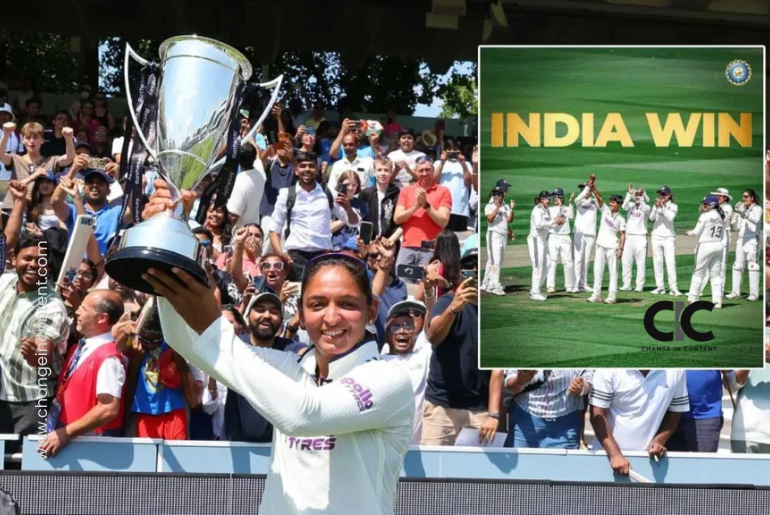
The first women’s Test at Lord’s between India and England set a record for Women’s Test Match attendance. Lord’s reported a cumulative crowd of 37,846, with 15,243 attending Day Two alone, both world records for women’s Tests. The match was part of a larger summer where over 108,000 fans attended women’s international matches at the ground.
So the question needs to change. Maybe women’s sport was never short of audience. Maybe it was short of stages, schedules, marketing, investment and belief.
India won. Women’s Cricket won louder.
The Cricket made the moment even bigger.
India defeated England by 270 runs in the first-ever women’s Test match at Lord’s. Kranti Gaud’s five-wicket haul and Yastika Bhatia’s century put them on the Lord’s Honours Boards. That makes the moment both symbolic and statistical.
That image should travel far.
Two Indian women. At Lord’s. On the Honours Boards. In front of a record crowd.
That is the kind of sporting memory that changes what young girls imagine for themselves.
A girl watching this does not only see Cricket. She sees a larger permission. At the same time, she sees that women can occupy the oldest rooms, the grandest grounds and the most guarded traditions. She sees that history can make space, even if it takes too long.
And yes, it took too long. Lord’s hosted its first women’s international in 1976, but it took another 50 years for a women’s Test to be played there.
That delay should not be forgotten. But neither should this arrival.
The revenue argument needs a fairer reading
Many often judge women’s sports by revenue before the sport gets infrastructure.
Men’s sport was not built in a day. It was built through schools, clubs, broadcast deals, fixtures, commentary, heroes, families watching together, brands investing, newspapers covering, boards scheduling, and generations being told that sport mattered.
Women’s sport has been asked to generate comparable returns without comparable backing. That is not a fair test.
Change in Content had earlier looked at the women-in-sports revenue gap and why the market argument often ignores the market-building process. Audiences do not arrive magically. You have to bring them by creating access, visibility, storytelling and habit.
Lord’s has now given a strong signal. When women’s Cricket is placed at a historic venue, marketed well, scheduled with seriousness and played at an elite level, people come.
The record also tells sponsors something they should hear clearly.
There is appetite; there is emotion; there is family interest; there are young fans; there are new fans. Lord’s said 27% of ticket purchasers across its women’s summer were new to Cricket, and nearly 40% of tickets were bought for females and juniors.
It would be an absolute error to call it a weak market. It is indeed a growing one.
BCCI’s pay parity decision matters here
India’s women cricketers did not reach this moment only through talent. Talent was always there. What has changed is the ecosystem around them.
BCCI’s 2022 pay equity policy was a major step.
The Board announced that contracted women cricketers would receive the same international match fees as men: ₹15 lakh for Tests, ₹6 lakh for ODIs and ₹3 lakh for T20Is. BCCI president Roger Binny called it a marquee decision, and Jay Shah said pay equity was an important step towards tackling discrimination.
Pay parity does not solve everything. It does not automatically fix domestic pathways, coaching access, media coverage, sponsorship gaps or social resistance. But it sends a signal.
It tells players that their labour has value. It tells families that women’s Cricket can be a profession. At the same time, it tells young girls that ambition in sport is not foolish. And it tells boards, sponsors and broadcasters that women’s Cricket deserves serious treatment.
Respect changes behaviour. Money changes choices. Visibility changes dreams. Together, they change results.
What parents should see in this moment of record Women’s Test Match attendance
A record crowd at Lord’s should reach Indian homes. Because in too many homes, girls still hear:
“Sports is fine, but studies first.”
“Play, but don’t take it too seriously.”
“There is too much competition.”
“What future is there?”
“Who will go for practice every day?”
“Why get into all this?”
That is where the Lord’s Test becomes more than Cricket. It answers the old question without shouting.
- There is a future when families support girls early.
- There is a future when schools give them grounds, coaches and fixtures.
- There is a future when offices sponsor women’s teams.
- There is a future when the media covers women’s sport between tournaments, not only after medals.
- There is a future when governing bodies invest before demanding proof.
A previous Change in Content essay on sports for women and girls argued that sport builds confidence, health, leadership, and a sense of belonging. The Lord’s attendance record adds another layer: sport can also build public imagination.
When people watch women play, more girls are allowed to play.
No. It is not just about Cricket.
Cricket will get the headline. It should. But the message travels beyond Cricket.
Girls should be encouraged in football, boxing, athletics, badminton, hockey, kabaddi, wrestling, swimming, shooting, tennis, basketball, and every sport in which they show interest.
They do not all need to become professionals. Sport still gives them something powerful.
A body that feels strong. A mind that can handle pressure. Friends outside the classroom. Confidence in public spaces. Leadership without a title. The habit of trying again.
Not every girl will stand at Lord’s. But every girl deserves some version of a ground where she is allowed to become more than careful.
The final word on record Women’s Test Match attendance
The record Women’s Test Match attendance at Lord’s should make one argument harder to repeat.
Women’s sport does have an audience.
It needs belief before the numbers, not after. At the same time, it needs scheduling, coverage, pay, facilities, sponsors and family support. It needs schools that do not treat girls’ sports as a side activity. Also, it needs offices that sponsor women’s leagues with the same pride they bring to men’s cricket tournaments. And it needs parents who see sport as formation, not distraction.
India’s win at Lord’s will be remembered for the runs, wickets and Honours Boards. But the fuller story is bigger.
A historic ground opened wider. A record crowd came. Indian women wrote their names into cricket memory. And somewhere, a girl watching the match may have asked for a bat, a ball, a kit, a chance.
That is how change begins. Not with one speech. With one more girl being allowed to play.
Editorial Note and Sources
This article is based on official information from Lord’s/MCC and the BCCI, as well as verified match reporting. It interprets the attendance record through the Change in Content lens of women, sport, visibility, pay, family support and future opportunity. The article is intended for editorial and informational purposes only and should not be read as sports policy, financial, sponsorship or career advisory guidance.
Sources used:
- Lord’s/MCC: Attendance records broken and history made as women’s Cricket is celebrated at Lord’s this summer
- BCCI: BCCI implements pay equity policy for Women Cricketers