
The Quick Read
- Indian men are spending more visible time in kitchens, and that deserves encouragement.
- Yet the division of labour at home remains deeply unequal. India’s Time Use Survey 2024 found that females spent 289 minutes per day on unpaid domestic services for household members, while males spent 88 minutes per day.
- Women also spent 137 minutes a day caring for household members, compared with 75 minutes for men.
- The real gap is often hidden in planning: deciding what to cook, tracking groceries, remembering preferences, managing help, cleaning afterwards and carrying the mental list.
- The Indian kitchen will truly change when men move from “helping” to owning work, and when women stop being treated as the default managers of home life.
Division of labour at home: The Indian kitchen has a new hero
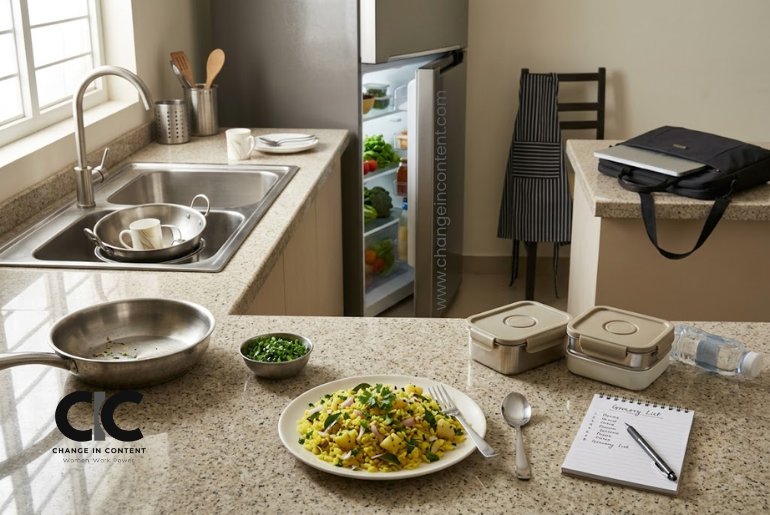
Somewhere in an Indian apartment on a Sunday morning, a man has made poha. Within minutes, the family WhatsApp group knows.
His wife posts it with pride. Then his mother sends folded-hand emojis, and his sister-in-law writes, “Jiju goals.” Someone adds a heart. Someone adds fire. A cousin types, “Pookie husband.”
The poha is decent. Maybe even good. The man has chopped onions, roasted peanuts, added coriander and remembered lemon. He has also used three pans, two plates, one extra bowl and half the kitchen towel roll.
By noon, the kitchen is back to its original owner.
She knows where the mustard seeds are. She knows the gas cylinder is almost empty. And she knows the coriander was bought on Friday and must be used before it turns into a wet green apology. The woman also knows the child does not want peanuts, the father-in-law cannot eat too much chilli, and the domestic help is on leave tomorrow.
He made the poha. She is still running the kitchen.
That small difference is where the division of labour at home lives.
Men in kitchens are good news. The applause economy is the problem
Let us say this clearly. Men cooking is a good thing.
A man making dinner, feeding a child, washing dishes, packing a lunchbox or calling the vegetable vendor is welcome. It is better than the old performance of walking into the kitchen only to ask, “Khaane mein kya hai?”
Many men are genuinely trying. Some did learn that during the pandemic, while some learned after moving away from home. A few men ended up learning because their wives work long hours, and a select few because their daughters asked them why only mummy cooks. Some men did learn because they finally discovered the emotional superiority of a good tadka.
All of this is progress. The problem begins when every small act of male participation becomes breaking news.
A woman can cook 3 meals a day for 30 years and receive silence. But a man makes round rotis once, and the family behaves as though he has returned from Everest with the national flag. That is the strange applause economy of Indian homes.
- When women cook, it is a duty. When men cook, it is their personality.
- When women manage food, it is expected. When men make pasta, it is the new reel.
- When women clean after dinner, nobody notices. When men wash dishes, somebody says, “You are lucky.”
Lucky? That word has done too much unpaid labour in Indian marriages.
What the data tells us about who still carries the home
The latest Time Use Survey gives this story a clear statistical backbone.
India’s Time Use Survey 2024, conducted by the National Statistics Office under MoSPI, measures how people spend time across paid and unpaid activities. The survey covered 1,39,487 households and collected information from 4,54,192 persons aged six years and above.
The findings are blunt.
Females spent 289 minutes a day on unpaid domestic services for household members. Males spent 88 minutes. Females also spent 137 minutes a day caring for household members, compared with 75 minutes for males.
For the 15-59 age group, the pattern is equally telling. Female participants in unpaid domestic services spent about 305 minutes a day in 2024. The survey also found that 41% of females aged 15-59 participated in caregiving for household members, compared with 21.4% of males.
It is the part no Sunday breakfast reel can hide.
Men may be entering kitchens more visibly. Women are still spending far more time keeping homes functional.
The gap is not only in cooking. It is in everything that surrounds cooking.
- It is menu planning.
- It is noticing the oil level.
- It is remembering everyone’s preferences.
- It is soaking chana the night before.
- It is knowing which dabba has ajwain.
- It is checking whether the maid has properly washed the cooker.
- It is planning dinner while replying to an office email.
- It is getting up during the film because the dal needs a second whistle.
That is why women often smile when men say, “I help a lot at home.” Help is kind. Ownership is different.
A few Indian kitchen scenes, from no one house and every house
It is not a formal survey. These are composite scenes. You may recognise one. You may recognise all.
In a Tier-1 city, a dual-income couple orders groceries online. The man pays, and the woman made the list. She checked the fridge, remembered the child’s snack day, added oats for his father’s cholesterol, chose the right brand of atta, removed the expensive tomatoes, applied the coupon and scheduled delivery for the hour when someone would be home.
He says, “I ordered groceries.”
In a Tier-2 city, a husband makes tea for guests. Everyone praises him. His wife has already cleaned the cups, bought the biscuits, remembered who takes sugar, and mentally calculated whether dinner needs one more sabzi.
He says, “I made tea for everyone.”
In a small town, an older father now makes his own breakfast after retirement. That is progress. His wife still wakes up first because the milkman comes early, the newspaper bill has to be paid, and the pressure cooker needs a new gasket.
He says, “I do my own work.”
In a young urban marriage, the man cooks once a week. He enjoys it; he experiments; he plays music; he makes Thai curry. His wife loves that he tries. She also knows he will ask where the coconut milk and the knife are, whether the rice is washed, and what to do with the leftovers.
He says, “Cooking relaxes me.”
For many women, cooking is not relaxation. It is logistics.
The “hubby who cooks” trend needs a small audit
Social media loves a man in an apron.
“Hubby made dinner.”
“POV: You married a man who cooks.”
“Green flag husband.”
“Pookie made chai.”
“Manifesting this.”
Some of it is sweet, and some of it is harmless. Also, some of it is genuinely affectionate. But the trend deserves a small audit.
Why does routine domestic work become adorable when men do it? Why is women’s work rarely made heroic in the same way? And why do family WhatsApp groups celebrate a husband’s upma but not a wife’s appraisal, promotion, bonus or salary raise with the same enthusiasm?
Imagine this message in a family group: “Ghar ka Beta got a 22% hike and led a national project this quarter. Congratulations.” Some families would celebrate. Many would move on to asking whether she has eaten.
Now imagine: “Jiju made paneer.” And the group wakes up.
The problem is not appreciation. Appreciation is good. Men who share care should be encouraged, especially in a culture that has trained many of them to stay away from domestic work. The imbalance lies in the scale of celebration.
Men get praised for entering a space that women have been expected to run without applause. And women get measured on whether the space runs well. That is the old bargain wearing a new apron.
What women are tired of saying
Many women are not asking men to become MasterChef contestants. They are asking them to notice.
- Notice that the kitchen does not run on cooking alone.
- Notice that the sink is part of the meal.
- Notice that breakfast begins the night before.
- Notice that groceries do not appear through divine intervention.
- Notice that children’s tiffins are emotional engineering.
- Notice that leftovers require a strategy.
- Notice that “What should I make?” is a question women are tired of answering every day.
There is a difference between doing a task and carrying responsibility for it.
A man can cook dinner and still leave the mental load untouched. Sometimes, a man can cut vegetables and still wait for instructions. A man can wash dishes and still behave like the assistant chef in a kitchen owned by his wife. That is where the emotional comedy turns serious.
Women are working outside the home in larger numbers. Most of us also expect them to remain the household’s central operating system. That operating system has no salary, no weekly off, no appraisal and no retirement plan.
A previous article by us on women and the weight of expectations made the same point in 2024. The thought still stands in 2026. Women are not born knowing how to manage households. The society has just trained them into it. Men are not born helpless around kitchens. The same society has just excused them from learning. Today, that excuse is ageing badly.
What men can change without making a speech about it
Men do not need to announce reform. They can start with the fridge.
Know what is inside it. Then, know what is about to expire. Figure out what needs to be bought. Know what can be cooked when everyone is tired. Remember which child hates lauki and which parent pretends to like quinoa because the doctor said so.
Take full responsibility. Not a task. A responsibility.
Breakfast is yours. Or groceries; or school tiffins; or dinner three nights a week; or the cook’s coordination; or the dishes after every meal. Own it fully. Plan it, execute it, clean it, remember it, and adjust it.
Do not ask for management instructions and then call it sharing. Also, learn the invisible parts.
- If you cook, clean up after.
- If you shop, restock properly.
- If you feed the child, know the child’s schedule.
- If you host guests, plan the meal too.
- If you say “I will help”, pause and ask why you used the word help.
Home is not her department. Dear Men, remember that this shift does not reduce men. It grows them. A man who can care, cook, organise and anticipate becomes more capable, not less masculine.
Change in Content recently wrote about The Fatherhood Programme, where fathers in Jordan, Egypt and Morocco began participating more actively in care and household work. The loveliest lesson from that story was when fathers choose care, children inherit a better idea of family. Indian homes need that lesson too.
What women can change, even if it feels uncomfortable
This part is delicate.
Women did not create the unequal system. Still, many women have been made its managers, and sometimes its protectors.
Mothers may praise sons for doing the smallest chore while expecting daughters to know everything. Mothers-in-law may celebrate a son who cooks while criticising a daughter-in-law who orders food. Wives may redo the task after husbands perform it imperfectly. Sisters may serve brothers automatically.
None of this comes from nowhere. It comes from years of conditioning. But it can be interrupted.
Let men do things badly at first. Do not rescue every task. Stop turning his first failed dal into proof that he is useless. Competence needs repetition. Women got repetition. Men need it too.
Stop calling basic participation “help”. Use words such as responsibility, partnership and share. Also, celebrate your own work differently. Speak about the labour. Name it. Let children hear it. Let sons and daughters both learn that homes run because people work inside them.
Do not give up your effort to keep the peace. Peace built on women’s exhaustion is expensive.
Why this is also a workplace story
The Indian kitchen does not stay inside the home. It follows women into meetings, calls, deadlines, travel plans and performance reviews.
A woman may be at work, but part of her mind is tracking dinner. She may be in a client meeting while remembering the cook is off tomorrow. She may be preparing for a presentation while also planning the school snack, the gas booking and the in-laws’ medicine.
That is one reason conversations about women at work cannot ignore what happens at home.
When the division of labour at home is unequal, women arrive at paid work with less time, less rest and less mental space. That affects career choices. Sometimes, it affects networking. It affects mobility. And it affects late calls, travel, relocation and leadership readiness.
The office may see only the employee. The home has already shaped her day.
That is why employers should care. Flexible work, childcare support, predictable schedules and genuine respect for caregiving responsibilities are not side benefits. They are part of women’s career infrastructure.
But no company policy can fully fix what a household refuses to share.
The new Indian kitchen needs fewer heroes and more partners
The Indian kitchen is changing. Slowly. Unevenly. Sometimes beautifully.
Men are cooking more. Sons are learning recipes on YouTube. Fathers are packing tiffins. Husbands are trying. In some homes, boys are being told to serve themselves. In some homes, girls are being told they can study while their brothers make tea.
These are good signs. But change cannot stop at the photo.
The kitchen should not become another stage where men receive applause and women handle production.
The goal is not to shame men who cook. Let them cook; let them burn the first tadka; let them discover that coriander is both essential and always missing. And let them experience the spiritual defeat of cleaning a pressure cooker.
But then let the work continue. After the Instagram story, after the guests leave, after the family group claps, and after Sunday becomes Monday. That is where equality lives.
The Change in Content view on the division of labour at home
The division of labour at home will not change because men make a beautiful breakfast. It will change when men know what is for breakfast before being asked. Furthermore, the change will happen when children stop assuming mothers are the default kitchen authority. It will change when families celebrate women’s professional milestones with the same excitement they reserve for men’s domestic experiments. And when women stop carrying invisible lists alone.
Indian kitchens are changing. Now Indian homes need to catch up.
The next time a man cooks, praise him if you like. Then hand him the grocery list, the sink, the leftovers, the next day’s tiffin, and the quiet responsibility of remembering. That division of labour at home would be worth celebrating.
FAQs
Q: What does the division of labour at home mean?
A: Division of labour at home refers to how household work is shared between family members. It includes cooking, cleaning, childcare, eldercare, grocery planning, laundry, emotional support, scheduling and the mental work of keeping a home organised.
Q: Are Indian men doing more household work now?
A: Many Indian men are participating more visibly in cooking and household chores. However, official time-use data still shows a large gender gap. Females spend far more time than males on unpaid domestic services and caregiving in India.
Q: Why is cooking by men celebrated more than cooking by women?
A: Men cooking is often treated as special because domestic work has traditionally been seen as women’s responsibility. This creates an unfair applause gap, where men receive praise for occasional participation while women’s daily labour remains invisible.
Q: What is the difference between helping at home and sharing responsibility?
A: Helping means doing a task when asked. Sharing responsibility means owning the full work cycle: planning, remembering, doing, cleaning, adjusting and repeating without needing someone else to manage it.
Q: Why is household labour a workplace issue?
A: Unequal household labour affects women’s time, rest, mobility, career choices and mental load. When women carry most domestic responsibilities, it can shape their paid work, leadership opportunities and long-term career growth.
Editorial Note and Sources
This Sunday Read is an editorial essay by Saransh Jain for Change in Content. It uses composite scenes drawn from everyday Indian household patterns, social conversations and recurring cultural behaviours. It is not based on formal interviews or a Change in Content survey. The article is intended for editorial and informational purposes only and should not be read as sociological research, legal advice, marital counselling or workplace policy guidance.
Sources used
- Ministry of Statistics and Programme Implementation, National Statistics Office: Time Use Survey 2024 Fact Sheet
- Press Information Bureau, Government of India: Time Use Survey (TUS), January–December 2024
- Change in Content: Women and the weight of expectations: challenging gender roles
- Change in Content: The Fatherhood Programme: When Fathers Choose Care, Everyone Gains
