
The Short Read
- The Fatherhood Programme featured by UN Women follows fathers in Egypt, Jordan and Morocco who are taking a more active role in childcare and household work.
- The initiative is part of Dare to Care, linked to UN Women’s TransformCare global initiative.
- Fathers in the programme speak about cooking, cleaning, raising children, supporting their wives, encouraging their daughters, and passing on healthier values to their sons.
- The story offers a hopeful view of gender equality: when care is shared, women gain time, children gain emotional closeness, and men gain fuller family lives.
- For Change in Content, this is a reminder that equality at work begins long before people enter offices. It begins at home, around children, meals, laundry, conversations and the small habits families repeat every day.
The Fatherhood Programme: A quiet kind of revolution
The Fatherhood Programme featured by UN Women does not begin with a corporate policy, a campaign slogan or a speech about equality. It begins at home.
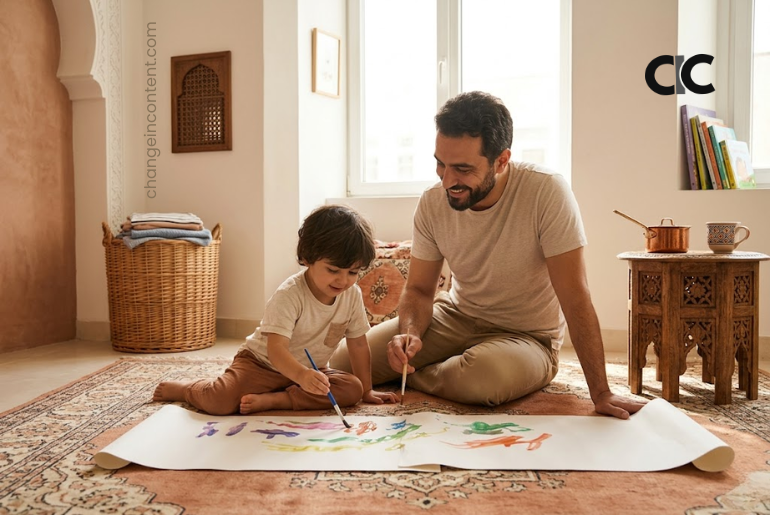
A father sits with his children and paints. Another cooks when his wife is unwell. Then a man who once avoided household work now plans the next day’s responsibilities with his wife over coffee. And a father in Morocco speaks about leaving harmful ideas behind so his children inherit something better.
There is something quietly powerful about this kind of change. It does not ask for applause. It simply rearranges family life more generously.
UN Women’s story brings together fathers from Jordan, Egypt and Morocco who participated in Dare to Care sessions through local partner organisations. The programme encourages men to take part in care work, childcare, and household responsibilities. It challenges the longstanding belief that domestic work is primarily women’s work.
The men in the story do not sound like they have been converted by theory. They sound like people who discovered something waiting inside ordinary life: closeness.
The father in Jordan who found his way back home
In Russeifa, Jordan, Mamoun Saleh speaks about the man he used to be.
He worked, came home tired and slept. Family life carried on around him. The home functioned, the children grew, his wife managed responsibilities, and he remained mostly outside the emotional centre of it.
After joining the Dare to Care programme through Athar, a community-based organisation, he began to rethink his role within the family.
The shift was practical first. He started sharing household and care work. Then the emotional change followed. He became more involved with his children. He supported his wife’s small-business projects. The family began planning responsibilities together.
One detail from the UN Women story stays with you: Every night, he and his wife sit with coffee and decide what needs to be done the next day. And that is partnership in its simplest form.
No grand declaration. No performance. Just two adults treating family life as shared work.
His eldest daughter has even named her own project Takder, inspired by the programme’s Arabic name. In that small family detail, the programme’s larger meaning becomes clear. Children do not only listen to what adults say about equality. They watch how adults divide time, labour, encouragement and attention.
When a father changes, the home becomes a classroom without calling itself one.
The father in Egypt who cooked, cleaned and carried the lesson forward
In Fayoum, Egypt, Nady Ashry tells another story of change.
He once held tightly to patriarchal habits. According to UN Women, he would not even get himself a cup of water or let neighbours see him taking laundry off the drying rack.
Then his wife, Warda Eid, was briefly hospitalised. The situation asked a simple question: who would care for the children, the home and the daily rhythm of family life?
Ashry did. He cooked; he cleaned; he did the laundry; he took the children to the nursery; and he handled what needed handling.
Many families have seen this moment. A woman falls ill, travels, works late, or simply cannot carry everything, and the house suddenly reveals how much labour she had been holding it together with.
For Ashry, the experience seems to have opened a door. He began to see care as something a father could do with pride. He also began modelling it for his sons. They now do household responsibilities because they see him doing them.
That may be the loveliest part of the story.
- A boy who watches his father cook does not need a lecture about respect.
- A boy who sees his father doing laundry grows up with a different idea of manhood.
- A boy who is told to get his own water instead of asking his sister learns fairness in the shape of a glass.
These are small scenes. Their cultural weight is large.
The father in Morocco who wants one generation to stop the damage
In Loudaya, Morocco, Azzedine Sbai speaks about tradition, masculinity and what families pass down.
He says the belief that a man becomes less manly by sharing household work came from traditions, not religion. He also says more people are beginning to recognise that family responsibilities should be shared.
His words carry the calm confidence of someone who has looked at an old idea and decided it does not deserve another generation.
Sbai participates in sessions hosted by Project Soar, a UN Women partner. He speaks about sharing responsibilities at home and about the stress created when everything is left to one person.
There is warmth in the way he recalls his own father cooking tagines. He sees the positive habits that deserve to travel forward. He also recognises the harmful ones that must stop with his generation.
That is a beautiful way to think about fatherhood.
Every parent inherits something. Every parent edits that inheritance. Some habits are kept; some are softened; some are ended before they reach the children.
Why this story matters for women’s work
A happy story about fathers and care also belongs on a platform about women, work and power.
Care sits behind every economy. It decides who has time, who has rest, who can work longer hours, who can take a promotion, who can travel, who can study, who can build a business and who keeps stretching quietly so everyone else’s life can function.
When care is placed primarily on women, the effects follow them into the workplace.
It can shape employment, fertility choices, financial independence and career continuity. Across developing countries, the relationship between women’s employment and fertility decline is often discussed in economic and policy terms. Still, within homes, it is also shaped by who changes nappies, who cooks dinner, who takes children to school, who remembers appointments, and who gets uninterrupted time.
Shared fatherhood changes that equation gently, but meaningfully.
A mother with support at home has more room to work, rest, think, recover, earn, lead or simply breathe. A father who participates in care gets more than a list of chores. He gets intimacy with his children, confidence in his role and a fuller understanding of family life.
Children gain too. They grow up seeing love expressed as action. They see daughters encouraged, sons participating, mothers supported, and fathers emotionally present.
It is the kind of equality that does not need to announce itself at the door. It shows up at breakfast, bath time, homework, school runs, bedtime and the tired hour when everyone still needs dinner.
The workplace lesson hiding inside the home
Workplaces often discuss gender equality once women have already reached the office.
By then, many women are carrying years of unequal care expectations. Some have already slowed down, declined opportunities, accepted lower flexibility, moved closer to family support or planned careers around the assumption that home will still depend mostly on them.
That is where fatherhood matters.
The workplace conversation around fathers still has a long way to go. In many systems, men who become fathers may be seen as more stable, more committed or more deserving of responsibility. Women who become mothers often face the opposite assumptions. The fatherhood premium and motherhood penalty clearly capture that imbalance.
The Fatherhood Programme offers another possibility.
- When fathers embrace care fully, the story of parenthood changes for everyone.
- Mothers are not treated as default caregivers.
- Fathers are not treated as occasional helpers.
- Children are not taught that care has a gender.
- Employers, too, are being pushed to stop designing work around the old assumption that men have someone else to handle the home.
That shift can be joyful. It can be playful. It can look like a father painting with his child, cooking a meal, folding clothes, sitting with his daughter and helping her imagine her own project.
Progress does not always look like confrontation. Sometimes it looks like a father taking laundry off the line without embarrassment.
A softer, stronger idea of masculinity
One of the most refreshing parts of the UN Women story is the way it treats men as capable of change.
The fathers are not mocked for what they once believed. They are shown learning, adjusting, practising and finding happiness in new roles. That matters.
Gender equality often gets framed as men losing something. The Fatherhood Programme shows what men can gain: closeness, purpose, emotional confidence, better relationships, pride in care, and a home where they are needed for more than money.
- A father who cooks is not diminished.
- A father who cleans is not smaller.
- A father who comforts his child is not softer in a weak way.
He is present. And Presence is a strong thing. For many families, this may be the most persuasive argument. Shared care is not only fair. It makes the home happier.
Change in Content View on the Fatherhood Programme
The Fatherhood Programme is a happy reminder that equality can grow through ordinary love.
- A father learning to cook for his children.
- A husband planning the next day with his wife.
- A man tells his son to get his own water.
- A parent choosing which traditions deserve to continue.
These moments may look small from the outside. Inside a family, they can change the emotional weather.
- For women, shared care creates time and space.
- For men, it opens a fuller version of fatherhood.
- For children, it builds a home where responsibility is not divided by gender before they even understand the word.
It is the kind of change we need more of. Practical, warm, repeatable.
A better world for women will not be built only in boardrooms, through policies, or through public campaigns. Some of it will be built in kitchens, nurseries, living rooms and bedtime routines.
And sometimes, a change in content begins with a father saying, “I can do this too.”
FAQs
Q: What is The Fatherhood Programme?
A: The Fatherhood Programme featured by UN Women highlights fathers in Egypt, Jordan and Morocco who are taking a more active role in childcare and household responsibilities through Dare to Care sessions.
Q: How does involved fatherhood support women?
A: When fathers share care work, women gain more time, flexibility and support. This can affect their well-being, work participation, financial independence and family life.
Q: Why does fatherhood matter for gender equality?
A: Children learn gender roles at home. When fathers cook, clean, care and participate emotionally, children grow up seeing care as a shared human responsibility.
Q: What is UN Women’s TransformCare initiative?
A: TransformCare is UN Women’s global initiative that focuses on addressing the undervaluation and unequal division of care work to improve the lives of women and girls.
Editorial Note and Sources
This article is based on UN Women’s feature story on The Fatherhood Programme, published in June 2026, and related Change in Content coverage on care, fertility, work and parenthood. It is written as a Mosaic story for Change in Content, focusing on the human side of shared care and gender norms.
