
The Quick Read
- Women hold more jobs than men in the US nonfarm economy for only the third sustained period in the historical data.
- BLS data for July 2026 shows women holding 79.517 million nonfarm payroll jobs, accounting for 50.1% of the total.
- The previous crossovers occurred around the Great Recession in 2009–10 and immediately before the COVID-19 pandemic. Indeed Hiring Lab says the current shift differs because it has emerged without a recession.
- Women have benefited from stronger employment growth in female-dominated sectors such as healthcare and education, while several traditionally male-heavy industries have been softer.
- Falling male labour-force participation is another part of the story. The gap between men’s and women’s participation rates has been narrowing for decades because men’s participation has fallen much faster.
- A female majority in payroll jobs does not mean women have achieved equal pay, equal access to occupations, equal seniority or equal economic power. In 2025, full-time women still earned 82.1% of men’s median weekly earnings.
Women hold more jobs than men: 3rd time in the US history
Some headlines invite applause before they invite examination. This is one of them.
Women hold more jobs than men in the United States.
For only the third time in the historical record, women make up a slight majority of employees on US nonfarm payrolls. The latest Bureau of Labour Statistics data puts their share at 50.1% in July 2026.
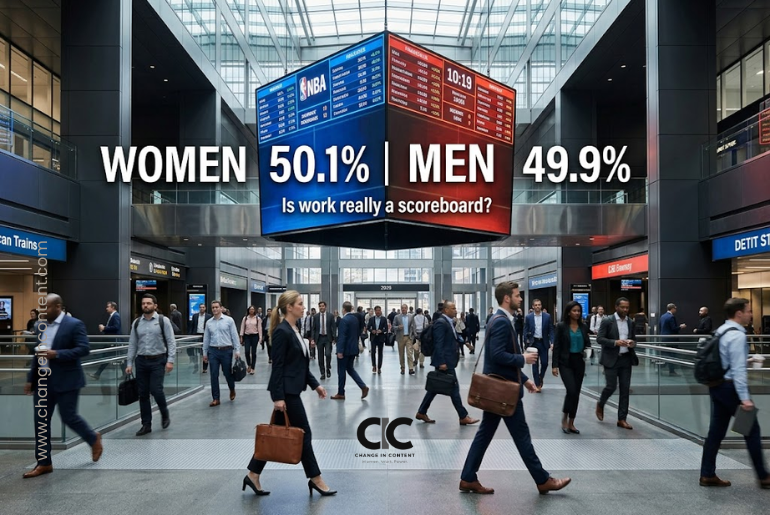
After generations in which paid employment was overwhelmingly male, there is obvious historical significance in that number. But equality is not a football match. Women reaching 50.1% does not mean the score is Women 1, Men 0.
Nor would Change in Content want it to.
A healthy labour market offers women and men comparable access to work, fair compensation, opportunity to progress and the freedom to participate. One gender gaining a statistical majority because another is retreating from parts of the labour market is a very different outcome.
And that is what makes this American crossover worth unpacking.
First: What does “women hold more jobs than men” actually mean?
The headline refers to the Current Employment Statistics survey, which estimates the number of employees on US nonfarm payrolls. It is not counting every person who works.
Farms, the self-employed and several other categories sit outside this payroll measure. One person can also hold more than one payroll job, meaning “jobs” and “people employed” are not interchangeable concepts.
For July, the BLS recorded 79.517 million jobs held by women, representing 50.1% of total nonfarm payroll employment. This distinction is especially important because a separate BLS household survey paints a different picture.
In July, approximately 85 million men and 77.2 million women were employed according to the household measure. Men also continued to participate in the labour force at a significantly higher rate: 66.8% of men aged 16+ compared with 56.4% of women.
So no, there are not suddenly more working women than working men across America. There are slightly more nonfarm payroll jobs recorded as being held by women.
A less exciting headline perhaps. A much more accurate one.
Why is this only the third time?
Indeed Hiring Lab economist Laura Ullrich traced the employment gap back through several decades.
In the early 1990s, men held almost 7 million more nonfarm jobs than women. That gap gradually narrowed as women’s participation in paid employment increased.
The first crossover came around the Great Recession.
That was not exactly a triumphant moment for gender equality. Male-dominated industries such as construction and manufacturing were hit particularly hard during the downturn. Women briefly became the majority of payroll employees partly because men were losing jobs faster.
By early 2010, BLS was recording women at roughly half of nonfarm payroll employment after the recession had eliminated millions of positions.
The second crossover arrived around late 2019, immediately before COVID-19.
In November 2019, women accounted for 50.1% of nonfarm payroll jobs; by December, the non-seasonally adjusted share had reached 50.2%.
Then the pandemic changed the equation again.
Retail, hospitality and other female-heavy industries were devastated by shutdowns. School and childcare closures also shifted enormous care responsibilities back into homes, disproportionately affecting women. Indeed notes that female employment suffered more severely during this period.
Now we have crossover number three. And this one is different.
Women gained ground. Men also lost some.
The tempting explanation would be that women have simply stormed into the workforce and overtaken men. The data is messier.
Indeed found that the US added around 1.2 million nonfarm jobs between February 2024 and February 2026, with women accounting for roughly two-thirds of that growth.
But over the narrower year between February 2025 and February 2026, total employment barely expanded. Jobs held by men fell by 142,000, while those held by women increased by 298,000.
So women did advance. At the same time, male employment weakened.
Indeed identifies another long-running structural trend: male labour-force participation has been falling faster than female participation.
At the start of 2000, approximately 75.1% of men participated in the labour force. By early 2026, that rate had fallen to around 67.2%.
Women’s participation also fell during that period, but less sharply, from 60.1% to 57.2%. Describing this simply as men becoming “less willing to work” goes beyond what the data can prove.
Participation can be affected by ageing, disability, health problems, education, discouragement, retirement, family circumstances and broader economic changes.
Indeed describes the decline in male work activity as structural and points towards several possible contributing factors. What can safely be said is that women did not close the participation gap solely because their own participation surged.
Some of the gap closed because men moved in the opposite direction. That changes how we should interpret the milestone.
The American economy is also creating the “right” jobs for women
Look at where employment has been resilient, and another explanation appears.
Healthcare and education employ large numbers of women. And they have been among the stronger parts of the US labour market.
In July, private education and health services employed more than 21.3 million women, and women accounted for 76.5% of employment across that combined sector. Government employment was 58.4% female. Women also formed majorities in leisure and hospitality and several other service industries.
Compare that with traditionally male-heavy sectors:
- Construction: women 14.3%
- Manufacturing: women 28.6%
- Transportation and warehousing: women 26.2%
- Mining and logging: women 14%
Indeed argues that the recent crossover reflects strength in healthcare, education and some service industries alongside cooling in areas such as manufacturing and information. This is labour-market composition at work.
When healthcare expands and manufacturing contracts, the gender balance changes even if nobody has made a deliberate decision to improve gender equality. And that is why Change in Content would resist turning 50.1% into an empowerment graphic without explaining what sits underneath it.
More jobs do not automatically mean better jobs
Here is another number worth placing beside 50.1%. In 2025, full-time female wage and salary workers in the US earned median weekly wages of $1,089. Men earned $1,326. Women’s earnings were therefore 82.1% of men’s.
By the second quarter of 2026, women’s median weekly earnings stood at $1,131 compared with $1,380 for men.
Women can hold slightly more payroll jobs while earning less.
Both statements can coexist because headcount does not tell us:
- How much each job pays
- How many hours people work
- Whether jobs are full-time
- Which occupations women occupy
- Who holds senior positions
- Who owns businesses
- Who controls capital
- Who receives promotions
- Who has greater job security
The American labour market remains heavily occupationally segregated.
Women dominate areas such as health, education and care. Men remain far more concentrated in construction, manufacturing and many technical occupations.
Change in Content recently examined why female-dominated jobs can command lower pay even when the work requires substantial skill and responsibility. The geography was India, but the principle travels: who performs work and how that work is valued are separate questions.
America has crossed a numerical threshold without erasing that distinction.
And then July delivered the perfect reality check
There is an almost inconvenient epilogue to this story. The “women now hold more jobs” headline gained traction just as the July jobs report arrived.
Women still held 50.1% of nonfarm payroll employment. But they had just lost 32,000 payroll jobs during July.
Total US payroll employment fell by 23,000, which means women absorbed more than the entire net decline while men registered a small gain. The female labour force also contracted sharply in the household survey during July.
We examined that contradiction separately in our analysis of US job losses in July and the disproportionate impact on women. It illustrates perfectly why 50.1% should not be mistaken for a finish line.
A narrow majority can disappear within a few months. Equality needs sturdier foundations than a decimal point.
So, should women celebrate?
There is something worth acknowledging. Millions more women have access to paid employment today than previous generations did. Occupations once effectively closed to women are more open. Women have built careers, incomes and professional identities that their grandmothers could not take for granted.
The disappearance of a historic employment deficit matters. But Change in Content sees no value in replacing one imbalance with another and calling that victory. If men are withdrawing from the labour market because of poor health, weak opportunity, changing industries or social disconnection, that deserves attention too.
Gender equality should improve human opportunity rather than rearrange scarcity. And for women, the unfinished agenda remains obvious. They may hold 50.1% of US payroll jobs while continuing to face earnings gaps, caregiving penalties, occupational segregation and underrepresentation at the highest levels of business.
Our earlier analysis of the gender pay gap and the importance of transparent workplace data made a related point: headline representation tells us little without knowing where women sit, what they earn and how opportunity is distributed.
The same scrutiny belongs here.
The Change in Content Perspective: Retire the Scoreboard
The history behind this crossover deserves recognition.
Women once trailed men by millions of payroll jobs. Today, that gap has vanished. But perhaps we should resist the urge to turn every gender statistic into a contest.
Women ahead. Men behind. Somebody wins. Work should offer a better ambition.
A labour market becomes more inclusive when women and men can participate without their gender deciding which occupations are open, how much they earn, whether caregiving destroys a career or how high they can rise.
The 50.1% figure tells us that one old imbalance has disappeared, at least for the moment. It cannot tell us whether opportunity is equal. For that, we need to keep reading past the headline.
Editorial Note and Disclaimer
This article uses US Bureau of Labour Statistics Current Employment Statistics and Current Population Survey data, together with analysis from Indeed Hiring Lab. “Jobs held” refers here to nonfarm payroll employment and should not be interpreted as the number of individual people working; employees may hold multiple jobs, and the series excludes categories such as the self-employed and farm workers. Monthly employment estimates are subject to revision. This article is intended for editorial and informational purposes and does not constitute employment, economic or financial advice.
Sources
- US Bureau of Labour Statistics: Employment of Women on Nonfarm Payrolls, July 2026
- US Bureau of Labour Statistics: Employment Situation, July 2026
- US Bureau of Labour Statistics: Employment Status by Sex and Age
- Indeed Hiring Lab: How Women Have Closed the Other Workforce Gender Gap
- US Bureau of Labour Statistics: Median Weekly Earnings, 2025
