
The Quick Read
- The Pnet Job Market Trends Report from SA for August 2026 analyses 1.5 million South African jobseeker profiles and focuses on how women are adopting artificial intelligence skills.
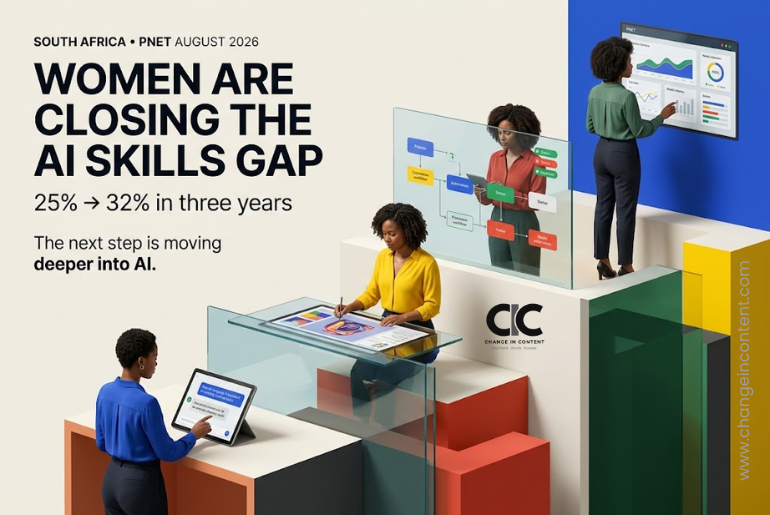
- Women now account for 32% of professionals listing AI skills on their CVs, up from 25% three years ago.
- Women are particularly strong in generative AI for design, media and content creation. Around 60% of candidates listing ChatGPT as a skill are women.
- Female representation in robotic process automation has risen from 27% to 39%, while the share in machine learning has moved from 20% to 24%.
- The bigger opportunity is to ensure women progress from being users of AI tools to holding deeper technical, analytical and decision-making roles around the technology.
Pnet Job Market Trends Report SA
The workplace argument around women and artificial intelligence usually begins with a gap. Women use AI less. Women may be more exposed to AI-driven job disruption. And women remain underrepresented in technology roles.
South Africa has produced a welcome addition to that conversation: The gap can move.
The Pnet Job Market Trends Report from SA for August 2026 finds that women are increasingly adding artificial intelligence capabilities to their professional profiles. In some categories, women are already ahead of men.
3 years ago, women represented about 25% of South African professionals listing AI skills on their Pnet profiles. That figure has now reached 32%.
Men still make up roughly two-thirds of the overall AI-skilled group, so parity has certainly not arrived. But the direction of travel deserves attention.
Women are leading in some forms of generative AI
The most striking numbers appear in areas where AI is already deeply embedded in everyday knowledge work.
Women accounted for approximately 70% of professionals adding generative AI skills for design and media during the past three years. In the previous three-year period, their share was 57%.
Content-related AI shows a similar pattern.
Women account for more than half of professionals listing content-generation AI tools, while 60% of candidates adding ChatGPT to their profiles are female.
That is useful because it moves the women-and-AI conversation away from the assumption that women are simply standing outside the technology revolution waiting to be trained.
Many are already experimenting. They are applying AI to communications, design, administration, research and everyday productivity.
Pnet Head of Data Anja Bates said the organisation’s six-year analysis showed a clear acceleration in AI adoption among female professionals, with the strongest gains occurring during the most recent three years.
The technical gap has not disappeared
The encouraging numbers come with an important qualification. Women remain considerably less represented in some of the AI capabilities most closely associated with specialist technology careers. Among professionals adding machine-learning skills, women’s representation has increased from 20% to 24% over three years.
That is progress, but a substantial gender difference remains.
Robotic process automation offers a stronger improvement: Women’s representation rose from 27% to 39%. Women also constitute about 39% of professionals listing general AI capabilities.
Look at specific jobs and the distinction becomes even clearer.
- Among data scientists listing AI capabilities, women account for approximately 31%.
- Among software developers with AI skills, they represent just 21%.
- Among the executives, virtual and personal assistants who list AI capabilities, however, women account for an overwhelming 96%.
That last statistic is simultaneously encouraging and worth examining carefully.
Women are adapting rapidly inside an occupation where they are already strongly represented. The longer-term prize is for that AI familiarity to help them move into higher-value roles, rather than merely making traditionally female-heavy occupations more productive.
Why South Africa’s numbers matter beyond South Africa
The Pnet findings describe one country’s job market and should not be automatically transferred to India or the rest of the world. But the behaviour they reveal is worth learning from.
Women do not need to wait for AI careers to arrive neatly packaged as “AI jobs”. AI capability is spreading across occupations.
Marketing. Finance. Operations. Administration. Consulting. Design. Software. Research. Leadership.
The workplace advantage increasingly belongs to people who understand how AI changes their existing job, not only to people who build large language models.
That is particularly important because the International Labour Organisation’s latest research finds women’s jobs are actually more exposed to generative AI than men’s. Female-dominated occupations are almost twice as likely to be exposed to GenAI as male-dominated ones, at 29% compared with 16%.
There are two possible responses to that exposure.
- Wait for the job to change.
- Or learn enough to participate in changing it.
South African women’s recent behaviour suggests more are choosing the second.
There is a useful lesson for women in India
Change in Content has been following a similar development in India.
Our earlier analysis of the women and AI adoption gap examined research showing women historically adopting generative AI more slowly than men. But more recent signals have become encouraging.
The India AI Workforce Report 2026 found that women moving into AI-enabled careers reported an average 145% increase in compensation. However, that study covered a specific population of AI learners and should not be read as the experience of every woman changing roles.
And India’s current policy conversation is increasingly recognising the need for inclusive and gender-responsive AI, particularly as adoption moves deeper into workplaces.
The lesson from South Africa is therefore practical rather than celebratory: Start using the technology, then keep moving up the capability ladder.
- A woman who already uses ChatGPT for emails can learn research workflows.
- Someone using AI for content can learn analytics.
- An operations professional can explore automation.
- A finance professional can learn AI-assisted modelling.
- A designer can learn generative workflows and the governance around them.
- A developer can move deeper into machine learning.
The objective should be progression.
Employers have a job here too
Pnet’s findings also contain an instruction for organisations. If women are voluntarily building AI capabilities, employers should not leave that development entirely to personal initiative.
Training needs to reach beyond IT departments. Women should have access to:
- Practical AI training
- Advanced technical programmes
- Safe experimentation
- AI-enabled stretch assignments
- Mentors with technical expertise
- Clear pathways into emerging roles
- Recognition when AI increases responsibilities or productivity
Pnet itself argues that AI is becoming a core workplace competency rather than a specialist technical capability. That shift changes what inclusion looks like.
5 years from now, asking whether women had equal access to AI training may sound rather like asking whether employees had equal access to computers.
The Change in Content Perspective: Learning AI is Good. Shaping it is Better.
There is plenty to like in the South African numbers.
Women have moved from 25% to 32% of professionals signalling AI capability in three years. They lead in several creative generative-AI applications. They are gaining ground in automation.
And the movement is accelerating. But the next milestone should not be another statistic about how many women use ChatGPT.
Watch machine learning. Data science. Software development. AI leadership. Product design. Governance. Investment.
The most important transition will happen when women are equally visible not only among the people using artificial intelligence, but among the people deciding what it does, where it is deployed and how the value it creates is distributed.
South African women appear to be moving. Women elsewhere would do well to watch the direction rather than simply applaud the numbers.
Editorial Note and Disclaimer
This article is based primarily on Pnet’s August 2026 Job Market Trends Report and Pnet’s published summary of its findings. The analysis is based on approximately 1.5 million South African jobseeker profiles and reflects AI skills professionals list on their profiles; it should not be interpreted as a direct measurement of AI usage by every South African worker. International and Indian comparisons have been included for context and should not be treated as directly comparable datasets. This article is intended for editorial and informational purposes and does not constitute career or employment advice.
Sources
- Pnet – Job Market Trends Report, August 2026
- Pnet – August 2026 report summary: How SA women are embracing AI in the workplace
- International Labour Organisation – Gen AI, occupational segregation and gender equality in the world of work, 2026
