
The Brief
- A new peer-reviewed study from Emory University examined Gender Representation and Women’s Job Interest across four studies involving 1,680 US adults. It found that women generally reported greater interest and anticipated belonging when jobs were portrayed as having more women.
- Participants were surprisingly good at estimating the actual gender balance across 60 occupations, suggesting that people carry a reasonably accurate mental picture of which professions are male- or female-dominated.
- In experimental job advertisements, female representation influenced women’s responses even after researchers considered stereotypes about whether jobs require innate “brilliance” or persistent “dedication”.
- The effect became stronger as the gender imbalance became more extreme. Women reacted much more negatively to a 90% male environment than to relatively balanced 60:40 workplaces.
- The research measures interest and anticipated belonging, not actual applications, hiring or long-term career decisions. It was also conducted with US participants, so it should not automatically be generalised to women everywhere.
Gender representation and women’s job interest: The association
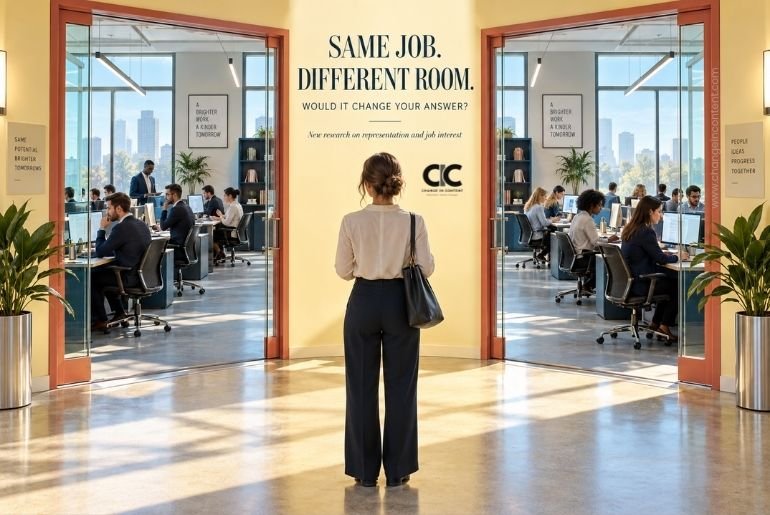
Suppose you find two jobs.
Same salary; same title; same benefits; same qualifications; same career prospects.
There is only one difference. At Company A, 75% of the people doing the work are men. At Company B, 75% are women.
Would that information change whether you applied? New research from psychologists at Emory University suggests that, for many women, it might. And not merely because it is pleasant to see more women in a photograph.
The study, published in PLOS ONE in August 2026, suggests that gender composition can influence whether women expect to belong in a profession and whether they express interest in pursuing it.
That is a much bigger idea. Because we normally think about gender representation as the result of career choices.
Women choose nursing. Men choose engineering. Women enter HR. Men enter construction.
The workforce eventually reflects those decisions. This research asks us to consider the loop running in the other direction too.
What if the people already in a profession influence who feels inclined to enter it next?
We apparently notice who does what
The researchers began with something deceptively simple.
Do people actually know which occupations are dominated by women or men?
Participants were asked to estimate the proportion of women and men across a broad range of 60 occupations.
The list was remarkably varied. Engineers. Software developers. Electricians. Pilots. Surgeons. CEOs. Teachers. Nurses. Librarians. Lawyers. Firefighters. Journalists. Financial analysts. Chefs. Truck drivers. Psychology professors. Physics professors.
Participants’ estimates corresponded strongly with the real-world gender composition of those professions. At the occupation level, the correlation was 0.891, an unusually strong relationship.
In plain English: People notice.
You may never have searched for a spreadsheet showing the gender breakdown of electricians. But you probably carry an impression of what an electrician looks like.
The same may be true of a nurse, a software engineer, a professor, a CEO, and a pilot. And those impressions may begin influencing career decisions long before somebody formally enters the occupation.
Representation may be saying something without saying anything
This is where the study becomes especially interesting. Why should the number of women already in a field matter? The researchers suggest gender representation may act as a proxy for workplace climate.
A woman looking at a heavily male profession may infer things she has not actually been told.
- Will I fit in here?
- Will I constantly stand out?
- Will people like me be taken seriously?
- Is this environment highly competitive in a stereotypically masculine way?
- Will I have to prove myself repeatedly?
- Is there a reason so few women stay?
None of those conclusions has to be accurate in a particular company. That is important.
A workplace that is 80% male is not automatically hostile to women. And a workplace with many women is not automatically inclusive. But representation can still function as a signal when the candidate has incomplete information. And candidates almost always have incomplete information.
That is what makes this commercially interesting for employers.
The researchers tried to compete representation against another stereotype
Psychologists have previously studied what is called the field-specific ability beliefs theory.
The idea is that some professions are culturally presented as requiring exceptional natural brilliance. Others are seen as rewarding sustained effort and dedication.
The stereotype matters because society has historically been more likely to associate extraordinary innate intellectual ability with men than women. So fields perceived to require “genius” can appear less welcoming to women.
The Emory team wanted to know whether that was the whole story. What happens when messages about ability and the actual gender composition of the workplace point in different directions?
So, they created hypothetical advertisements. Some emphasised brilliance. Others emphasised dedication. Then they manipulated who supposedly worked there.
In one study, the organisation was described as 75% men and 25% women.
In another version of the same job, it was 75% women and 25% men.
The result was striking. Women were significantly more interested in female-dominated jobs. Men, in that particular experiment, showed roughly equal interest whether the workplace was male- or female-dominated. But there was an even more surprising finding.
Women sometimes preferred representation over the “right” stereotype
Think about this combination.
- Job A says success requires brilliance. But most employees are women.
- Job B says success requires dedication. But most employees are men.
Previous research might lead us to expect Job B to feel more welcoming to women because “dedication” fits the cultural stereotype more favourably. That is not what happened.
Women anticipated greater belonging in the female-dominated brilliance job than in the male-dominated dedication job. That deserves a moment.
The people already doing the job appeared capable of outweighing what the advert said about the kind of person required to succeed. Perhaps the most persuasive message an employer can send to a woman is therefore not: “Women can succeed here.”
It may simply be: women already do.
And the percentage mattered
The final experiment went further. Instead of comparing only one male-dominated workplace with one female-dominated workplace, the researchers varied the ratios.
60:40.
75:25.
90:10.
The more extreme the imbalance became, the more gender composition affected interest and anticipated belonging. Both men and women showed some preference for environments where their own gender was better represented. But women were noticeably more sensitive to severe imbalance.
- At 60:40, the difference was relatively modest.
- At 90:10, it became much more consequential.
That provides an interesting way to think about the phrase “token woman”.
One woman in a room may technically create representation. Psychologically, she may not create the same signal as a workplace where seeing women has become ordinary.
There may be a difference between: a woman is here, and women belong here.
This could help explain why occupational segregation reproduces itself
Consider a profession that has historically been 90% male.
Now, few women enter.
- Because few women enter, the profession remains visibly male.
- The next generation of women sees that imbalance.
- Some may anticipate that they would fit less comfortably there.
- Fewer express interest.
- The workforce remains male.
- The signal survives.
This is the self-reinforcing cycle at the heart of the paper, whose title is appropriately direct: “Gender representation begets gender representation.”
The implication is surprisingly powerful.
We frequently ask: Why aren’t more women choosing this profession?
Perhaps one useful supplementary question is: What are they seeing when they look at the people already there?
India gives us plenty of interesting places to ask that question
The Emory research involved US adults. We should not take an experimental finding from America and announce that it explains Indian women’s career choices. It does not. But it gives us a fascinating hypothesis to think about as India’s occupational map changes.
Women are entering roles in engineering-aligned design, law and technical work that were once overwhelmingly associated with men. Our earlier report on women entering male-dominated roles in India found sharp increases in female applications across several such categories.
Now imagine what happens if those women remain.
- A schoolgirl considering engineering no longer sees engineering as almost entirely male.
- A graduate considering manufacturing sees women wearing PPE on the production line.
- A young lawyer walks into court and sees more women arguing cases.
- A woman considering technical sales finds women already leading territories.
The first group does more than occupy jobs. It changes what the next group imagines to be normal. That is a very different way to think about representation.
Sometimes a recruitment advertisement begins before the vacancy exists
Companies put enormous effort into employer branding.
- Carefully written job descriptions.
- Careers pages.
- Inclusive photographs.
- Employee testimonials.
- Statements about belonging.
- Graduate recruitment campaigns.
All useful. But candidates can also search LinkedIn.
- Visit the office.
- Look at the leadership page.
- Attend a conference.
- See who arrives from the company for a campus presentation.
- Look at a factory floor.
- Notice who appears in technical roles.
- Notice who appears in support functions.
- Notice who leads.
In other words, your existing workforce may be advertising the company before your recruitment team does. That does not mean organisations should manufacture photographs to appear diverse.
The research points towards the opposite conclusion. Actual representation carries information precisely because candidates believe it tells them something about the organisation. If the image and reality diverge, the illusion will not last.
One woman cannot be expected to recruit the next hundred
There is also a potential trap here. If visible representation attracts more women, employers might conclude that existing women employees should become diversity ambassadors.
- Put them on panels.
- Send them to campuses.
- Feature them in recruitment campaigns.
- Ask them to mentor every new woman.
Representation matters, but turning a small number of women into the organisation’s permanent evidence of inclusion creates another burden.
The better goal is not to make a few women excessively visible. It is to reach a point where their presence becomes unremarkable.
That is much harder. It means: Recruiting. Retaining. Promoting. Giving substantive work. Designing workplaces people want to stay in.
Our recent coverage of Reframe 2026 by Breakthrough reached a related conclusion from a completely different direction: getting women through the door is only part of the workforce question. Culture helps determine whether they remain.
This study suggests culture and representation may begin shaping the decision even before they enter.
But we should not turn an experiment into destiny
The limitations here matter.
- All 1,680 participants were based in the United States.
- The studies measured reported interest and anticipated belonging, not whether participants subsequently applied, accepted offers or stayed in those careers.
- Several experiments used hypothetical advertisements rather than real employers.
- The research also focused its analysis on participants identifying as women or men, excluding participants whose gender fell outside that binary framework.
- Studies 1–3 were not preregistered; Study 4 was.
And representation is clearly not everything. Pay matters. The work itself matters. Managers matter. Flexibility. Location. Safety. Career growth. Skills. Culture. Care.
The authors explicitly caution against treating greater female representation as a complete solution to workplace gender inequality. Still, the experiment reveals something worth noticing.
People apparently do not assess careers only by asking: Can I do this job?
They may also be asking: Can I see myself among the people who do it?
Those are different questions.
Change in Perspective: Someone Has to Be the First. But Being First Is Expensive.
Every profession that changed its gender composition once had a first woman. And then a second. Then 10. Then enough that nobody counted anymore.
We rightly celebrate the people who cross those boundaries first. But perhaps we underestimate what we ask of them.
To enter a profession where few people resemble you requires an extra act of imagination. You have to believe you belong before the environment gives you much evidence that you do.
The Emory study suggests that once representation increases, that psychological work may become easier for the women who follow.
That changes how we should think about the value of representation. It is not only an outcome. It may be part of the infrastructure that produces the next outcome.
- Today’s engineer can make engineering look more possible tomorrow.
- Today’s pilot can alter somebody’s picture of a pilot.
- Today’s factory supervisor changes what a factory supervisor looks like.
- Today’s founder changes what entrepreneurship looks like.
And perhaps that is the unexpectedly practical connection between Gender Representation and Women’s Job Interest: Sometimes the people already inside a profession help determine who can imagine walking in next.
Editorial Note & Sources
This article interprets a peer-reviewed US study examining the relationship between occupational gender composition, job interest and anticipated belonging. The experiments do not establish that gender representation determines actual career choices, nor should their findings automatically be generalised to India or other populations. References to Indian workplaces are illustrative applications of the research question, not findings of the Emory study itself.
Sources
- Lourenco, Stella F.; Novick, Kylee; Kruger, Ryno; Tasimi, Arber: “Gender representation begets gender representation”, PLOS ONE, 26 August 2026. Primary peer-reviewed paper covering all four studies, 1,680 participants, methodology, results and limitations.
- Emory University: “Gender representation key to women’s job interest, study suggests”, 14 September 2026. Primary university release including researcher interpretation and contextual explanation from lead author Stella Lourenco.
