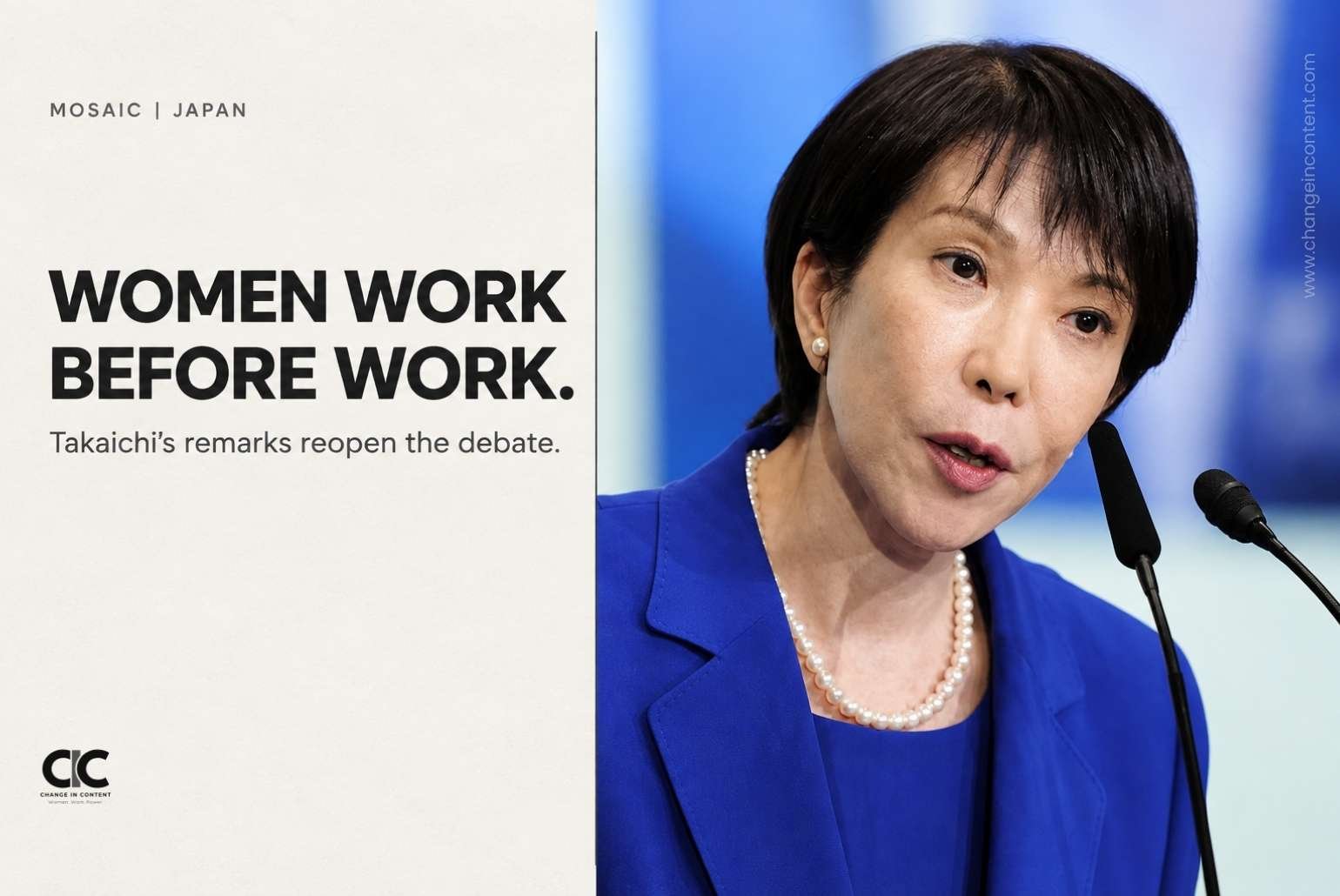
The Brief
- Takaichi discussed domestic tasks and make-up during a parliamentary committee exchange on 14 October.
- She estimated that these activities took her three or four hours more than male prime ministers.
- The comparison was her personal assessment, not a measured gender gap.
- The response has raised questions about both unequal expectations and accountability in office.
- CIC’s view: Recognising women’s additional work should lead to fairer arrangements, rather than sympathy alone.
Japan PM Sanae Takaichi has sparked a gender debate after describing the household tasks and personal preparation that sit around her official working day. Speaking in parliament on 14 October, she said making breakfast, washing dishes, bathing and applying make-up could leave her spending several more hours on these activities than her male predecessors.
The remarks came during a House of Representatives Budget Committee exchange about the time Japanese prime ministers spend in parliament. They were not a standalone policy address on women’s work.
Women work before work captures the issue this story examines. It is the framing of this article, rather than a verified verbatim quotation from Takaichi.
What Takaichi said, and why the context matters
“I feel like I’m spending three or four more hours than male prime ministers doing these things,” Takaichi said.
She was responding to Fumitake Fujita of the Japan Innovation Party, who questioned the amount of time the prime minister spends attending parliamentary proceedings. Takaichi also described the difficulty of finding time for sustained thinking about the country’s direction.
Kyodo’s Japanese-language account adds another detail: She said her aides had initially struggled to adjust to having a female prime minister, including allowing a few minutes for make-up touch-ups before televised proceedings. She framed the wider question as how to organise the conditions in which a prime minister performs the job.
Her estimate should remain attached to that account. It does not establish that all women spend three or four additional hours getting ready, that men do no domestic work, or that personal preparation is identical to unpaid household labour.
Those differences matter when discussing the double shift of paid employment and unpaid work. Household tasks can occupy the hours before paid work as well as those after it.
The debate includes accountability
Takaichi’s remarks have not received an entirely sympathetic response. Associated Press reported criticism from lawyer Fusako Miwa, who objected to make-up being offered as an excuse in a discussion of the prime minister’s performance.
That criticism raises an accountability question alongside the discussion of unequal expectations. A political leader can face additional pressures and still be answerable for how the office functions. Acknowledging those pressures does not resolve questions about parliamentary scrutiny, staffing or the organisation of government.
Nor do comments on social media establish what the whole country thinks. The available reporting documents a debate; it is not a representative survey of Japanese public opinion.
The unpaid-work gap has an official record
Japan’s 2021 Survey on Time Use and Leisure Activities provides a more systematic picture of domestic work. Among couples living with children under six, wives spent an average of seven hours and 28 minutes a day on housework and related activities, compared with one hour and 54 minutes for husbands. The category includes childcare, shopping and caring or nursing.
There was progress within those figures. Husbands’ time had increased by 31 minutes since 2016, while wives’ time had declined by six minutes. The gap nevertheless remained substantial. That domestic context is relevant to the wider discussion of workplace conditions and women’s career progression.
These are 2021 findings for a particular household group. They do not describe every Japanese couple, measure make-up time, or verify the prime minister’s personal estimate.
The issue also appears in official policy discussion. Japan’s 2025 White Paper on Gender Equality explicitly calls for challenging rigid gender roles and addressing women’s unequal burden of housework, childcare and nursing care. It also identifies work-life balance and shared parenting as priorities. Recognition exists; how it changes everyday arrangements requires continued scrutiny.
Indian readers have their own evidence to consider. India’s Time Use Survey 2024 found that female participants aged six and above averaged 289 minutes a day on unpaid domestic services, against 88 minutes for male participants. These participant averages are not directly comparable with the Japanese figures, which concern a different population and activity grouping.
Together, the sources give reason to examine domestic expectations in their own settings. They do not justify treating Japan and India as interchangeable.
The Change We Need: Take women’s time seriously
Takaichi’s remarks bring several conversations together: unpaid domestic work, the time and expense associated with appearance, and working cultures that leave little room for either. These pressures overlap, but each needs a response suited to it.
The phrase grooming tax is useful here as shorthand for additional time or expense attached to appearance expectations. It is not a literal tax, and choosing to wear make-up does not automatically demonstrate coercion. The question for an employer or institution is whether women face requirements or judgements that go beyond what the job reasonably needs.
Domestic work raises a different question: who owns the responsibility? Redistributing unpaid care and household work means sharing the planning and follow-through, as well as the visible task. Asking someone to remember everything and delegate it still leaves them managing the work.
Long hours deserve examination too. Employers can distinguish genuine operational demands from habitual late meetings, unpredictable schedules and the assumption that availability proves commitment. Families can discuss responsibilities before exhaustion turns them into an argument. Education can help children learn domestic competence and shared responsibility without assigning either by gender.
There has been progress, and it deserves recognition. But awareness should become more than agreement that women are busy. It should change whose time is protected, whose contribution is recognised and how responsibilities are distributed.
Equity and inclusion deserve to be treated as questions of fair opportunity and workable institutions. Women should not have to invite sympathy for the extra work they do before anyone considers sharing it.
Editorial Note
This news piece draws on AFP and Kyodo accounts of the 14 October exchange, AP reporting on reactions, and official Japanese and Indian publications. The parliamentary archive confirms the session; it has not been used here as an independently translated verbatim transcript. The English quotation is attributed to AFP. “Women work before work” is editorial framing, not a verified Takaichi quote. The closing section is CIC’s interpretation. Sources checked on 19 October 2026.
Sources
- AFP: Japan PM says housework makes her busier than male predecessors, 14 October 2026.
- Kyodo, carried by Kumamoto Nichinichi Shimbun — Takaichi’s Budget Committee remarks, 14 October 2026, Japanese.
- Associated Press — Japan’s Takaichi says chores and makeup add hours to her workday, sparking debate on gender roles, 15 October 2026.
- House of Representatives — Budget Committee video archive, 14 October 2026.
- Statistics Bureau of Japan — 2021 Survey on Time Use and Leisure Activities, summary.
- Japan’s Gender Equality Bureau — White Paper on Gender Equality 2025, English summary.
- MoSPI — India’s Time Use Survey 2024.