
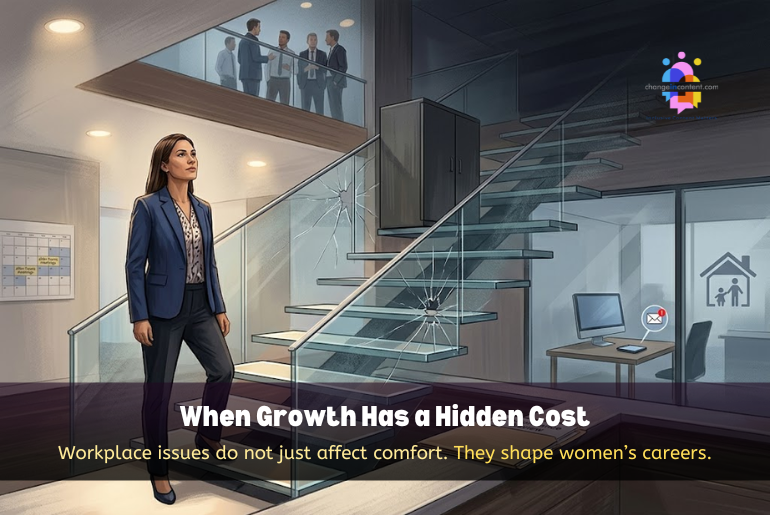
Are workplace issues and career progression connected? That is the wrong question to ask, because they always were. The more urgent question is whether organisations are willing to measure that connection honestly.
When a woman slows down at work, refuses a promotion, avoids visibility, changes teams, or leaves a company, the explanation is often made personal.
- She was not ambitious enough
- She needed more balance
- She chose family
- She lacked confidence
- She did not “lean in” enough
Familiar, right?
But research tells a more complex story. A study on women employees in the Indian civil airline industry examined how workplace issues affect women’s career growth perspectives. Based on 562 responses from women across six major Indian airlines, the study explored how discrimination, workplace challenges, and organisational environments shape career progression.
This article looks beyond one industry. It examines how workplace issues affect women’s career progression across sectors. It also examines why most people often misread these issues as individual choices, and what organisations must do if they genuinely want women to grow.
What do workplace issues do to women’s career progression?
Workplace issues affect career progression by changing how women access opportunity, visibility, support, confidence, safety, time, and leadership pathways. Some barriers are obvious, such as harassment, discrimination, unequal pay, and exclusion from promotions. Others are quieter, such as being overlooked for stretch roles, penalised for flexibility, interrupted in meetings, or judged through motherhood bias.
The result is not always an immediate exit. Often, it is slower.
- A woman may stop volunteering for high-visibility projects because she knows the team culture is hostile.
- She may avoid travel because the company has poor safety protocols.
- She may delay asking for a raise because layoffs have made her anxious.
- She may take flexible work and then quietly disappear from promotion conversations.
SurveyMonkey’s Women at Work 2026 poll found that nearly half of women workers (45%) feel burned out. Burned-out women were more likely to feel dissatisfied with their jobs, feel limited in career growth, report career setbacks, delay asking for raises, and consider quitting.
That data matters because it shows that burnout is not just a wellness issue. It is a career issue.
Why women’s career barriers are often misread as a lack of ambition
One of the most damaging workplace myths is that women self-select out of growth.
The 2025 Women in the Workplace report by McKinsey and LeanIn.Org found that, for the first time, women were notably less likely than men to say they wanted a promotion. But the report also found that when women receive equal career support, the ambition gap disappears.
That finding should make every organisation pause and think. If ambition rises when support becomes equal, then ambition was never the core problem. The workplace was.
The cost of entering leadership
Women are not always opting out of leadership. Many are calculating the cost of entering leadership systems that do not support them. They are asking themselves questions that men may not have to ask as often.
- Will this promotion increase my workload without increasing my authority?
- Will I be judged more harshly if I make a mistake?
- Will flexibility make me look less committed?
- Will I lose visibility if I become a mother?
- Will I be given a title but not real power?
- Will I be expected to mentor everyone, fix culture, and still outperform?
When organisations ignore these questions, they mistake caution for lack of ambition.
The broken rung starts early.
Career progression does not only fail at the top. It often fails at the first step into management.
The 2025 Women in the Workplace report found that for every 100 men promoted to manager, only 93 women were promoted. McKinsey describes this as the “broken rung”, the early promotion gap that prevents women from catching up later.
It matters because the first managerial promotion is not just a title change, but the start of the leadership pipeline. Once fewer women become managers, fewer women become directors, vice presidents, CXOs, board members, and decision-makers.
The same report also shows that women in entry-level roles are less likely than men to have sponsors. Only 31% of entry-level women had a sponsor, compared with 45% of men at the same level. Women were also less likely to have senior colleagues put them forward for promotion or introduce them to people who could help their careers.
That is how career progression gets shaped before performance reviews even begin.
The woman may be doing strong work. But if no one senior is saying her name in the right room, her growth becomes slower, quieter, and easier to ignore.
Sponsorship is not mentorship, and women need both
Many companies proudly talk about mentorship. But mentorship and sponsorship are not the same.
- A mentor gives advice, whereas a sponsor uses influence.
- A mentor may tell a woman how to prepare for leadership. A sponsor recommends her for the leadership role.
- A mentor helps her think. A sponsor puts her name forward when she is not in the room.
Harvard Business Review argues that very few women reach top roles partly because they do not get the high-stakes assignments that prepare people for senior leadership. Often, that is because they lack powerful sponsors who actively ensure they receive those career-making opportunities.
It is a critical workplace issue because many organisations assume talent automatically rises. It does not.
Talent rises when systems notice it, test it, support it, and advocate for it. If women receive mentorship rather than sponsorship, they may become better prepared without being better positioned.
That distinction decides careers.
Flexibility helps women stay, but flexibility stigma can hold them back
Most people often present flexibility as a women-friendly policy. Maybe it is. But flexibility becomes harmful when its ‘quiet usage’ reduces a woman’s visibility, credibility, or chances of promotion.
The Women in the Workplace report shows that the stigma around flexibility penalises women. Women who work mostly remotely are far less likely to be promoted or have a sponsor, while men who work remotely do not face the same penalty.
It is one of the most important hidden barriers in modern workplaces.
How does flexibility stigma as a workplace issue hamper career progression for women
A woman may use flexibility to manage childcare, eldercare, health, commute safety, or her workload. The organisation may officially support it. But if managers still associate ambition with physical presence, late evenings, spontaneous availability, or constant visibility, flexibility becomes a career tax.
That is why organisations must stop treating flexibility as a policy and start treating it as a design principle.
If promotions still reward those who are seen most often rather than those who contribute most effectively, women will keep paying for flexibility with slower progression.
Burnout is a promotion blocker.
Most people (even today) discuss burnout as exhaustion. But its career impact is deeper.
SurveyMonkey’s Women at Work 2026 poll found that burned-out women were more likely to report lower job satisfaction, weaker perceptions of career growth, more career setbacks, fear-based delays in taking paid time off, delays in asking for raises, and a higher likelihood of quitting.
In Changeincontent’s previous analysis of the SurveyMonkey Women at Work 2026 findings, we noted that it is incorrect to treat burnout, flexibility, retention, inclusion, and leadership as separate issues. They form one system. You can read that analysis here.
Burnout as a workplace issue and its impact on career progression
For women, burnout often carries an additional burden. Organisations often expect them to perform at work while also absorbing emotional labour, domestic labour, team culture work, and sometimes informal DEI labour. For example, the business may expect a senior woman to deliver business outcomes, mentor younger women, represent diversity on panels, soften difficult conversations, and remain composed while doing more invisible work than her male peers.
Let us not look at this as resilience. It is an extraction.
If organisations do not measure workload quality, emotional labour, meeting load, after-hours expectations, and recovery time, they cannot honestly say they are supporting women’s growth.
The care penalty still shapes women’s careers.
Care responsibilities remain one of the strongest forces shaping women’s career decisions.
The International Labour Organisation estimated that 708 million women globally were outside the labour force in 2023 due to unpaid care responsibilities, compared with 40 million men.
That does not mean women are less career-oriented. It means we are still building work systems around the assumption that the ideal worker has someone else managing life at home. That assumption punishes women repeatedly.
It affects who can stay late, travel at short notice, attend informal networking events, take relocations, accept demanding roles, or recover after childbirth. It also affects how managers interpret commitment. They may see a father leaving early as responsible, while a mother leaving early can be considered distracted.
How the care misconception workplace issue impacts career progression
The career impact is not always visible within a single appraisal cycle. It accumulates.
- One missed networking dinner.
- One declined travel opportunity.
- One delayed promotion conversation.
- One manager who assumes she is “not ready right now”.
Over time, these small decisions become a large leadership gap.
Safety, harassment, and belonging are career issues, too
Let us get this straight. We cannot separate women’s career progression from their sense of safety.
When women experience harassment, microaggressions, exclusion, or identity-based judgment, they not only feel uncomfortable. They change behaviour. They may speak less in meetings, avoid certain leaders, reduce travel, stop attending informal gatherings, or leave teams with better opportunities.
Deloitte’s Women @ Work 2025 report shows that career development opportunities, work-life balance, flexibility, and pay and benefits are key drivers for the small share of women who plan to stay with their current employer for more than five years.
Retention and progression, therefore, are strongly connected. Women do not grow in workplaces where they feel they cannot stay.
Nearly one in four women (22%) feel it is more difficult to be themselves at work than a year ago. Where women saw a decline in women-specific initiatives, they were more likely to feel the workplace was less diverse and harder to belong to.
Belonging may sound soft, but its impact is practical.
People who cannot be themselves spend energy managing perception. For women, that may mean:
- Sounding assertive but not aggressive
- Friendly but not too available
- Ambitious but not threatening
- Competent but not cold
- Committed but not unavailable at home.
That constant self-editing has a career cost.
Bias in performance reviews is where inequality becomes official
Many workplace issues become career progression issues during performance reviews.
- A manager may ask a woman to “show more confidence” while calling a man with the same style ‘thoughtful.’
- A woman may hear people telling her that she needs more executive presence when the actual issue is that leadership has a narrow idea of what authority looks like.
- The organisation may praise her as a team player but not rate her as strategic.
- The HR may assign her cultural work and then penalise her for not producing enough visible business outcomes.
That is how bias becomes documented.
Capgemini’s 2025 research shows that 53% of female leaders had experienced pay bias due to gender. At the same time, only just over half of the leaders agreed that men and women had equal opportunities for promotion in their organisation.
That finding points to a basic truth. If pay, promotions, and leadership access are not subject to rigorous audits, organisations may continue to reward inequality while calling it merit.
One cannot assume fairness. It has to be designed.
Workplace issues and career progression: Why this matters for organisations, not only women
Some organisations still treat women’s career progression as a moral issue alone. It may be a moral issue. But it is also a business, talent, governance, and culture issue.
When workplace issues slow women’s careers:
- Organisations lose trained talent
- They weaken succession pipelines
- They reduce diversity in decision-making
- They spend more on replacement hiring
- They send a message to younger employees that growth is not equally available
- They also damage trust.
The best employees watch what happens to women around them.
- They notice who gets sponsored.
- They notice who is interrupted.
- They notice whose mistakes are forgiven.
- They notice who gets stretch roles.
- They notice whether mothers return to growth or stagnation.
- They notice whether harassment complaints are handled or hidden.
Culture is not what organisations announce. It is what employees learn by watching consequences.
What organisations should do differently?
Organisations need to stop asking whether women are ambitious and start asking whether the workplace makes ambition sustainable.
Audit promotion data
First, organisations must audit promotion data by gender, level, function, location, motherhood status (where legally and ethically appropriate), and work arrangement. If women are entering but not moving, the organisation needs to know where the pipeline breaks.
Structure sponsorship
Second, sponsorship must become structured. Managers should be expected to identify high-potential women, put them forward for stretch roles, and be evaluated on how fairly they distribute opportunity.
Flexibility should not reduce visibility.
Promotion criteria should reward outcomes, leadership quality, collaboration, decision-making, and business impact rather than physical presence or performative availability.
Honest workload measurement
An organisation must measure the workload honestly. Wellness sessions do not solve burnout if the job itself is badly designed. Organisations need to examine meeting load, after-hours expectations, understaffing, role creep, and emotional labour.
Fair performance reviews
Performance reviews must be bias-checked. Vague phrases such as “not ready”, “needs more confidence”, “too aggressive”, “not strategic enough”, or “lacks executive presence” should be challenged with evidence.
Care is a workforce reality.
Every organisation must treat care as a workforce reality. Parental leave, childcare support, returnship pathways, predictable schedules, safe transport, and manager training can directly affect women’s retention and progression.
Psychological safety
Organisations must build psychological safety into leadership. Women should not have to become experts at surviving the workplace before they can grow in it.
Workplace issues and career progression: What women employees can take from this conversation
The burden of fixing workplace inequality should not fall on women. Still, women deserve practical language to identify what is happening to their careers.
If your growth has slowed, ask whether the issue is truly performance or access.
- Are you getting stretch assignments?
- Are senior leaders aware of your work?
- Are you receiving specific feedback or vague judgment?
- Are you being mentored but not sponsored?
- Are you doing invisible culture work that goes unrewarded?
- Are you using flexibility in a team that privately penalises it?
- Are you being asked to prove commitment in ways that ignore your actual contribution?
These questions do not solve structural inequality. But they help name it. And once a barrier is named, it becomes harder for organisations to dismiss it as a personal shortcoming.
Methodology and editorial note
This article draws on the ScienceDirect-listed research paper “Does Workplace Issues Influence Women Career Progression? A Case of Indian Airline Industry”, SurveyMonkey’s Women at Work 2026 poll, McKinsey and LeanIn.Org’s Women in the Workplace 2025 findings, ILO data on unpaid care responsibilities, Deloitte’s Women @ Work 2025 insights, and Capgemini’s 2025 research on gender and leadership.
The article uses these sources to examine workplace issues as structural factors that influence women’s career progression. The intention is not to suggest that all women experience the same barriers or that every organisation fails in the same way. The aim is to identify patterns that organisations can measure, challenge, and redesign.
Changeincontent Perspective: Women’s careers do not stall in isolation
We cannot discuss workplace issues and career progression separately. Talent is not the only thing that shapes a woman’s career. What also shapes talent are the conditions under which it is recognised, sponsored, rewarded, and protected.
At Changeincontent, we believe organisations need to move beyond the language of “fixing women”. We do not always have to make women more ambitious, more confident, more resilient, or more available to broken systems. Workplaces need to become less biased, less punishing, less performative, and more honest about how careers actually grow.
Inspiration panels will not alone build the future of women’s leadership. We need fair promotions, real sponsorship, safe cultures, flexible work without penalty, better care infrastructure, and leaders who understand that inclusion is not a feeling. It is a system.
If women are leaving, slowing down, or refusing growth, organisations should not ask what is wrong with them. They should ask what the workplace has contributed to the growth cost.
