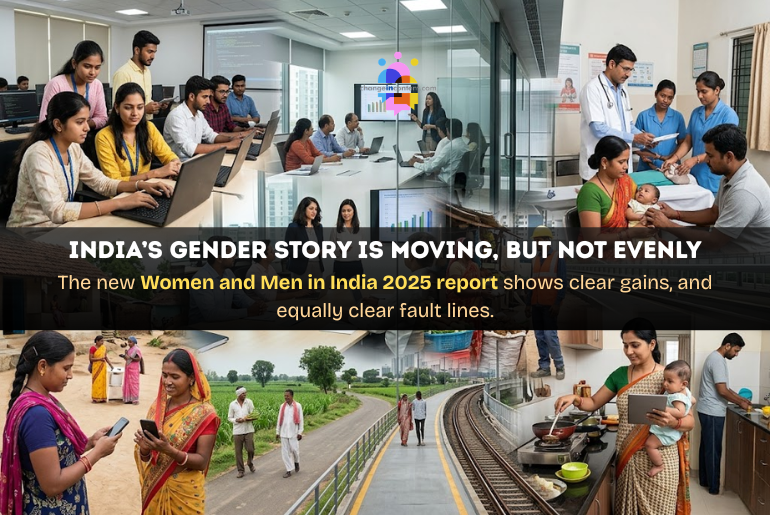
The new Women and Men in India 2025 report does not tell a simple story of progress or failure. It tells a more realistic one. India is seeing movement in several key gender indicators, and some of that movement is significant.
- The sex ratio at birth has improved.
- India is close to achieving gender parity across school education.
- More women are entering higher education.
- Rural women’s labour force participation has risen sharply.
- Women in managerial positions are growing faster in percentage terms than men.
But that is only one side of the picture. The same report also reminds us that gains in enrolment or participation do not automatically erase deeper inequalities.
- Preventive healthcare access remains weak in key areas.
- Literacy gaps still reflect the exclusion of older generations.
- Women continue to shoulder a disproportionate share of unpaid work.
- And digital spaces are not becoming safer or more accessible at the same pace as women’s dependence on them is growing.
In other words, the report is useful precisely because it resists easy celebration. It also builds on what we explored in our earlier analysis of the Women and Men in India 2024 report, where the larger question was not only what the numbers showed, but what they still failed to change in everyday life.
Women and Men in India 2025: About the report
The Ministry of Statistics and Programme Implementation (MoSPI) has released the 27th edition of its report, “Women and Men in India 2025: Selected Indicators and Data“, on April 29, 2026, at the National Deliberative Summit on Data for Development in Bhubaneswar.
First brought out in 1995, this annual publication has, over the years, become an important source of data on the social and economic conditions of women and men in India. It brings together information from different ministries and official records.
The report covers areas such as population, health, education, work and income, and violence against women.
Where Women and Men in India 2025 shows the gender gap narrowing
The latest report by the Ministry of Statistics and Programme Implementation highlights areas where the gender gap has narrowed over time. From survival rates at birth to education and employment, the data highlight shifts indicating improved access and outcomes, especially for women and girls.
Improvement in sex ratio at birth and infant survival
The sex ratio at birth has improved at the all-India level, rising from 904 in 2017–19 to 917 in 2021–23. It points to better survival of girl children in their early years. At the same time, infant mortality has gone down for both girls and boys between 2008 and 2023. That suggests improvements in healthcare and early-life support.
A steady decline in the Maternal Mortality Ratio (MMR) and Infant Mortality indicates better healthcare access for women. MMR reduced from 254 (2004-06) to 88 (2021-23).
Closing the gap in school education
In school education, the gap between girls and boys has reduced significantly. We have reached gender parity now across all levels, from primary to higher secondary. It means that girls are enrolling in and continuing in school at levels similar to those of boys. That marks an important shift from earlier years, when dropout rates among girls were higher.
Rise in higher education enrolment.
The Gross Enrolment Ratio has increased for both women and men, but the rise is slightly higher for women. For women, it has increased from 28.5 to 30.2, while for men it has increased from 28.3 to 28.9 between 2021–22 and 2022–23. It shows that more women are entering colleges and universities than before.
Increase in women in managerial roles
Changes are also visible in the workplace, especially in leadership roles. Between 2017 and 2025, the number of men in managerial positions increased by 73.8%. In comparison, the increase for women during the same period is higher, at 102.54%.
Even though the total number of women in such roles may still be lower, this faster growth suggests that more women are gradually entering previously difficult-to-access spaces.
But where do inequalities still remain?
Along with areas of progress, the report by the Ministry of Statistics and Programme Implementation also points to concerns that continue to hold women back.
Limited access to health screening
Preventive care is still out of reach for many women. Screenings for serious illnesses like cervical and breast cancer remain very low. For example, only about 1.7% of women have ever undergone a cervical cancer screening test. It means that many cases may go undetected until it is too late.
A literacy gap that has not fully closed
While younger generations show higher literacy levels, the overall gap between men and women remains wide. There is a 14.4 percentage point difference in literacy among people aged 7 and above. That is largely because older groups of women had fewer opportunities to attend school, and that effect is still evident in the data today.
Unequal share of unpaid work
Women spend much more time on unpaid domestic work and caregiving than men. Time-use data shows a sharp difference in how daily hours are spent, with women carrying most of the household responsibilities. It often leaves them with less time and fewer chances to take up paid work or pursue other opportunities.
Digital spaces are not equally safe.
As daily life becomes more dependent on the internet, gaps in digital access and awareness are becoming more serious. Many women do not have the skills or support needed to deal with online violence. They often face targeting in cybercrimes, but fewer women report these incidents compared to men. That makes it harder to address the problem and ensure safer online spaces for them.
The Changeincontent perspective
What makes Women and Men in India 2025 useful is that it refuses a one-directional story.
The report clearly shows that India has made meaningful progress across several gender indicators, especially in schooling, higher education, early survival, women’s labour force participation, and managerial growth. But the report is just as valuable for what it shows about the stubbornness of structural inequality.
Health screening, unpaid care work, literacy gaps among older adults, and digital vulnerability all reveal the same thing: access is improving faster than equality.
That means policymakers and institutions should be careful not to confuse visible progress with complete progress. More girls in school and more women in colleges or jobs do matter. But unless healthcare access improves, care work is redistributed, and women are safer both offline and online, the system will continue to produce uneven outcomes.
The report is not a verdict that the gender gap is closing cleanly. It is evidence that India is moving, but still carrying deep imbalances into the future.
Conclusion: Women and Men in India 2025 shows that progress is real, but still uneven
The report by the Ministry of Statistics and Programme Implementation shows a mixed picture. On one hand, more girls are staying in school and entering colleges and jobs. On the other hand, many barriers remain, especially in access to health care, basic literacy among older women, unpaid work at home, and safety in digital spaces. What this really points to is that progress is happening, but it is uneven.
Moving forward, the focus cannot be only on increasing numbers in education or jobs. Equal access to healthcare, sharing care work at home, and building safer, more accessible digital spaces matter just as much.