
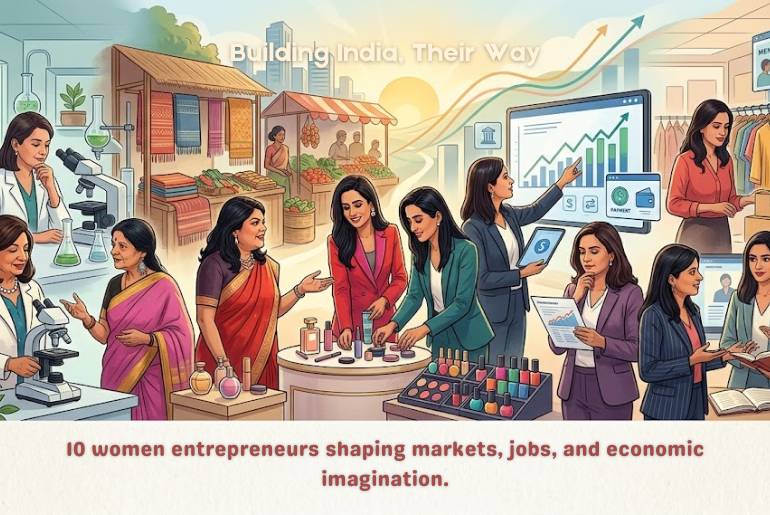
There is a quiet confidence in the way women entrepreneurs are driving India’s economic growth and shaping the country today. They are not waiting to be invited into the economy. They are building it, one company, one product, one platform, one village enterprise, and one market shift at a time.
- Some are building listed companies.
- Some are taking Indian brands global.
- Some are creating access to finance, menstrual education, wellness, digital payments, beauty, careers, and rural livelihoods.
- Some began in boardrooms.
- Some began with lived experience.
- Some began when the market said no.
Together, they show us that women’s entrepreneurship in India is no longer a side story. It is part of the main growth story.
According to a report published in a leading daily, women make up nearly 15% of Indian entrepreneurs. At the same time, women are at the helm of over 20% of India’s MSMEs. The same article also notes a more than 40% rise in credit borrowing by women. That reflects greater entrepreneurial capacity and financial participation.
It is not only about numbers. It is about a change in imagination. India is beginning to see women not only as workers, consumers, or beneficiaries, but as builders of markets.
Why women entrepreneurs matter to India’s economy
Women entrepreneurs matter because they create value in places that traditional business has often overlooked.
- They build for women consumers.
- They bring local markets into formal systems.
- They employ other women.
- They create products around problems that people once dismissed as personal, domestic, rural, or too small.
It is especially important for India’s MSME sector. IBEF notes that women-owned MSMEs accounted for 20.5% of Udyam registrations, 18.73% of employment, and 10.22% of turnover.
The opportunity is far larger. Bain & Company’s research estimated that India had 13.5 to 15.7 million women-owned enterprises. That is fewer than 20% of all enterprises. Still, these businesses directly employed around 22 to 27 million people. The same research argued that helping women-owned enterprises start and scale could generate 150 to 170 million jobs by 2030, directly and indirectly.
That is why we must not treat women’s entrepreneurship as a soft development issue. It is a productivity issue, a jobs issue, and a formalisation issue. It is also a national competitiveness issue.
Women entrepreneurs driving India’s economic growth: The story India needs to hear.
This story is not a ranking of the richest women entrepreneurs in India. It is not a list built solely on valuation. It is a story of women who have expanded the possibilities of Indian entrepreneurship.
- Some built consumer brands.
- Some built financial access.
- Some built science-led companies.
- Some built confidence for rural women.
- Some built platforms for women’s health and careers.
The common thread is simple. Each of these women entrepreneurs saw a gap the market had ignored and built something around it.
10 women entrepreneurs driving India’s economic growth
Let us look at 10 women entrepreneurs in India who inspire a generation. These women are significant contributors to driving India’s economic growth.
1. Kiran Mazumdar-Shaw made biotechnology feel possible from India
Kiran Mazumdar-Shaw’s story is the kind of story that rewrites industrial imagination. In 1978, she began Biocon from a garage in India. Today, Biocon describes her as a first-generation entrepreneur and global business leader with over four decades of experience in biotechnology.
Her contribution goes beyond building a company. She helped prove that India could participate seriously in biotechnology, biosimilars, affordable medicines, and scientific innovation. In a country where women founders are still often pushed towards “softer” categories, Mazumdar-Shaw built in a complex, regulated, science-heavy sector.
That matters. It tells young women that deep-tech, pharmaceuticals, biotech, and research-led entrepreneurship are not closed rooms. They are difficult rooms, but women can enter these rooms.
2. Falguni Nayar turned beauty into a serious business category
Falguni Nayar founded Nykaa after a long career in investment banking. Interestingly, she did that at an age when the society expects most women to slow down rather than start over. She saw that Indian beauty consumers wanted trust, authenticity, choice, education, and access. Nykaa built around that gap.
The scale is now visible. Nykaa’s FY2025 integrated annual report recorded ₹15,604 crore in GMV and ₹7,950 crore in net revenue, with net revenue growing 24% year on year.
Nayar’s story is important because she did not simply sell products. She changed how beauty was bought, explained, reviewed, discovered, and trusted in India. She also helped make women consumers visible as powerful market-makers.
3. Ghazal Alagh built a consumer brand from parental concern
Ghazal Alagh co-founded Mamaearth under Honasa Consumer, starting from a deeply personal space: a parent looking for safer products. That is a common pattern in women-led entrepreneurship. A lived problem becomes a market insight.
Honasa Consumer’s brand portfolio now includes Mamaearth, The Derma Co., Aqualogica, Dr Sheth’s, BBlunt, Lumineve, Staze, and other brands. Reuters reported in 2025 that Honasa had posted an 8% rise in revenue to ₹20.67 billion for the fiscal year ended March 31, while planning wider offline expansion.
Alagh represents a new generation of Indian founders who understand that brand-building is no longer only about manufacturing. It is about trust, community, feedback, digital storytelling, and listening carefully to households.
4. Vineeta Singh made Indian beauty bolder and more inclusive
Vineeta Singh, co-founder and CEO of SUGAR Cosmetics, entered a crowded beauty market but brought a sharper understanding of Indian skin tones, digital consumers, affordability, and confidence-led branding.
Her public visibility on Shark Tank India has also made entrepreneurship more relatable to a generation that consumes business stories as part of the culture.
Her journey matters because it normalises persistence. Not every founder has one idea, one launch, and one clean success graph. Many build through experiments, refusals, pivots, and bruises. Singh’s story makes that truth visible.
5. Upasana Taku helped bring digital finance into everyday India
Upasana Taku co-founded MobiKwik at a time when digital payments were still far from ordinary for most Indians. MobiKwik was founded in 2009 by Bipin Preet Singh and Upasana Taku. It now has over 186.6 million registered users and a merchant network of 4.79 million.
Taku’s contribution sits at the intersection of fintech, access, and trust. Digital payments are not just about convenience. They bring small merchants, kirana stores, and everyday consumers closer to formal finance.
Her story matters because financial technology can sound abstract until we see its daily impact. A woman entrepreneur building in fintech helps shift the idea of who gets to design money systems for Bharat.
6. Radhika Gupta made financial leadership more human
Radhika Gupta is not only a finance leader. She is also an entrepreneur who co-founded Forefront Capital before Edelweiss acquired it, and she later became MD and CEO of Edelweiss Mutual Fund. Edelweiss Mutual Fund states that Radhika became CEO in 2017 at the age of 34 and later MD and CEO in 2020.
Her impact is unusual because she has helped make investing sound less intimidating. Her public communication has often brought emotional clarity to financial discipline. That matters in a country where women’s financial participation still needs deeper cultural support.
As of late 2025, Edelweiss Mutual Fund’s AUM was around ₹1.64 lakh crore, up from ₹91,000 crore in October 2022. Gupta’s story is a reminder that economic growth is not only built by starting companies. You can also build it by helping more people participate in wealth creation.
7. Richa Kar made a private category respectable
Richa Kar founded Zivame in 2011 and built one of India’s early intimate-wear e-commerce platforms. Zivame is India’s largest intimate-wear platform, making intimate-wear shopping more respectful and comfortable for Indian women.
It may sound like a consumer story, but it is also a cultural story. For years, women’s intimate-wear shopping in India has been marked by discomfort, secrecy, and a poor retail experience. Kar saw the dignity gap inside a market gap.
That is the strength of women-led entrepreneurship. It often identifies problems that traditional businesses overlook because these problems live within women’s everyday experience.
8. Neha Bagaria built a platform around women’s career restarts
Neha Bagaria founded HerKey, formerly JobsForHer, after taking a career break herself. She founded the platform in 2015 after a 3.6-year break while she was raising her children. Today, HerKey is one of India’s largest career engagement platforms for women.
HerKey’s work matters because women’s entrepreneurship is not only about building companies. It is also about building pathways for other women to return, work, learn, and lead.
A platform that helps women restart careers contributes to the economy in a very practical way. It brings talent back into circulation and challenges the idea that a career break is a full stop. At the same time, it helps employers see women’s career journeys with more realism.
9. Aditi Gupta turned menstrual education into a social enterprise
Aditi Gupta co-founded Menstrupedia in 2012 with Tuhin Paul. Gupta is a Forbes India 30 Under 30 achiever, was named one of the BBC’s 100 most influential women in 2015, and has shared her work across seven countries.
Her entrepreneurship is powerful because it turns taboo into education. Menstrual awareness is not just a health conversation. It affects school attendance, confidence, dignity, family attitudes, and future participation.
Gupta’s work shows that you can build an enterprise around social change without losing seriousness. A comic, a classroom, a conversation, and a curriculum can also be economic infrastructure when they help girls stay informed and confident.
10. Chetna Sinha made rural women entrepreneurs visible
Chetna Sinha’s work with Mann Deshi Foundation and Mann Deshi Mahila Sahakari Bank is one of India’s most powerful stories of entrepreneurship because it begins with rural women refusing to remain financially invisible.
Sinha founded the Mann Deshi Foundation in 1996 in Mhaswad, Maharashtra, to economically and socially empower rural women. In 1997, she set up Mann Deshi Mahila Sahakari Bank, India’s first bank for and by rural women.
That is entrepreneurship at the ecosystem level. It is not only one woman building a business. It is one woman helping thousands of women build theirs.
This story also connects directly with the larger national conversation on rural women entrepreneurship. Changeincontent has previously analysed the government’s national campaign for rural women entrepreneurship and why rural women need more than slogans. They need finance, market access, skilling, mobility, and institutional support. You can read that analysis here: Rural Women Entrepreneurship: Government’s New National Campaign Explained.
Women entrepreneurs driving India’s economic growth: What these stories tell us about India’s future
These 10 stories are different, but they point to one larger truth. Women entrepreneurs are not entering the economy in one way. They are entering through science, beauty, fintech, finance, wellness, health education, rural credit, career platforms, and consumer categories.
- They are not only creating companies. They are expanding markets.
- They are turning embarrassment into dignity.
- They are turning care into consumer insight.
- They are turning financial exclusion into access.
- They are turning career breaks into career platforms.
- They are turning rural ambition into enterprise.
- They are turning scientific capability into global credibility.
That is why women entrepreneurs driving India’s economic growth deserve more than applause. They need ecosystem support that matches their ambition.
The challenges women entrepreneurs still face
We can celebrate progress without pretending the road is easy. Women entrepreneurs in India still face real barriers.
- Access to credit remains uneven.
- Networks are often male-dominated.
- Investor confidence can be biased.
- Family expectations affect time, mobility, and risk appetite.
- Many women-led enterprises remain micro-sized or informal, which limits access to procurement, technology, market expansion, and formal finance.
Women entrepreneurs often face obstacles to accessing credit, exclusion from business networks, and gaps between policy and practice. NITI Aayog’s Women Entrepreneurship Platform responds to some of these issues by aggregating support across funding, mentorship, incubation, compliance, networking, skilling, and market access.
The challenge now is not only to encourage women to start. It is to help them scale.
That requires patient capital, access to procurement, local business support, digital infrastructure, mentoring beyond motivation, formalisation support, and policies that understand women’s lived constraints.
The Changeincontent perspective
The story of women entrepreneurs driving India’s economic growth is no longer exceptional. It is becoming a story of direction.
At Changeincontent, we believe women’s entrepreneurship deserves to be seen with the seriousness usually reserved for macroeconomic policy, startup funding, export strategy, and industrial growth.
When women build, they do not only create balance sheets. They create jobs, confidence, dignity, local demand, community wealth, and new ideas of what markets can serve.
India’s next economic chapter will not be written only by unicorns, industrial houses, or policy announcements. It will also be written by women who start from a kitchen table, a lab bench, a laptop, a village bank, a WhatsApp catalogue, a clinic, a classroom, a small shop, or an idea that nobody else took seriously.
That is the beauty of this story. Women are not waiting for India’s growth to include them. They are already building it.
Disclaimer and editorial note
This article is based on publicly available data and reporting from Hindustan Times, IBEF, Bain & Company, NITI Aayog’s Women Entrepreneurship Platform, company pages, official annual reports, investor information, and verified profiles of the entrepreneurs mentioned.
Changeincontent editorially curates the list of 10 women to represent a mix of scale, sectoral diversity, social impact, consumer-market influence, and ecosystem-building.
It is not a ranking. It does not claim that these are the only women entrepreneurs driving India’s economic growth. India’s entrepreneurial story includes millions of women in self-help groups, MSMEs, family businesses, local manufacturing, farms, digital commerce, home-run enterprises, and professional services. This article uses 10 visible stories to reflect a much larger movement.
