
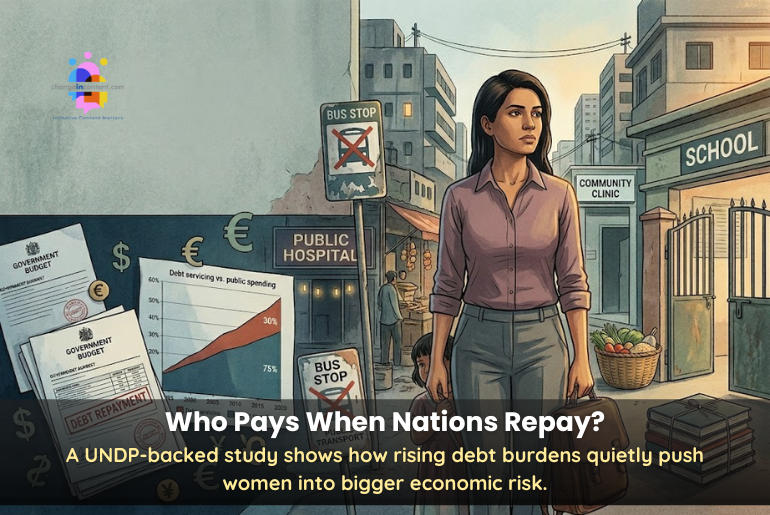
The impact of rising debt on women is often invisible in public debate because sovereign debt is usually discussed through numbers, deficits, interest payments, and repayment schedules. But behind those figures are hospitals, schools, care services, public jobs, food prices, and household decisions. When governments lose fiscal space, families do not simply absorb the shock equally. Women usually absorb more of it.
A new UNDP EQUANOMICS working paper, Who Pays the Price? Gender Inequality & Sovereign Debt studies data from 85 developing countries across three decades. Its central finding is stark. When countries move from moderate to high debt servicing burdens, women’s employment rates fall by 6.3% in the short run, equivalent to 55 million jobs. In the long run, when you include the feedback effects, the fall rises to 10.6%, equivalent to 92.5 million jobs.
The report also estimates that women’s per capita income falls by 17%, while men’s income does not significantly change. Maternal mortality rises by 32.5% in the long run, equal to 67 additional maternal deaths per 100,000 births.
These are not small statistical movements. They show how global debt pressure can reverse development gains, especially for women in countries already facing limited fiscal room.
What does the UNDP report actually say?
The UNDP press release summarises the findings clearly. Rising debt servicing is estimated to put 55 million women’s jobs at risk in the short term and 92.5 million in the long term when countries move from moderate to high debt repayment burdens. It also points to a 17% fall in women’s per capita income and a 32.5% increase in maternal mortality.
The report relies on data from the World Bank, the International Labour Organisation, and the Human Development Report databases. It studies how external public and publicly guaranteed debt servicing affects employment, income distribution, health, and education in developing economies.
In simple terms, the report asks one question. When a country has to spend more money repaying its debt, who bears the social cost?
The answer is clear. Everyone may feel the impact, but women face the sharpest consequences across employment, income, care work, and maternal health.
Impact of rising debt on women: Why debt repayment becomes a gender issue
Debt itself is not always bad. Countries often borrow to build infrastructure, expand services, respond to crises, and support development. The problem begins when debt repayments become so heavy that they crowd out public spending.
The report notes that global public debt has increased by more than 60% in the last 10 years. It also says that more than 3.3 billion people live in countries where debt servicing exceeds spending on education or health. That matters because public spending is not gender neutral.
When governments cut health, education, transport, childcare, social protection, or public-sector jobs, women often bear the brunt through multiple routes.
- They may lose paid work because women are heavily represented in care, health, education, and public service roles.
- They may take on more unpaid care when public services shrink.
- They may face higher household stress when food, fuel, medicine, and school costs rise.
- They may lose access to reproductive health services when health budgets tighten.
- They may push into informal or low-paid work to keep households afloat.
Debt servicing can reduce fiscal space, cut social investment, reduce women’s employment in the public sector, increase unpaid care work, worsen maternal health, reduce schooling, and create macroeconomic pressures such as inflation and currency depreciation.
So the debt crisis is not only about what a government owes. It is about what a government can no longer afford to protect.
The hidden chain reaction: Impact of rising debt on women
For a layperson, the debt gender link can feel abstract. But the chain is easier to understand when we follow it step by step.
- A country has high debt repayments.
- The government has less money for public services.
- Budgets for health, education, social protection, transport, childcare, or public employment face pressure.
- Women lose jobs in public and care-heavy sectors.
- Families receive fewer services.
- Women fill the gaps at home without pay.
- Girls may take on more care work.
- Households spend more on essentials.
- Women’s income, health, and time suffer.
That is why the report’s numbers are so powerful. It not only says women lose work. It shows how debt can move through the economy and enter the most intimate spaces of life.
- A budget cut in a finance ministry can become a woman leaving paid work because childcare has disappeared.
- A debt repayment schedule can result in a pregnant woman losing access to safe maternal care.
- A currency shock can become a mother stretching food, fuel, and medicine across a household.
That is the real impact of rising debt on women.
Why women’s jobs are more vulnerable
The UNDP report finds that women’s employment takes a much larger hit than men’s when debt servicing rises. Moving from moderate to high debt servicing leads to a 6.3% fall in women’s employment rates in the short run, compared with a 1.3% fall for men.
One reason is sectoral concentration. Women are often overrepresented in health, education, care, and public service roles. These sectors are among the first to face pressure during fiscal consolidation. The report also notes a 13.2% decline in women’s public sector employment when debt servicing increases.
Unpaid care economy
Another reason is the unpaid care economy.
When public services shrink, the work does not disappear. It moves into homes.
- Someone still cares for children.
- Someone still looks after elderly family members.
- Someone still manages food, health visits, water, school needs, and household provisioning.
That “someone” is usually a woman.
As governments cut social spending to meet debt obligations, women face job losses and increased unpaid care responsibilities, especially in developing countries already under fiscal strain.
Why maternal health becomes part of the debt story
One of the most alarming findings is the rise in maternal mortality.
The report estimates that moving from moderate to high debt servicing leads to a 32.5% increase in maternal mortality in the long run. That represents 67 additional maternal deaths per 100,000 live births.
That is where the human cost becomes impossible to ignore.
Maternal health depends on public systems. It depends on clinics, trained staff, transport, emergency care, medicines, reproductive health services, nutrition, and timely access. When countries face debt pressure and health budgets shrink, these systems weaken.
Women do not experience that weakening as a line item. They experience it as longer waits, fewer medicines, understaffed clinics, higher costs, and more dangerous pregnancies.
That is why the report argues that debt management must protect human development and gender equality. The issue is not only whether a country repays its debt. The issue is whether repayment is happening in a way that endangers women’s lives.
Impact of rising debt on women (and the households)
The report also makes clear that debt servicing can increase the burden of unpaid care. When governments cut social provision, women absorb the work inside households.
This part is often missing from economic analysis.
- If a clinic shuts, the state saves money, but a woman may spend more time caring for a sick family member.
- If transport becomes expensive, a girl may stop attending school regularly.
- If food prices rise, women may reduce their own meals first.
- If public childcare is unavailable, mothers may leave paid work.
- If social protection narrows, families may borrow, and women may carry the emotional and practical burden of repayment.
Changeincontent has previously written about how women can be trapped by debt at the household level in the context of microfinance and informal borrowing. That piece explored how financial systems can become exploitative when women are made responsible for repayment without being given real economic power. You can read it here.
The UNDP report looks at a different level: National Debt. But the pattern is connected. Whether debt sits with a country or a household, women often become the shock absorbers.
Why conflict and global shocks make the problem worse
The debt crisis is unfolding in a world already affected by conflict, inflation, climate shocks, food insecurity, high borrowing costs, and reduced aid flows.
The UNDP report warns that conflict-driven shocks to energy and food systems can increase poverty and hit countries with limited fiscal space the hardest. The rising energy and food costs, conflict-driven turbulence, and high interest rates worsen debt pressures for developing countries.
It matters because developing countries often borrow in difficult conditions. They may face higher interest rates, weaker currencies, and more expensive imports. When debt is external, repayment may require foreign exchange. If currencies weaken, repayment becomes even harder.
The result is a cycle.
- External shocks raise costs.
- Governments borrow or spend reserves.
- Debt servicing rises.
- Budgets tighten.
- Social spending falls.
- Women lose jobs, income, time, and services.
In crisis settings, women and girls often become more vulnerable to economic insecurity, displacement, violence, interrupted education, and loss of health access. Changeincontent has previously explored this in the context of the Ukraine crisis and how war deepens risks for women and girls. You can read that analysis here.
The debt report adds another layer. Even when the crisis begins in geopolitics or global finance, the burden often lands on women’s bodies, work, and households.
Who Pays the Price: What the report recommends?
The UNDP report does not argue that countries should ignore debt. It argues that debt management must become more gender-responsive.
Its recommendations include five broad policy directions.
Debt management strategies
The first direction is that debt management strategies should include gender impact assessments. If repayment decisions will affect employment, care work, health, and social spending, one must measure their effects before making cuts.
Fiscal consolidation programmes
The second is that fiscal consolidation programmes should avoid cuts in areas critical for gender equality. This includes health, education, childcare, social protection, reproductive health, and services that prevent violence against women.
Global financial architecture
The global financial architecture needs reform. Developing countries often face high borrowing costs and difficult restructuring processes. The report argues that debt relief and restructuring should recognise gender-regressive impacts and protect fiscal space for human development.
The role of the governments
The fourth direction is that the governments should monitor both the use of borrowed funds and the distribution of repayment costs. Borrowing can support gender equality when used well, but repayment burdens should not fall on women through service cuts and unpaid work.
Gender responsive budgeting
The fifth direction is that the gender-responsive budgeting should be applied to debt management. The report notes that even countries with formal gender-responsive budgeting systems rarely extend these practices to debt decisions.
The message is simple. A country’s debt strategy should not be considered sustainable if it is balanced by cutting women’s jobs, health access, safety, education, and time.
What this means for developing countries
For developing countries, the report changes the way debt must be discussed.
Debt sustainability is usually measured by a country’s ability to repay its debt. But this report asks a deeper question. Can a country repay without damaging its people?
If debt repayment forces cuts in public health, education, care, and social protection, then the cost is not only economic. It is developmental. It can reduce women’s employment, widen income gaps, worsen maternal health, increase unpaid labour, and weaken the next generation’s opportunities.
That means finance ministries, international lenders, creditors, and development institutions need to rethink how they define responsible debt management.
A repayment plan that looks clean on paper may be socially destructive in practice.
Impact of rising debt on women: Why this matters for India and South Asia
The report covers 85 developing countries, including India. It does not discuss India as a country in the same debt distress position as many low-income economies. But the gendered logic still matters for South Asia.
Public spending, care infrastructure, women’s employment, health access, and household debt are deeply connected in the region. When fiscal choices reduce investments in health, transport, childcare, safety, social protection, or women’s livelihoods, women’s economic participation suffers.
The report also cites research showing that lowering barriers to women’s participation can generate large GDP gains, including 22.1% in South Asia. Policymakers should read it as both a warning and an opportunity.
- If fiscal stress pushes women out of work, growth weakens.
- If public finance supports women’s participation, growth strengthens.
That is why countries cannot treat debt, gender, and development as separate policy files.
Changeincontent Perspective: Debt policy cannot be gender blind anymore
The impact of rising debt on women shows us that macroeconomics is never only macro. Debt repayment may occur at the level of governments, but its consequences extend to homes, hospitals, schools, labour markets, and women’s unpaid working days.
At Changeincontent, we believe this report should change how policymakers, lenders, and citizens think about debt. You cannot call a debt strategy responsible if it quietly shifts the cost of repayment onto women’s employment, income, health, and care work. At the same time, you cannot call a budget balanced if women end up having to forcibly offset the damage.
The lesson is not that countries should never borrow. The lesson is that countries must design borrowing, repayment, restructuring, and austerity with gender impact at the centre.
Because when public systems shrink, women expand their unpaid labour to hold society together.
That is not resilience. That is an unpaid bailout.
Methodology and editorial note
This article draws on the UNDP EQUANOMICS working paper “Who Pays the Price?” Gender Inequality & Sovereign Debt, the UNDP press release on the report, and The Guardian’s news coverage. The UNDP study analyses data from 85 developing countries. It uses the Arellano-Bond Generalised Method of Moments estimator to examine how external public and publicly guaranteed debt servicing affects gendered outcomes in employment, income, health, and education.
The report itself notes limitations. It focuses on women and men and does not separately assess impacts on girls, older women, persons with disabilities, or LGBTQ+ groups. It also cannot fully capture unpaid care work due to limited panel data.
This Changeincontent article is an analytical news interpretation. It is not financial advice, legal advice, or a country-specific debt assessment.
