
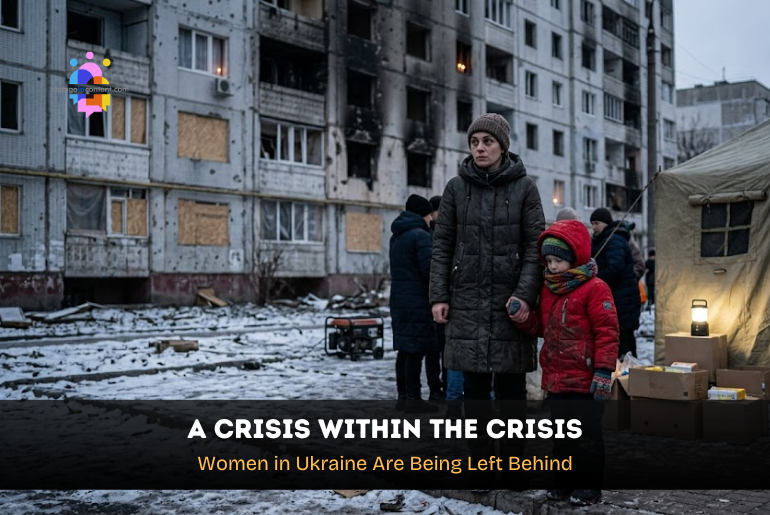
Women and girls in Ukraine are no longer just living through a war. They are navigating a crisis that has quietly deepened into something far more complex and dangerous.
Imagine living in a city where the lights go out without warning, where heating systems fail in the middle of winter, where support centres shut down because funding has dried up, and where, in that darkness, safety itself becomes uncertain. Let us not see this as hypothetical. It is the lived reality that the latest UN Women report brings to the surface.
The report, The Impact of Foreign Assistance Cuts on Women’s Rights and Women-Led Organizations in Ukraine (Phase 2), alongside the UN Women press release, lays out what one can only describe as a systemic unravelling. War continues to dominate headlines, but beneath it lies a slower collapse of infrastructure, of support systems, and of global attention. And in that collapse, it is women and girls who are absorbing the heaviest impact.
Women and girls in Ukraine: Living inside a “Triple Crisis”
UN Women’s framing of the situation as a “deadly triple crisis” is not rhetorical. It is precise.
Three forces define the crisis, and they do not operate independently but instead reinforce each other relentlessly. These are ongoing armed conflicts, targeted attacks on energy infrastructure, and a sharp reduction in international funding.
- War displaces.
- Energy attacks destabilise daily life.
- Funding cuts remove the very systems designed to respond.
Together, they create a feedback loop where vulnerability multiplies. What makes this particularly dangerous is not just the severity of each factor, but the way they overlap.
- A blackout is no longer a logistical inconvenience. It becomes a condition where violence can go unseen.
- A funding cut is no longer administrative. It translates into closed shelters, fewer counsellors, and delayed interventions.
The crisis becomes harder to see, but far more dangerous to live through.
When infrastructure collapses, safety collapses with it
Energy has emerged as one of the most critical (and overlooked) dimensions of this crisis.
Repeated attacks on Ukraine’s energy grid have left large parts of the country facing prolonged outages. Policy discussions often frame it in terms of economic disruption. But on the ground, the consequences are far more immediate and deeply gendered.
Without electricity, homes and shelters plunge into darkness. Heating systems fail, exposing families (particularly elderly women and children) to extreme cold. Water supply systems become unreliable. Hospitals and care facilities struggle to function at full capacity.
For women, these disruptions reshape daily survival. Care work intensifies. Safety diminishes. Mobility becomes restricted. In many cases, women are forced to make choices between unsafe conditions and no conditions at all.
Energy, in this context, is not infrastructure. It is protection.
The Quiet Withdrawal: How funding cuts are reshaping the crisis
If energy attacks are visible, funding cuts are not. But their impact is just as severe. The report documents how reductions in foreign assistance are directly affecting women-led organisations. These entities have been central to crisis response since the war began.
These organisations are not peripheral actors. They are often the first point of contact for:
- Survivors of gender-based violence
- Displaced women seeking shelter
- Individuals requiring legal and psychological support
Yet many of them are now operating under severe financial strain. Programmes are being scaled down. Staff are being reduced. Outreach is shrinking.
That is where the crisis becomes structural. Because when women-led organisations weaken, the entire ecosystem of support weakens with them. Access disappears not just physically, but socially. Trust erodes. Survivors retreat into silence.
And the most dangerous part? It happens without headlines.
Violence does not wait. It expands in silence.
One of the most uncomfortable truths reinforced by the report is this: war does not pause gender-based violence. It intensifies it.
As systems weaken, women and girls face increased risks within homes, in shelters, and in transit. The very spaces meant to offer safety can become sites of vulnerability.
At the same time, access to justice becomes fragmented. Legal systems slow down under pressure. Reporting mechanisms weaken. Survivors face greater barriers, both logistical and psychological.
It creates a paradox. Violence increases, but visibility decreases. And when visibility decreases, accountability disappears.
Displacement and the rewriting of women’s lives
The scale of displacement in Ukraine has fundamentally altered the roles women occupy.
Women are now navigating multiple identities simultaneously (caregivers, income earners, decision-makers), often without institutional support.
We must not see displacement as just physical movement. It is a restructuring of life itself. Women must rebuild routines, secure livelihoods, and manage uncertainty, all while operating within unfamiliar systems.
Access to employment remains inconsistent. Social protection frameworks are strained. For many, the path forward is unclear. And yet, the expectation to endure remains constant.
The psychological cost of a prolonged crisis
Beyond the visible impacts lies a quieter, more enduring consequence—mental health.
The report highlights rising levels of stress, anxiety, and trauma among women and girls. For those working within women-led organisations, the burden is even heavier. They are not just responding to a crisis. They are living within it.
Mental health services, already limited, are further constrained by funding shortages. This creates a long-term risk that extends beyond the current conflict.
Trauma, when left unaddressed, does not fade. It accumulates. And in doing so, it shapes future generations.
Women and girls in Ukraine and the pattern of global neglect
What is unfolding in Ukraine is not isolated. It follows a pattern seen across conflict zones. Initial global response is strong. Attention is high. Funding flows. Then, gradually, the world shifts its focus.
The Ukraine crisis is entering that phase. And history shows us what happens next. We explored similar patterns in global conflict zones here.
When attention fades, vulnerability deepens. Not because the crisis ends, but because support does.
The Changeincontent perspective: This is not a Ukrainian problem alone
At Changeincontent, we do not see this report as a regional issue. We see it as systemic.
The crisis facing women and girls in Ukraine exposes a deeper flaw in how global systems respond to prolonged emergencies. The society consistently positions women as recipients of aid, rather than central actors in response and recovery. At the same time, it treats women-led organisations as complementary rather than foundational.
We are designing policies with gender considerations in mind, but rarely building them around women. If we continue to respond this way, we are not just failing Ukraine. We are reinforcing a global model where women remain peripheral to decision-making, even when they are central to survival.
That is not a gap in resources alone. It is a gap in design.
Conclusion: Women and girls in Ukraine cannot be left behind again
Women and girls in Ukraine are not just surviving a crisis. They are carrying it. And the most dangerous moment in any crisis is not its peak. It is the point at which it becomes familiar. Because familiarity breeds silence.
If there is one takeaway from this report, it is this:
Support systems must not shrink when crises persist. They must expand. These systems must not add women to recovery frameworks. They must shape them. Because if they are not at the centre of rebuilding, we are not rebuilding equitably.
We are rebuilding the same inequalities that made them vulnerable in the first place.
Disclaimer: The views expressed in this article are based on the writer’s insights, supported by data and resources available both online and offline, as applicable. Changeincontent.com is committed to promoting inclusivity across all forms of content. We broadly define inclusivity in terms of media, policies, law, and history. It encompasses all elements that influence the lives of women and marginalised individuals. Our goal is to promote understanding and advocate for comprehensive inclusivity.
