
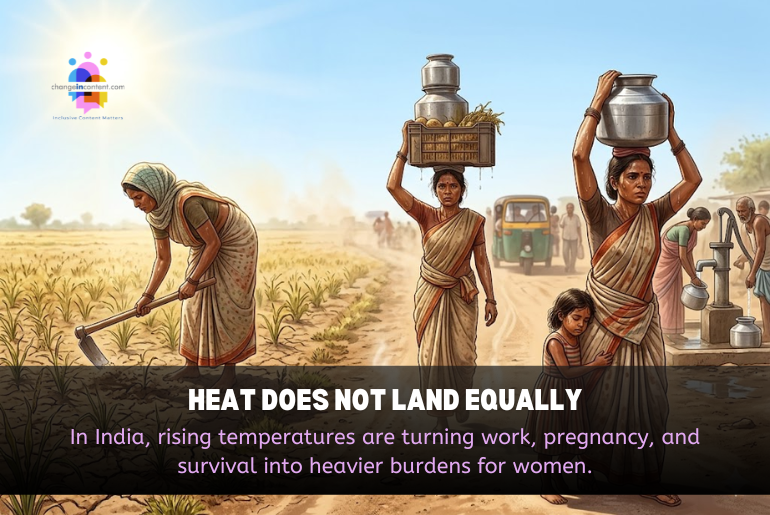
By now, the heat in India no longer feels seasonal. It feels structural. Streets shimmer longer, workdays become harder to endure, and ordinary routines begin to demand more physical effort than before. But what often gets missed in this conversation is that heat does not fall equally on everyone. The gendered impact of rising temperatures is sharper in places where women already carry more unpaid labour, more precarious work, and less control over the conditions in which they live and earn.
That is why this is not only an environmental story. It is a story about inequality under pressure. In India, women perform a significant share of labour in agriculture, informal work, caregiving, and physically demanding daily routines, making it far harder to escape the heat. When the temperature rises, it not only brings discomfort. It magnifies existing disadvantages, from wage loss and health risk to pregnancy complications and social vulnerability inside patriarchal systems.
From Fields to Sales Floors: Heat stress in women’s work
A large share of women’s work in India happens outdoors or in conditions where avoiding heat is not an option. According to NITI Aayog, nearly 80% of rural women work in agriculture. As temperatures rise, their workdays are becoming more difficult and more risky. Long hours in the sun, limited access to shade, and lack of proper rest or hydration affect both health and productivity. The same holds in construction, where 96.9% of women employed in the industry work as casual labour, according to PLFS 2022/23 data.
The increasing prevalence of UV radiation- and heat-stress-related illnesses among agricultural workers worldwide is a result of rising temperatures and global air pollution. Prolonged exposure not only leads to immediate issues like dehydration and exhaustion but also raises the risk of long-term health problems.
Not all heat-exposed work looks like field labour.
The impact is not limited to manual labour. Women working in sales or front-facing roles also deal with rising temperatures in different ways. Many of these roles require constant movement, long hours on their feet, and interaction with people in spaces that may not always be well-cooled.
Women working as field sales executives or promoters often travel between locations by bus or two-wheeler in peak heat. Now, when you link this with menstruation, perimenopause, or menopause, the strain increases.
Many front-facing roles expect women to look fresh and composed throughout the day. Sweat, fatigue, or visible discomfort can be judged negatively, even if it’s due to extreme weather. Studies also report that women in supervisory roles experience dizziness and fainting during peak summer, which increases the chances of slips, falls, and workplace injuries.
Why the gendered impact of rising temperatures hits women’s incomes harder
With every 1°C increase in long-term average temperature, female-headed households see a 34% drop in income compared to male-headed households. For women in informal work, around 97% report income loss during peak summer months. They often lose 20 to 25% of their daily earnings because the heat reduces how much they can work.
Over time, this creates a cycle in which rising temperatures undermine financial stability for women, especially those already working with limited resources and support.
How the gendered impact of rising temperatures threatens maternal health
Pregnancy already places physical stress on the body, and extreme heat makes this period even more difficult. In tropical regions, especially across low- and middle-income countries like India, pregnant women face higher risks because of constant exposure to rising temperatures and limited access to cooling, rest, and healthcare support.
Many pregnant women continue to work long hours in India’s informal economy, travel in crowded conditions, and manage household responsibilities even during extreme heat.
Heat stress can directly affect both the mother and the unborn child. Medical research shows that heat stress during pregnancy increases the chances of complications such as preterm labour, worsening of existing health conditions, and even stillbirths.
Data from studies by the Asian Development Bank indicate that for every 1°C rise in temperature, preterm births increase by approximately 6%. During heatwaves, it can rise to 16%. At the same time, the risk of stillbirth also grows, increasing by about 5% with each degree rise in temperature.
Heat exposure, male birth decline, and social consequences for women
Recent research has brought out another dimension of how rising temperatures may be affecting pregnancy. A new large-scale study of nearly five million births across India and 33 countries in sub-Saharan Africa found that heat exposure during pregnancy was associated with fewer male births, with the timing of exposure varying by region. In India, the association was strongest during the second trimester.
In sub-Saharan Africa, this effect was observed among women exposed to extreme heat during the first trimester. However, in India, higher temperatures during the second trimester lead to fewer male births. The impact was more noticeable among older mothers, women with multiple children, and those without sons, particularly in northern states.
What temperature rise means for preterm birth and stillbirth risk
If rising temperatures are actually reducing the chances of having boys, women are the ones who’ll end up taking the blame, even though it’s completely out of their control. In many families, this can mean more pressure to keep trying, more stress, and even being treated badly for not having a son.
So now it’s not just about health risks from heat, it’s also about added social pressure piling onto women because of something caused by the climate crisis.
This also connects to another climate-linked reality we have explored earlier in Water Wives in Maharashtra: How water scarcity is forcing women into polygamous marriages, where environmental stress ends up restructuring women’s lives in deeply unequal ways.
The Changeincontent perspective
The climate crisis is often described in universal terms, as though heat arrives as a neutral fact. It does not. It enters unequal homes, unequal labour markets, unequal pregnancies, and unequal marriages. That is why we must discuss the gendered impact of rising temperatures as more than just environmental stress. It is a multiplier of the inequalities women are already living with.
A woman working in a field under direct sun, a pregnant woman travelling in a crowded bus, a woman in informal work losing hours she cannot afford to lose, a woman being blamed for not producing a son in a heat-distorted pregnancy outcome: these are not separate stories. The same structure connects them. Rising temperatures are not creating patriarchy. They are intensifying its consequences.
Climate policy that ignores gender will keep undercounting harm. What is needed now is not only more heat alerts and seasonal advisories. Instead, we need gender-responsive labour protections, maternal-health safeguards during extreme heat, better access to cooling and water, and targeted social protection for female-headed and informal-worker households. At the same time, we need a public vocabulary that recognises this burden before it becomes even more normalised.
The final thoughts
What is needed now is to recognise that the climate crisis is not gender-neutral. Heat, water scarcity, and extreme weather are all placing a heavier burden on women, especially those already working with fewer resources.
Addressing this means moving beyond general solutions and focusing on gender-responsive policy and planning. It includes safer working conditions, access to water, healthcare, and social protection during climate stress. Without this, the response to climate change will remain incomplete, leaving women to absorb a disproportionate share of its impact.
Disclaimer: The views expressed in this article are based on the writer’s insights, supported by data and resources available both online and offline, as applicable. Changeincontent.com is committed to promoting inclusivity across all forms of content. We broadly define inclusivity in terms of media, policies, law, and history. It encompasses all elements that influence the lives of women and marginalised individuals. Our goal is to promote understanding and advocate for comprehensive inclusivity.
