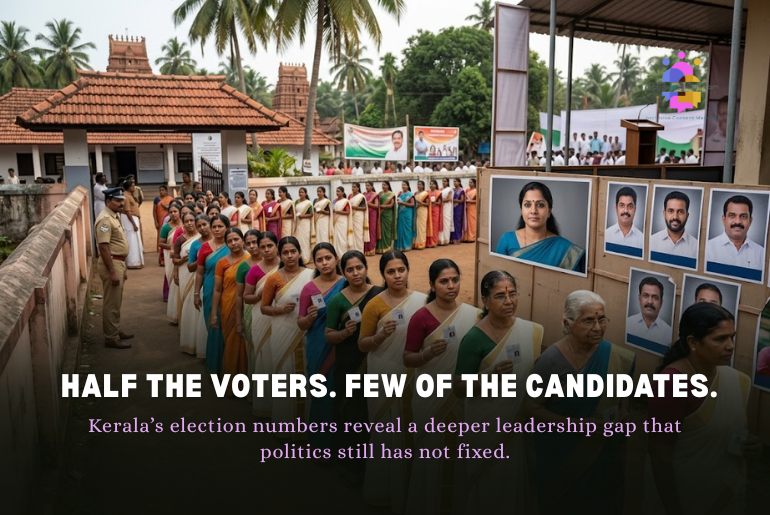
The story of women candidates in Kerala Assembly Elections begins with a contradiction that is hard to ignore. Women are not on the margins of Kerala’s democracy. They are central to it. They vote in huge numbers, shape electoral outcomes, and form a larger share of the electorate than men. But when the time comes to distribute candidacies, leadership remains strikingly male.
That gap says something deeper than one election cycle ever could: political participation is welcome, but political power is still tightly controlled.
That is why this is not only an election story. It is a leadership story. The same pattern appears in politics and organisations alike: women are counted, relied upon, and mobilised, but far less often trusted with the top role. Kerala’s latest candidate lists simply make that imbalance harder to ignore, as the numbers are so stark and the symbolism so visible.
Women candidates in Kerala Assembly Elections: 1.39 Crore women voters, but only around 40 candidates
Data from the Election Commission of India shows that Kerala has 1,39,21,868 women voters, compared to 1,32,20,811 men. Although women comprise a larger share of the electorate, their representation among candidates remains limited. Out of more than 1.39 crore women voters, only around 40 women are contesting in the upcoming Assembly elections.
Among the major parties, the Communist Party of India (Marxist) has fielded 12 women, the Indian National Congress 9, the Bharatiya Janata Party 14, and the Communist Party of India 5. First, the Indian Union Muslim League has allocated two seats to women candidates.
Breaking down party-wise representation of the women candidates in the Kerala Assembly Elections
Across alliances, both the LDF and NDA have 18 women each out of 140 candidates, which comes out to 12.85%. The UDF has 12 women out of 140, which comes to 8.57%. Taken together, the three alliances have 48 women out of 420 candidates, or 11.42%. It remains far below the 33% level often discussed in policy circles.
This gender gap has remained largely unchanged over time. Historical reporting around the 2026 election notes that women’s representation in the Kerala Assembly has never really moved far beyond the 10% range since the state’s formation, showing how persistent the imbalance remains. Moreover, since the first Kerala Assembly in 1957, only 100 women have ever been elected to the house.
Why do women candidates in Kerala Assembly Elections still face a harder political path?
Parties rely heavily on workers who go door-to-door, organise local meetings, and stay connected with voters. Fewer women tend to be present in these roles, often because of safety concerns, time constraints, family responsibilities, and social expectations. Even though this has improved compared to earlier years, the numbers are still low.
Why grassroots access still shapes who gets seen as “winnable”?
Since these grassroots roles are usually the starting point for political careers, fewer women here means fewer women move up within the party.
Student politics, campus unions, and youth wings serve as early training spaces where future leaders build confidence, networks, and public-speaking skills. If women are less present in these spaces, they miss out on opportunities that later change into bigger roles.
Why women in politics still face gendered attacks beyond electoral competition
Alongside this, women who do step forward often face a different kind of scrutiny. Instead of being questioned on policy or performance, they are targeted personally. Online abuse, public insults, and comments about their character and physical appearance are common. These attacks try to discredit women rather than engage with their political work.
Why sexist campaigning also a leadership barrier
A few days back, U Prathibha, a candidate from the Communist Party of India (Marxist) in Kayamkulam, faced misogynistic remarks during her campaign. The comments, reportedly made by Irshad Chakkalassery of the Indian Union Muslim League, stated that she was contesting the election on the basis of her “oratory skills and physical appearance.”
Such incidents show that the barriers are not only about entry into politics, but also about the conditions women face once they are there. Lower participation, limited visibility, and targeted gender attacks together create an environment where it becomes harder for women to grow in political life.
Also Read: Combating online misogyny in politics: The role of women, media, and AI.
The Changeincontent perspective
The real problem is not that women are absent from democratic life. Kerala’s numbers show the opposite. Women are present in the electorate in massive numbers. What remains missing is equal access to candidacy, visibility, and political trust. That is why this article should not be reduced to an election statistic. It is about how institutions continue to consume women’s participation while restricting women’s authority.
The pattern is familiar beyond politics, too. In many organisations, women are central to the workforce, the voting bloc, the customer base, or the day-to-day functioning of the system, yet they remain underrepresented in nominations, promotions, succession, and final decisions. Kerala’s candidate lists simply mirror that wider truth. Representation at the base does not automatically become representation at the top. Someone still has to open the gate.
If parties are serious about democracy, they cannot keep treating women as a decisive constituency but a secondary leadership choice. The same applies to organisations. Real inclusion begins when institutions stop relying on women’s participation while rationing women’s power.
The problem is not women’s interest in politics. It is who parties still choose to back.
The issue is not whether women are interested in politics, but whether they are given equal and respectful space within it. Political parties must look closely at their own processes, from grassroots involvement to candidate selection and public representation.
Without a wider base of women within party structures and consistent opportunities to grow, the numbers are unlikely to change in any meaningful way.
Disclaimer: The views expressed in this article are based on the writer’s insights, supported by data and resources available both online and offline, as applicable. Changeincontent.com is committed to promoting inclusivity across all forms of content. We broadly define inclusivity in terms of media, policies, law, and history. It encompasses all elements that influence the lives of women and marginalised individuals. Our goal is to promote understanding and advocate for comprehensive inclusivity.