
The Quick Read
- Unconditional Cash Transfers to women are direct payments given to eligible women without requiring them to complete conditions such as school attendance, clinic visits or work participation.
- The idea is to give women cash directly and trust them to decide what their household or personal life needs most.
- Evidence from cash transfer studies shows that transfers can support food security, consumption, well-being and women’s agency, though results vary by design, amount, regularity and local gender norms.
- UN Women has warned that cash transfers should not impose burdensome conditions on women and should be supported by public services and infrastructure.
- India now has several state-level women-focused cash transfer schemes, including Madhya Pradesh’s Ladli Behna, Maharashtra’s Ladki Bahin, Tamil Nadu’s Magalir Urimai Thogai, Karnataka’s Gruha Lakshmi and Jharkhand’s Maiya Samman Yojana.
- The real question is not whether cash helps. It often does. The better question is whether cash is designed with awareness, dignity, direct access, transparency and long-term empowerment in mind.
Unconditional Cash Transfers to Women (UCTs): Why this debate gets so emotional
The moment a government announces direct cash for women, the room divides.
One side says, “Finally, women are getting money in their own hands.”
The other side says, “This is just free money from taxpayers.”
Some call it empowerment, while some call it politics. One section calls it welfare, while the other calls it waste.
The debate is loud because money is never only money. Especially when it enters a woman’s bank account.
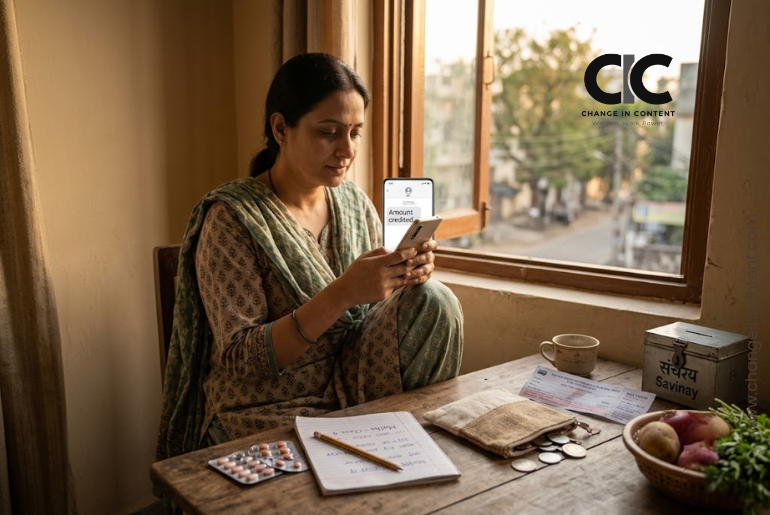
In many homes, a small amount of cash can decide whether a woman buys her own medicines, pays for a bus ride, keeps mobile data active, buys better food, pays a child’s fee, contributes to a self-help group, keeps emergency savings, or simply avoids asking someone else for every small expense.
Dependency is not always dramatic. Sometimes, it is having to ask for ₹100 and explain why.
So when we discuss Unconditional Cash Transfers to Women, we should not reduce the conversation to a “freebie or empowerment” issue. That is too lazy for a serious society.
Cash transfers are not magic. They are not a full economic strategy. They cannot replace jobs, safety, childcare, good schools, healthcare, transport or fair wages. But they can give women something many systems have denied them for generations: Money with their name on it.
What is an unconditional cash transfer (UCT)?
An unconditional cash transfer is a direct payment given to a person or household without behavioural conditions attached.
That means the recipient does not have to prove that a child attended school, that she visited a health clinic, or that she completed a monthly training programme to receive the money.
It differs from conditional cash transfers, in which payments are linked to specific actions. Many countries have used conditional transfers to achieve education, health, or nutrition goals. UCTs are simpler in design because they are based on eligibility rather than on monthly behavioural compliance.
For women, this difference matters.
A conditional scheme may ask a mother to ensure a child’s school attendance or clinic visit. That may improve outcomes, but it can also place additional unpaid responsibilities on women. UN Women has cautioned that cash transfer programmes should, where possible, avoid unnecessary conditionalities and be supported by quality public services and infrastructure.
A UCT says something different: Here is money. You decide. That trust is part of the empowerment.
The common myth: “They will waste it”
Here is the first accusation women hear.
Give women cash, and they will waste it. Give poor families cash, and they will misuse it. And give direct support, and people will stop working.
These fears are repeated so often that they start sounding like evidence.
But research on cash transfers has often challenged the lazy version of this argument. Evidence reviews show that cash transfers can improve food security, consumption, and well-being, though the scale and type of impact depend on context, transfer design, and surrounding services.
GiveDirectly’s early evidence from Kenya found that unconditional transfers improved several household outcomes, and when transfers went to female heads, psychological well-being and female empowerment were higher in the short term.
That does not mean every cash scheme works perfectly. It means the “they will waste it” argument is often more prejudiced than policy analysis.
Poor women are not careless because they are poor. They are usually experts in stretching money.
What can ₹1,000 or ₹1,500 really change?
Let us be honest. ₹1,000 a month will not buy freedom in any grand sense.
- It will not solve patriarchy.
- It will not create equal pay.
- It will not open a safe workplace.
- It will not erase domestic violence.
- It will not pay rent in most cities.
But it may still matter.
- It can buy sanitary products without asking.
- It can pay for a bus pass.
- It can keep a phone active.
- It can cover medicines.
- It can support a small savings group.
- It can help a woman contribute to the grocery bill.
- It can reduce the humiliation of having to ask for every minor need.
- It can create a small private cushion in an unpredictable home.
Power does not always enter life as a revolution. Sometimes it enters as a monthly deposit. That is why small cash transfers should be judged with a human lens, not only a spreadsheet lens.
India’s cash transfer wave is not accidental
Several Indian states now run women-focused cash transfer schemes.
Madhya Pradesh’s Ladli Behna scheme states that its objectives include women’s economic self-reliance, improved health and nutrition, and strengthening women’s role in family decision-making. Its official portal currently mentions ₹1,500 per month for eligible women through DBT-enabled bank accounts.
Maharashtra’s Ladki Bahin scheme is listed by the state’s Women and Child Development Department as a scheme introduced by the government for women’s support.
Tamil Nadu’s Kalaignar Magalir Urimai Thogai was launched as a monthly ₹1,000 assistance scheme for women, with the public broadcaster reporting that one crore women were to benefit at launch.
Karnataka’s Gruha Lakshmi scheme provides ₹2,000 in monthly assistance to women heads of household, according to a Karnataka government research report that lists the scheme among the state’s guarantees.
Jharkhand’s Maiya Samman Yojana is listed on the National Government Services Portal as providing ₹12,000 annually, paid monthly as ₹1,000, to eligible women in the Antyodaya category.
These schemes differ in amount, eligibility, documentation and delivery. They also differ politically. But they show one common shift: governments increasingly recognise women as direct economic citizens, not only as members of a household. And that is not a small shift.
For years, welfare often reached “the family”. In practice, the male head, or the household structure, controlled much of that access. Direct cash to women changes the address of the benefit.
Why giving money to women can be empowering
Cash in a woman’s account can change four things.
- First, it can improve daily choices. A woman does not have to ask for every small expense.
- Second, it can improve bargaining power. Even a modest independent income can change how a woman is heard at home.
- Third, it can improve mobility. Bus fare, mobile recharge and small savings can make it easier to search for work, attend training, visit a bank, go to a hospital or participate in local groups.
- Fourth, it can improve recognition. A woman who was seen only as dependent may begin to be seen as a financial participant.
It does not happen automatically for every woman. In some homes, men may still control the money. In others, the transfer may be absorbed into household expenses. Some women may face pressure to hand it over.
That is why design matters. The account should be in the woman’s name. The transfer should be predictable. Women should know their rights. Banks and local officials should not make access humiliating. Grievance systems should work. Middlemen should not sit between the woman and her money.
The feminist argument for UCTs is not “cash is enough”
No serious gender argument should pretend that cash transfers alone create equality. They do not.
Women need education, jobs, safety, healthcare, inheritance rights, childcare, transport, digital access, credit, property, legal support, fair wages and freedom from violence. Cash transfers should sit with these, not replace them.
UN Women’s work on social protection has repeatedly argued for gender-responsive systems that integrate income security with services and infrastructure. The World Bank has also highlighted economic inclusion programmes that combine cash transfers with skills, coaching, capital and market access as important for the poorest and most vulnerable people, particularly women.
Here is the cleanest position: Cash helps. Cash plus services help more. And cash plus jobs, safety, care support, public transport, skilling and dignity can help most.
The “freebie” argument is not completely useless
Let us not pretend critics have no point at all.
Cash transfer schemes must be fiscally responsible. They must not become election-season shortcuts with weak planning. Similarly, they must not crowd out spending on health, education, nutrition, childcare or jobs. They must have clear eligibility criteria, transparent budgets, and clean delivery systems.
Governments should explain where the money comes from, who receives it, how they prevent duplication, how appeals work, and how outcomes are measured.
There is also the risk of poor implementation.
Women may not know they are eligible. Applications may be confusing. Digital portals may fail. Bank accounts may be inactive. Aadhaar or DBT issues may block payments. Local agents may charge money to “help”. Genuine beneficiaries may be excluded during verification. Ineligible names may enter if checks are weak.
That is where welfare becomes stressful. A scheme meant to give dignity should not make women run from office to office with photocopies.
The real villains: confusion, middlemen and exclusion
If a woman is eligible, she should not need a fixer. That should be a basic rule.
The strongest cash transfer design is simple, direct, and explainable on a single local-language page.
- Who is eligible?
- What documents are needed?
- Where to apply?
- How much will come?
- When will it come?
- How to check the status?
- How to complain?
- How to appeal if removed?
The more complicated the process, the more space middlemen get.
It is especially important for women with low digital access, widows, older women, single women, migrant women, women with disabilities, women in remote areas, women without independent phones and women who do not control household documents.
A cash transfer can empower a woman only if she can access it without surrendering dignity or money to someone else.
Should UCTs go only to poor women?
This is a hard policy question. Targeting saves money. Universal or near-universal schemes reduce exclusion errors.
When schemes are tightly targeted, many deserving women may be left out because they lack documents, fail digital verification, fall just above a cut-off, or cannot navigate the application process. When schemes are broad, fiscal cost rises, and some better-off beneficiaries may receive support.
There is no perfect answer. But there is a practical lesson: Exclusion errors hurt poor women more than inclusion errors annoy policy purists.
A richer woman receiving money she does not need is inefficient. A poor woman being wrongly excluded can mean medicine missed, food reduced, debt taken, or mobility lost. It does not mean governments should ignore eligibility. It means they must design appeals and verification with care.
Do cash transfers reduce women’s desire to work?
This is another common fear. The worry is that women will stop working because they receive monthly cash. But most women-focused UCT amounts in India are too small to replace a real income.
A monthly transfer of ₹1,000 or ₹1,500 is support, not a salary.
For many women, it may actually help work. It may pay for transport to interviews. Sometimes, it may keep a phone active for job calls. It may fund a tailoring order, a beauty service kit, poultry feed, shop inventory, internet data, or a training fee. It may reduce emergency borrowing. And it may allow a woman to take a small risk.
Evidence on cash transfers and women’s employment is mixed, and impacts are stronger where gender constraints are lower. A UK Government evidence review notes that cash transfers have more meaningful impacts on women’s employment and empowerment when pre-existing gender constraints are low.
So cash alone may not pull women into the workforce if safety, childcare, norms, and job access remain weak. But cash can still be part of the bridge.
What makes UCTs gender-transformative?
A cash transfer becomes more transformative when it does more than land in an account.
Here is what good design should include.
- Money in the woman’s own account: The woman should receive the payment directly. Joint control often becomes male control in practice.
- Predictable payment dates: Irregular transfers reduce trust. Women plan better when they know when money will come.
- No middlemen: Applications, corrections and grievance redressal must be official, visible and free.
- Local-language awareness: Women should not learn about schemes through rumours, agents or political WhatsApp forwards.
- Easy appeals: If a woman is removed from a beneficiary list, she should know why and how to challenge it.
- Financial literacy: Women should understand DBT, bank accounts, savings, fraud risks and digital payments.
- Linkages to livelihood: Cash can be connected to skilling, SHGs, credit, markets, childcare and job information without turning the transfer into a burden.
- Safety from household capture: Programmes should recognise that some women may face pressure to hand over cash. Local women’s groups and helplines can help.
- Public reporting: Governments should publish beneficiary numbers, budgets, payment status, grievance data and audit findings.
- Respectful communication: Women should not be made to feel as though they are receiving charity. The language matters. This is not pity. It is social protection and economic recognition.
The Truth: Women already subsidise the economy
Before anyone asks why women should receive cash, we should ask how much unpaid work women already do. Cooking, cleaning, caregiving, elder care, child supervision, emotional labour, family health management and unpaid farm or family-enterprise work hold economies together. Yet much of it is unpaid, unseen and undercounted.
Cash transfers do not fully compensate for this labour. Not even close. But we can read them as a small public acknowledgement that women’s time and survival matter.
The danger is when governments use cash transfers to avoid deeper reforms. The promise is true when cash transfers become one part of a larger women’s economic citizenship plan.
The Change in Content view on unconditional cash transfers to women (UCTs)
Let us not casually dismiss the Unconditional Cash Transfers to women. They may not be perfect. Sometimes, these schemes are not enough. Leaders can use them for their political advantages. Their implementation can be questionable. They can create fiscal pressure if not planned well. They can fail women if awareness, access and grievance systems are weak.
But they can also matter deeply.
For a woman with no income of her own, money in her own account can change the texture of daily life. It can give her a little room, a little choice, a little confidence, a little bargaining power.
And sometimes, that little is the beginning of more.
The better debate is not “cash or empowerment”. The better debate is: How do we make cash transfers genuinely empowering?
Direct payment. Clean lists. No middlemen. Simple access. Local awareness. Financial literacy. Links to livelihoods. Strong public services. Care infrastructure. Safe workplaces. Women’s ownership of the money.
A society that trusts women with households, children, farms, food, care and survival should not suddenly distrust them with ₹1,000 in a bank account. Give women cash. Then give them roads, jobs, safety, childcare, skills, property rights and power too.
That is when a transfer becomes more than a payment. It becomes a doorway.
FAQs
Q: What are Unconditional Cash Transfers to Women?
A: Unconditional Cash Transfers to Women are direct payments made to eligible women without asking them to fulfil conditions such as attending training, sending children to school or visiting clinics every month.
Q: Are unconditional cash transfers the same as freebies?
A: They can be politically presented that way, but the idea is broader. Cash transfers are a form of social protection. When well designed, they can support women’s daily choices, financial agency, food security, mobility, and dignity.
Q: Do women misuse cash transfers?
A: Evidence does not support the blanket claim that poor women waste cash. Research reviews and cash-transfer studies show benefits for consumption, food security, well-being and agency, though outcomes vary by design and context.
Q: Can cash transfers empower women?
A: Yes, but not automatically. They are more empowering when money goes directly into women’s accounts, payments are predictable, access is simple, women know their rights, and schemes are linked to services, safety, and livelihood opportunities.
Q: What are the risks of women-focused cash transfers?
A: The risks include poor targeting, fiscal pressure, middlemen, digital exclusion, irregular payments, weak grievance systems, household capture of women’s money and governments using cash instead of investing in public services.
Editorial Note and Sources
This article uses evidence and publicly available information from UN Women, UNGEI/ODI, GiveDirectly, the World Bank and official Indian scheme sources. It interprets unconditional cash transfers through the Change in Content lens of women, work, care, dignity and economic agency. The article is intended for editorial and informational purposes only and should not be read as financial, legal, welfare, political or policy advisory guidance. Cash transfer outcomes vary by design, context, eligibility rules, fiscal capacity and local gender norms.
Sources used:
- UNGEI/ODI: Evidence briefing on the impact of cash transfers on women and girls.
- UN Women: Family-oriented cash transfers from a gender perspective.
- UN Women: Cash-based interventions and gender outcomes.
- GiveDirectly: Experimental evidence on unconditional cash transfers in Kenya.
- World Bank: Economic inclusion programmes and cash transfers.
- Madhya Pradesh Ladli Behna official portal.
- Maharashtra Women and Child Development Department scheme listing.
- National Government Services Portal: Jharkhand Maiya Samman Yojana.
- Karnataka Government research report noting the Gruha Lakshmi benefit.
- Akashvani News on Tamil Nadu Magalir Urimai Thogai launch.
