
The Quick Read
- Foundit’s May 2026 Insights Tracker says India’s white-collar hiring declined 4% year-on-year and 6% month-on-month, with the hiring index at 348, down from 361 a year earlier.
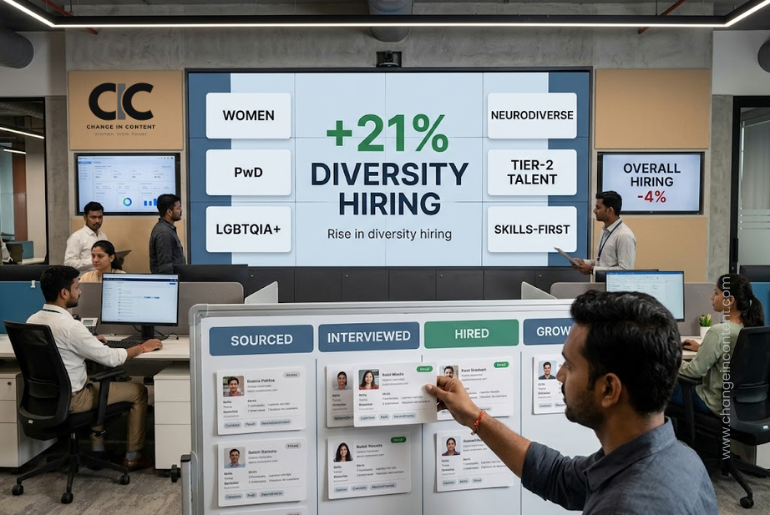
- Against that slowdown, diversity hiring grew 21% year-on-year, making it a clear outlier in the recruitment market.
- Women continue to lead diversity-focused hiring, but their share narrowed from 68% to 56% because the wider D&I hiring pool has expanded.
- Hiring under broader D&I categories, including LGBTQIA+ individuals, neurodiverse professionals and other inclusive hiring mandates, now accounts for 32% of diversity-focused hires.
- PwD hiring rose from 5% to 12%, while Bengaluru overtook Delhi-NCR as the leading city for diversity hiring.
- The message for employers is that diversity hiring must now move from intent to process, from representation to retention, and from headline numbers to real career outcomes.
At 21%, diversity hiring is rising when overall hiring is slowing
A slowdown usually makes companies cautious.
Hiring teams pause. Budgets tighten. Roles get rechecked. Backfills are questioned. “Business critical” becomes the favourite phrase in every workforce planning meeting. That is why Foundit’s latest data is interesting.
India’s white-collar hiring market softened in May 2026. Foundit’s Insights Tracker recorded a 4% year-on-year decline and a 6% month-on-month drop. Hiring was also down 10% over three months and 9% over six months, suggesting a more selective recruitment environment. Yet diversity hiring grew 21% year-on-year.
That is the story. When overall recruitment slows while diversity-focused hiring rises, it suggests that inclusion is no longer treated solely as a good-times priority. At least in some sectors and cities, companies are still spending hiring energy on building broader workforces.
It does not mean the problem is solved. It means the conversation has moved.
The sharper question now is: are companies hiring diverse talent only to report progress, or are they building workplaces where people can stay, grow and lead?
What Foundit’s report shows
Foundit describes diversity hiring as a clear outlier in May 2026. Month-on-month, diversity and inclusion hiring dipped 2%, in line with broader market softness. But the annual direction remained strong, with only two negative months across the past twelve.
The composition has also changed.
Women still account for the largest share of diversity-focused hiring. Their share, however, narrowed from 68% to 56%. Foundit notes that this is not due to a weakening in women’s hiring. It is because the diversity hiring category itself has become wider.
That widening matters.
D&I-focused hiring, covering LGBTQIA+ individuals, neurodiverse professionals and other inclusive hiring mandates, now accounts for 32% of diversity-focused hires. PwD hiring saw the sharpest proportional rise, moving from 5% to 12%, supported by accessibility investments, inclusive workplace design and ESG compliance needs.
That is a healthier reading of inclusion.
Diversity cannot be reduced to one category. Women’s hiring remains central, especially in a labour market where women’s workforce participation continues to need attention. But a serious inclusion strategy must also include disability, neurodiversity, LGBTQIA+ participation, regional access, socio-economic background and career-break returners.
Bengaluru leads, Hyderabad rises
The city data also offers clues.
Bengaluru has overtaken Delhi-NCR as the leading city for diversity hiring, with D&I hires rising from 15% to 19% of the total. Hyderabad rose from 10% to 15%, helped by its concentration of pharma, technology and BFSI employers with mature DEI mandates. Delhi-NCR declined from 21% to 17%, while Mumbai softened from 14% to 11%.
Metro cities still dominate diversity hiring. But tier-2 cities are beginning to matter. Foundit says 28% of women-focused hires now originate outside metros, while 22% of PwD roles come from tier-2 cities.
This should interest hiring leaders. If companies want more women and underrepresented talent, they cannot keep fishing in the same four-city pond. Opportunity is spreading. Talent is spreading. Hiring systems need to follow.
Change in Content’s recent analysis of the Unemployment Rate in June 2026 showed that urban women’s labour force participation remains low despite India’s broader labour-market stability. Diversity hiring data adds another layer: the jobs that open must be accessible to women across locations, not only to those already close to corporate hubs.
IT leads, but manufacturing is worth watching
Foundit says IT – Software & Services remains the largest contributor to diversity hiring, rising from 23% to 25% of the mix. Consulting and Analytics moved from 12% to 14%. Manufacturing and Automotive rose from 3% to 4%, a small share but a directionally meaningful change.
The manufacturing and automotive sectors deserve attention because they have traditionally been harder for women and underrepresented groups to enter at scale.
EV transition, smart factories, automation and modern production systems are changing the skill profile of manufacturing jobs. If companies design these roles carefully, they can create new entry points for women, PwD candidates and non-traditional talent.
That requires planning. Factory layouts, shift design, safe transport, restrooms, assistive infrastructure, manager training, anti-harassment systems and skilling pathways all matter. Diversity hiring in manufacturing cannot succeed through job postings alone.
What this means for women
For women, the Foundit data carries both promise and caution.
Promise, because women continue to be the largest group within diversity hiring. Employers are still actively hiring women, even as the broader white-collar market is cautious.
Caution, because hiring is only the doorway. A woman hired into a company still has to survive the culture, grow through the system, access visible projects, negotiate pay, handle care responsibilities, find sponsors and stay through life stages that often push women out.
That is why diversity hiring must not become a photo opportunity. The real test is what happens after joining.
- Are women promoted?
- Are they paid fairly?
- Are they moved into core business roles?
- Are returners treated seriously?
- Are mothers given strong assignments?
- Are women in smaller cities given remote or hybrid paths?
- Are women with disabilities supported beyond hiring day?
The Change in Content’s guide on Inclusive Hiring Practices in 2026 argued that fair hiring requires better job descriptions, structured interviews, skills-first screening, accountable AI, and wider sourcing. Foundit’s 21% rise in diversity hiring shows why those practices now need to become standard, not special initiatives.
What companies should do next
The 21% jump is encouraging. It should not become a comfort blanket. Companies should move from diversity hiring to inclusive workforce design. That means five shifts.
- First, measure the full funnel. Track who applies, who is shortlisted, who is interviewed, who receives offers, who joins, who leaves and who gets promoted.
- Second, widen sourcing. Women’s colleges, tier-2 talent pools, PwD networks, returnship communities, LGBTQIA+ groups, neurodiverse talent platforms, and skills-based networks should become part of regular hiring practices.
- Third, audit job design. Some roles exclude candidates through unnecessary travel, rigid hours, poor accessibility, vague flexibility, degree filters or unsafe commute expectations.
- Fourth, train managers. Diverse hiring fails when managers are unprepared to lead diverse teams.
- Fifth, connect hiring to growth. Representation at the entry level means little if leadership remains unchanged.
The change in content this conversation deserves is also clear. Companies should stop talking about diversity as a favour to underrepresented groups. They should speak about it in terms of talent strategy, market intelligence, workplace quality, and future readiness.
Diversity hiring jumps at 21%: The Change in Content View
Foundit’s 21% increase in diversity hiring is good news, especially given the hiring slowdown. It suggests that some employers are not abandoning inclusion when recruitment becomes selective. They are making it part of the selective hiring process.
But a strong year-on-year number is only the beginning. Diversity hiring must lead to fair pay, retention, promotion, accessibility, psychological safety and leadership pipelines. Women must not be hired into roles with no growth. PwD candidates must not be hired without workplace support. LGBTQIA+ and neurodiverse professionals must not be counted without being included.
The data shows movement. Now companies must show depth.
India does not need diversity hiring that looks good in a report and disappears inside the organisation. It needs hiring systems that widen opportunity and workplaces that make that opportunity worth staying for.
FAQs
Q: What did Foundit report about diversity hiring?
A: Foundit’s May 2026 Insights Tracker reported that diversity hiring grew 21% year-on-year, even as India’s overall white-collar hiring declined 4% year-on-year and 6% month-on-month.
Q: Why is the 21% rise in diversity hiring important?
A: The rise is important because it came during a broader hiring slowdown. It suggests that some employers continue to prioritise inclusive hiring even when overall recruitment is cautious.
Q: Are women still leading diversity hiring?
A: Yes. Women continue to lead diversity-focused hiring, but their share narrowed from 68% to 56% as the overall diversity hiring pool expanded to include additional D&I and PwD categories.
Q: Which cities are leading diversity hiring?
A: Bengaluru has overtaken Delhi-NCR as the leading diversity hiring city, rising from 15% to 19% of total D&I hires. Hyderabad also rose strongly, from 10% to 15%.
Q: What should companies do after hiring diverse talent?
A: Companies should focus on retention, fair pay, promotion, manager training, accessibility, safe workplaces, flexible work and leadership pathways. Hiring is only the first step.
Editorial Note and Sources
This article is based on Foundit’s May 2026 Insights Tracker and interprets the findings through the Change in Content lens of women, work, inclusion and labour-market access. We have written for editorial and informational purposes only and should not be read as HR, legal, investment, recruitment or workplace advisory guidance. Diversity hiring categories and definitions may vary across organisations and datasets.
Source used: Foundit: India’s Hiring Landscape in May 2026: Foundit Insights Tracker
