The Quick Read
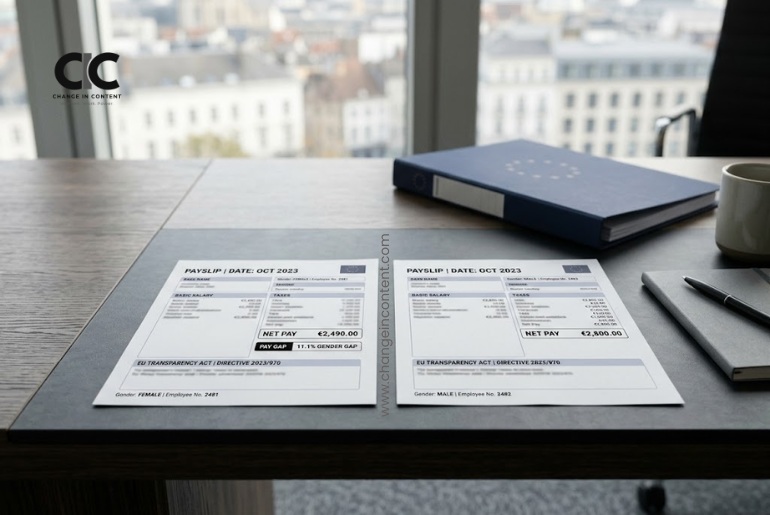
- The EU Gender Pay Gap stood at 11.1% in 2024, according to Eurostat’s unadjusted gender pay gap data. It means women’s gross hourly earnings were, on average, 11.1% lower than men’s.
- The gap varies widely across countries. Estonia recorded the highest gap at 18.8%, while Luxembourg recorded -0.8%, meaning women’s average hourly earnings were slightly higher than men’s there.
- The gap is not only about monthly pay. Eurostat data show that the EU gender pension gap was 24.9% in 2024, leaving women aged 65 or over with pensions about one-quarter lower than men’s.
- New EU pay transparency rules require employers to provide salary information, publish gender pay gap data for larger companies, and take action when an unjustified gap of at least 5% is found.
- For businesses, this is a governance issue. Pay secrecy weakens trust, damages employer credibility and keeps women from negotiating with equal information.
The EU Gender Pay Gap is a number, but it is also a system
The EU Gender Pay Gap is now 11.1%. At first glance, that may sound like progress. It is lower than it used to be. It is also lower than the gaps seen in many other parts of the world.
But 11.1% is still a large amount of money to lose because of gender.
That is not a small rounding error in payroll. It is lost rent, lost savings, lost investment, lost pension wealth, lost financial confidence and lost bargaining power. When women are paid less across years and decades, the damage compounds quietly.
That is why the phrase “economic violence” does not feel excessive. It captures the way unequal pay limits women’s choices. It decides how much risk they can take. At the same time, it affects whether they can leave unsafe homes, negotiate care, build assets, retire securely or recover from career breaks.
Eurostat defines the unadjusted gender pay gap as the difference between the average gross hourly earnings of male and female employees, expressed as a percentage of men’s average gross hourly earnings. In 2024, women’s gross hourly earnings in the EU were 11.1% lower than men’s on average.
That is the headline. The deeper story is about what sits behind it.
The gap has narrowed, but slowly
The EU has been working on equal pay for decades. The right to equal pay between women and men for equal work or work of equal value has been a founding principle of the European Union since the Treaty of Rome in 1957. Yet the gap remains.
The 2024 figure shows movement, but not resolution. Across EU countries, the gender pay gap ranged from -0.8% in Luxembourg to 18.8% in Estonia.
This variation tells us something important. The gap is not inevitable. It varies across labour markets, sectors, pay structures, care policies, transparency, public-sector wage grids, and the representation of women in higher-paying roles.
In other words, pay gaps are shaped. They are not natural.
That is where businesses should pay attention. Pay inequality does not always manifest as a single dramatic act of discrimination. Often, it builds through job segregation, opaque salary bands, weaker promotion pathways, career interruptions, part-time penalties, motherhood penalties and lower access to high-paying leadership tracks.
A previous Change in Content article on the gender wealth gap in India examined how income gaps translate into asset gaps over time. The EU data shows the same pattern in a different setting. What begins as a wage gap does not stay inside a payslip.
Pay secrecy is where inequality survives
One reason the gender pay gap continues is simple. Too many workers do not know what others earn. That lack of information hurts women more.
- If a woman does not know the pay range for a role, she enters negotiation with less power.
- If an employer asks about salary history, old underpayment can follow her into a new job.
- If pay criteria are unclear, managers can hide bias behind words such as “fit”, “potential”, “market correction” or “performance discretion”.
That is why the EU Pay Transparency Directive is significant.
The European Commission explains that the new rules require employers to inform job seekers of the starting salary or pay range in the vacancy notice or before the interview. Employers will no longer be allowed to ask candidates about their pay history. Employees will also be able to request information on their individual pay level and average pay levels, broken down by sex, for workers doing the same work or work of equal value.
For companies with at least 100 employees, employers must publish information on the pay gap between female and male workers. If reporting shows a gender pay gap of at least 5% that cannot be justified, employers must carry out a pay assessment.
It is not symbolic reform. It changes the information balance.
For years, women have been told to negotiate better. The more honest question is whether workplaces have allowed women to negotiate with the same information men often access through networks, informal conversations and legacy advantage.
The new rules begin to challenge that imbalance.
The pension gap shows the real cost
The pay gap is painful in the present. The pension gap shows what happens later.
Women aged 65 or over in the EU received pensions about one-quarter lower than men’s. The gender pension median gap stood at 24.9%. The widest gaps were in Luxembourg, Spain, the Netherlands and Austria, where women’s pensions were around 40% lower than men’s. That is why we cannot treat equal pay as an annual HR topic.
Lower earnings affect contributions. Career breaks affect pensions. Part-time work affects savings. Lower promotion rates affect lifetime income. Care work reduces paid work. The cycle continues.
For women, the result can be a quieter old-age insecurity. A woman may work for decades and still retire with less. That is not only unfair. It is economically inefficient and socially dangerous.
A useful literature here is the statement by Claudia Goldin on greedy jobs, because it explains how work structures that reward extreme availability can deepen gender inequality. Pay gaps are often linked to the way jobs are designed, not only the way salaries are negotiated.
The private sector has a harder question to answer
The gender pay gap tends to be higher in the private sector than in the public sector. One possible reason is that public sector pay is often determined by transparent wage grids that apply equally to men and women. That should make private employers uncomfortable.
Many companies speak the language of merit. But merit is difficult to prove when pay bands are hidden, promotion criteria are vague, and salary corrections happen only for those who ask loudly enough.
Private companies should not wait for enforcement anxiety to begin this work. They should treat pay transparency as a talent and trust strategy.
A serious employer should be able to answer basic questions.
- Are women and men paid equally for the same work or work of equal value?
- Are women concentrated in lower-paid departments?
- Are mothers penalised in progression?
- Are bonuses distributed fairly?
- Are salary offers based on role value or past salary?
- Are managers trained to make pay decisions without bias?
If the answer is unclear, the company has a problem.
What this means for women at work
For women, pay transparency can be powerful. But it will not remove every barrier.
Women still need to ask direct questions before accepting roles.
- What is the salary range?
- How are increments decided?
- Is bonus eligibility clear?
- What does promotion require?
- Is the organisation reporting gender pay data?
- Are pay audits conducted?
Women should also document value. Revenue influenced. Teams managed. Clients retained. Costs saved. Systems improved. Risks handled. Work done beyond the job description. These details matter in salary conversations.
But the larger burden cannot sit on women. Women did not create opaque pay systems. They should not be asked to fix them alone through personal confidence, negotiation coaching or resilience training.
That is the trap. It turns a structural issue into a personality project.
What companies should do now?
The EU rules provide a strong direction, but companies should go beyond minimum compliance.
- Start with pay audits. Look at gender gaps by role, level, department, location, employment type and bonus category. One headline percentage will hide too much.
- Next, publish salary ranges. It reduces guesswork and keeps managers honest.
- Then remove salary history questions everywhere, even where the law does not yet require them. Past underpayment should not become the baseline for future pay.
- Companies should also review promotions and bonuses. Pay inequality often grows through variable pay, access to leadership, and discretionary rewards.
- Finally, train managers. Pay fairness is not only a legal issue handled by HR. It is shaped in everyday decisions made by line managers.
That is where the EU’s 5% trigger is useful. If a company cannot justify a pay gap using objective, gender-neutral criteria, it should be required to act.
The Change in Content View on the EU Gender Pay Gap
The EU Gender Pay Gap is 11.1%. That number is lower than before, but it is still a serious failure.
Equal pay has been a legal principle for decades. The gap survives because law alone cannot fix opacity, occupational sorting, care penalties, biased promotion systems and weak accountability.
Pay transparency is a good start because it takes inequality out of the shadows. But transparency must lead to correction. Otherwise, companies will simply become better at displaying unfairness.
For women, the issue is not only what they earn today. It is what they lose over a lifetime. And for businesses, the message is clear. A workplace that cannot explain its pay decisions should not be surprised when women stop trusting its promises.
FAQs
Q: What is the EU Gender Pay Gap?
A: The EU Gender Pay Gap is the difference between the average gross hourly earnings of male and female employees, expressed as a percentage of men’s average gross hourly earnings. In 2024, the average unadjusted gender pay gap in the EU was 11.1%.
Q: Why is the EU Gender Pay Gap still a problem if it has reduced?
A: It remains a problem because 11.1% still represents a real loss of income for women. Over time, lower pay affects savings, pensions, housing, financial security and bargaining power. A smaller gap is progress, but it is not equality.
Q: Which EU country has the highest gender pay gap?
A: In 2024, Estonia recorded the highest unadjusted gender pay gap in the EU at 18.8%. Luxembourg recorded the lowest figure at -0.8%, meaning women’s average gross hourly earnings were slightly higher than men’s there.
Q: How does the gender pay gap affect pensions?
A: Lower pay over a working life can reduce pension contributions and retirement income. In 2024, the EU gender pension median gap stood at 24.9%, meaning women aged 65 or over received pensions about one quarter lower than men’s.
Q: What will the EU Pay Transparency Directive change?
A: The directive requires employers to give salary information to job seekers, stop asking candidates about pay history, provide workers with pay-level information on request, publish gender pay gap data for larger employers, and conduct pay assessments where unjustified gaps of at least 5% appear.
Q: What should employers do to close the pay gap?
A: Employers should conduct gender pay audits, publish salary ranges, remove salary history questions, review bonus and promotion systems, train managers, and correct unjustified pay gaps quickly. Pay transparency only works when it is followed by action.
Editorial Note and Sources
This article is based on official data and policy information from Eurostat, the European Commission and the Council of the European Union. It interprets the EU Gender Pay Gap through the lens of women, work and economic power. The phrase “economic violence” is used as an editorial framing to describe the long-term financial harm caused by persistent unequal pay. This article is for informational and editorial purposes only and should not be read as legal, employment, financial or compliance advice.
Sources used:
- Eurostat: Gender pay gap statistics
- European Commission: New EU rules on pay transparency explained
- Council of the European Union: Pay transparency in the EU
- Eurostat: Women in the EU