
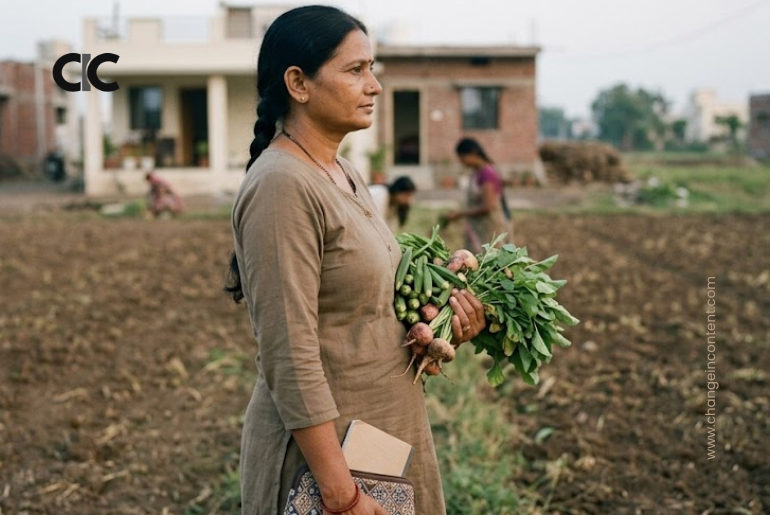
The Short Read
- ICRIER’s India Jobs & Occupational Tracker says the share of women in agricultural employment rose from 27% in 2017-18 to 44% in 2025. Nearly 75% of new rural female workers entered agriculture during this period.
- The same ICRIER bulletin says women have absorbed much of the work vacated by male out-migrants, largely as unpaid family labour.
- ICRIER’s policy brief on women’s work says more women are now in self-employment, and links this shift to women working as unpaid family labourers on agricultural farms.
- PLFS classifies self-employment to include helpers in household enterprises, meaning women working on family farms or in other household enterprises can be counted as employed even without a separate wage.
- The sharper question is: Are more women working, or are more women being counted while still unpaid?
Women in agricultural employment are changing India’s jobs data
The rise of women in agricultural employment is one of the most important details in India’s recent labour market story. It tells us that more women are entering the official count of work. It also asks us to slow down before celebrating the numbers too quickly.
ICRIER’s latest India Jobs & Occupational Tracker, which tracks labour market trends from Q2 2018 to Q4 2025 using PLFS data, says rural India saw a sharp rise in labour force participation. Women made up 73% of the people added to the rural labour force over the period.
The same report gives the data point that deserves the most attention: women’s share in agricultural employment rose from 27% in 2017-18 to 44% in 2025. Nearly three in four new rural female workers entered agriculture.
That sounds like a breakthrough until we look at the nature of the work.
ICRIER says agriculture presents a more complicated picture because women have absorbed much of the work vacated by male out-migrants, largely as unpaid family labour. The report describes this rise as less a sign of improved economic opportunity and more a sign of substitution within rural households.
In simple terms, more women are working on paper. Many may still not be earning in their own name.
What counts as work in the data?
That is where labour statistics and lived reality can diverge.
ICRIER’s policy brief, The States’ Narrative on Women’s Work in India, explains that PLFS records employment in three broad categories: self-employment, casual labour and regular salaried work. It further divides self-employment into own-account workers, employers and helpers in household enterprises. That last category is important.
A woman helping on the family farm can be counted as employed even if she does not receive a separate wage. Her labour is real. The classification is technically valid. The problem begins when public discourse treats every rise in employment as proof of greater economic independence.
A woman can be counted as employed and still lack:
- her own wage
- social security
- formal recognition as a farmer
- access to credit in her name
- control over the income generated by the household farm
- bargaining power inside the family economy
That is why the latest rise in women’s work should be read with more care. Unpaid employment can make the numbers look stronger, while women’s financial position remains fragile.
Why has agriculture absorbed so many women?
Agriculture can absorb labour quickly because it is close to home, tied to family survival, and often outside formal recruitment systems. When men migrate for construction, transport, trade, or other non-farm work, women may take on more agricultural responsibilities.
ICRIER’s bulletin says male agricultural employment remained stagnant, while construction absorbed nearly 40% of new rural male workers. For women, agriculture absorbed most new rural entrants.
That split says a lot about opportunity.
Men are moving into sectors with cash wages and visible demand. Women are moving into family-linked agricultural work, where the line between household duty and economic labour often disappears.
It does not reduce the dignity of farming. Rural women have always worked hard in agriculture, often with deep knowledge of seeds, livestock, harvesting, storage, water, fodder and food systems. The issue is recognition. When the work supports the household but does not generate a separate wage for the woman, it rarely builds financial agency.
A woman may work all day and still be described at home as “helping”.
The self-employment number needs a closer reading
Self-employment sounds positive in public debate. It can suggest enterprise, flexibility and independence. For some women, that is true. Many women do run shops, farms, food businesses, home enterprises, tailoring units, digital services and local trade with skill and ambition. But self-employment also contains a much weaker reality: unpaid helpers in household enterprises.
ICRIER’s policy brief says women have moved from regular salaried and casual work towards self-employment, while men’s occupational choices showed no similar change. It also says the decline in the gender gap in self-employment is linked to women’s rising contribution as unpaid family labourers in agricultural farms.
That means the same category can hold two very different stories.
One woman may be running a growing business. Another may be working on a family farm without direct pay. Both may appear under a broad self-employment umbrella. The data needs unpacking before it becomes a success headline.
It connects directly with our earlier piece on unpaid family work and self-employment among women in India, where we examined how rising self-employment can mask a large share of women’s unpaid labour.
Are more women working, or are more women being counted while still unpaid?
That is the central question.
The rise in women’s employment is real. No serious reading should dismiss it. More women entering the labour force can reflect changing household needs, greater recognition of work, improved survey capture, rural economic stress, post-pandemic shifts, and women’s own efforts to remain economically active. But the progress becomes thinner when large numbers are concentrated in unpaid or low-paid work.
- A woman counted as employed may still have no cash in hand.
- She may not decide how farm income is spent.
- She may not own land.
- She may not have access to crop loans, insurance or agricultural extension services.
- Institutions may not see her as a farmer, even though she performs farm work every day.
That is why the public conversation needs to move beyond one number. The better measure of progress would ask:
| What we should ask | Why does it change the story |
| Is the woman paid separately? | Employment without income limits financial independence |
| Does she control any earnings? | Income in the household is not always income in her hands |
| Is the work regular or seasonal? | Irregular work gives weak security |
| Is she recognised as a farmer or worker? | Recognition affects credit, schemes and benefits |
| Does the work build future earning power? | Some work keeps women busy without improving mobility |
| Does she have access to social protection? | Unpaid family workers often remain outside safety nets |
This is where India’s jobs debate must become more honest.
The unemployment story has a similar blind spot
A related issue appears in unemployment data, too.
ICRIER’s I-JOT bulletin says unemployment rates declined across rural and urban India over the long term, but the pattern differed by gender. For men, the decline was accompanied by a fall in the absolute number of unemployed people. For women, the number of unemployed people increased, but employment growth rose faster, so the unemployment rate still declined.
That is exactly why we need to read headline indicators carefully.
In our piece on the Global Unemployment Gender Gap, we explored how unemployment data counts people actively looking for work. Women who are outside that search because of caregiving, safety concerns, family pressure, or discouragement may never show up in the unemployment rate.
Here, the gap works differently. Women do show up in employment numbers, but many may be in unpaid family work. One indicator can hide exclusion before the job search. Another can hide unpaid labour after entry into work.
Both lead to the same warning: women’s work data needs more than a headline reading.
Unpaid care keeps the picture even more uneven
Women’s unpaid labour does not stop at the farm.
ICRIER’s care economy brief says women in India spend, on average, 30% of the day in unpaid care work, leaving less time for paid labour. It also argues for a stronger care infrastructure to support women’s participation in the workforce.
So a rural woman may be doing three kinds of work in the same day:
- farm work
- household enterprise work
- domestic and care work
Only some of it may be counted. Even less may be paid.
Our earlier article on the cost of unpaid work made this point clearly: unpaid labour is not outside the economy. It supports the economy while keeping women’s time, bodies and ambitions under pressure.
The ICRIER data brings that concern back into the labour market debate. Women are entering the work count, but the economy still needs to answer whether it is paying them fairly for the work they already do.
What should change in the way we talk about women’s work?
Here is the change in content this conversation deserves:
The first change is language.
A breakdown of job type should follow every rise in women’s labour force participation. Public reports, newsrooms and policy conversations should separate regular salaried work, casual wage work, own-account work, paid self-employment and unpaid family work.
The second change is recognition.
Women working on farms need stronger identification as farmers and agricultural workers. Land titles, tenancy records, credit systems, insurance, procurement access and extension services often pass through male ownership. That leaves women doing work without the institutional power that should come with it.
The third change is pathways out of unpaid work.
Rural women need more routes into paid non-farm employment, local manufacturing, services, food processing, care jobs, digital work, producer enterprises and formalised rural businesses. Skill training also needs to improve. ICRIER’s policy brief notes that only 18.6% of women in the labour force had received any formal training, compared with 36.1% of men.
The fourth change is care infrastructure.
Women cannot move into better-paid work if unpaid care continues to consume their time. Childcare, eldercare, safe transport, local work hubs and flexible skilling options can make a practical difference.
The fifth change is measurement.
India should continue to count unpaid family workers because their labour is real. But the data should be communicated in a way that prevents confusion between “employed” and “earning”.
The Change in Content View
Women in agricultural employment are doing work that keeps households, farms and rural economies moving. Their labour deserves visibility. It also deserves payment, recognition and a path to stronger economic agency.
The recent rise in women’s employment should be welcomed with care. It shows that more women are entering the labour force and that rural women’s work is being captured more visibly. But a count is not the same as a pay cheque. A workday is not the same as financial independence.
India’s next jobs conversation should be brave enough to hold both truths together.
More women are working. Many are still unpaid. That is where the policy challenge begins.
FAQs
Q: What does “women in agricultural employment” mean?
A: Women in Agricultural Employment refers to women counted as working in agriculture, including farming, livestock and related rural work. In India, this can include paid workers, self-employed workers, and women helping on family farms or in household enterprises.
Q: What did ICRIER find about women in agricultural employment?
A: ICRIER’s India Jobs & Occupational Tracker says women’s share in agricultural employment rose from 27% in 2017-18 to 44% in 2025. Nearly 75% of new rural female workers entered agriculture during this period.
Q: Why is this rise being viewed carefully?
A: The rise is important, but ICRIER says much of the increase reflects women absorbing work vacated by male out-migrants, largely as unpaid family labour. That means more women are being counted as employed, while many may still lack direct pay.
Q: Does unpaid family work count as employment?
A: Yes, it can. ICRIER’s explanation of PLFS categories shows that self-employment includes helpers in household enterprises. A woman helping on a family farm or household enterprise can therefore be counted as employed even without a separate wage.
Q: What should be tracked along with women’s employment numbers?
A: India should track whether women are in regular salaried work, casual wage work, paid self-employment or unpaid family work. Pay, income control, land ownership, social protection, training and care responsibilities should also be included in the wider picture.
Editorial Note and Sources
This DEI Insights article by Change in Content is an editorial analysis based on publicly available ICRIER research and official labour data. The main source is ICRIER’s India Jobs & Occupational Tracker (I-JOT) #5, which reports the rise in women’s agricultural employment from 27% in 2017-18 to 44% in 2025 and notes the role of unpaid family labour.
The article also uses ICRIER’s The States’ Narrative on Women’s Work in India for PLFS-based interpretation of women’s self-employment and unpaid family labour, and ICRIER’s care economy brief for context on unpaid care work. Since the 2025 PLFS uses a revised sampling design, comparisons across years should be read with methodological caution. The article’s interpretation focuses on job quality, income and women’s economic agency.
Sources used:
- ICRIER, India Jobs & Occupational Tracker (I-JOT) #5.
- ICRIER, The States’ Narrative on Women’s Work in India.
- ICRIER, The Care Economy: A case for expanding the role of the private sector.
- PIB/Ministry of Statistics & Programme Implementation, Periodic Labour Force Survey Annual Report 2025.
