
The Short Read
- Official labour data shows that a large share of Indian women workers are moving from unpaid family work to self-employment.
- PLFS 2025 shows that 55.2% of rural and urban women workers were self-employed in their current weekly status.
- Within that, 39.7% were own-account workers or employers, while 14.3% were helpers in household enterprises.
- This suggests a possible shift worth watching: women may be moving from unpaid family work towards more visible forms of self-employment.
- The shift is promising because it can strengthen women’s identities as earners, producers, and micro-entrepreneurs.
- The caution is equally important: self-employment can be empowering, but it can also mask low income, irregular work, and ongoing caregiving burdens.
- India needs better credit, markets, childcare, digital access, social security and bargaining power to turn this shift into real inclusion.
The woman who was always working
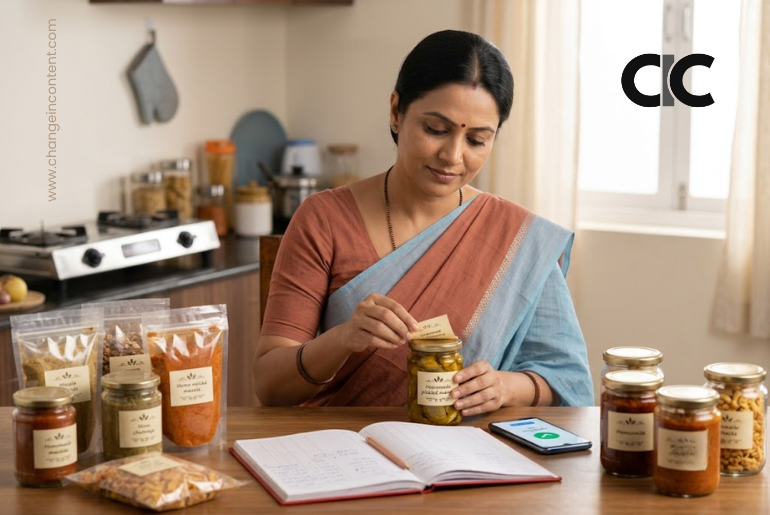
In a small town outside Indore, Meera spent years working in the family’s snack business.
- She roasted, packed, labelled and sorted orders.
- She answered customers when her husband was away.
- She knew which neighbourhood shop paid late and which school canteen ordered before festivals.
- She even changed the masala mix after noticing what children preferred.
But whenever someone asked what she did, the answer was usually the same. “She helps at home.” That word, “helps”, has swallowed millions of women’s working lives. It has turned skill into duty. Moreover, it has turned labour into a family contribution. And it has kept women close to the enterprise without giving them the identity of enterprise owners.
Now imagine a small but important change.
Meera opens a separate bank account for her orders. She registers a home food brand on a local delivery platform. Her name goes on the packaging. She joins a women’s Self-Help Group to access credit. Now, she starts tracking costs. And she begins selling directly instead of only supporting the family business.
The work may still happen from the same kitchen table. But the meaning changes.
That is the story India should be watching: the movement from Unpaid Family Work into Self-Employment among women. It may look quiet from a distance. It could carry serious economic meaning.
From unpaid family work to self-employment: What the data is showing
India’s labour data have indicated a rise in women’s labour force participation, particularly in self-employment.
The latest PLFS 2025 data show that among rural and urban women workers in their current weekly status, 55.2% were self-employed. Within this group, 39.7% were own-account workers or employers, while 14.3% were helpers in household enterprises. That’s an important split.
- A helper in a household enterprise often works in a family-run farm, shop, unit or informal business without direct pay or independent control.
- An own-account worker runs or operates work more independently, often without hiring regular employees.
Both fall under self-employment in labour statistics, but the lived reality can be very different.
The interesting signal is the possibility that some women may be moving from the “helper” column towards the “own-account” column. That is where the story becomes bigger than employment data.
A woman who moves from unpaid family labour to self-employment may gain a clearer economic identity. She may start earning directly. She may access a bank account, digital payments, customers, credit, markets and bargaining power. But the shift needs careful reading.
Self-employment is not automatically empowerment. It can be a step forward, a survival route, a compromise, or all three at once.
Why this shift feels important
For decades, women’s work in India has been hidden inside the home, farm, family shop, kitchen, tailoring corner, food unit, dairy activity, household enterprise or unpaid care system. They have produced value without always being counted as workers in the way the economy recognises value. That is why this shift matters.
When a woman moves from unpaid family work to self-employment, several things can change.
- Her work becomes easier to name.
- Her income becomes easier to track.
- Her contribution becomes harder to dismiss.
- Her bargaining position inside the household can improve.
- Her access to schemes, loans, markets and networks can increase.
This connects directly to the broader conversation about the cost of unpaid work. The issue is not that women were not working earlier. The issue is that much of their work was absorbed into family duty and treated as economically weightless.
Self-employment can begin to correct that invisibility.
The promise: A new kind of inclusion
This shift could matter for India’s economy in three ways.
- First, it can bring more women into visible economic activity. When women begin selling, producing, trading or offering services in their own name, the economy gains more recognised participants.
- Second, it can strengthen local enterprises. Women already know many small markets closely: food, tailoring, beauty, tuition, childcare, agriculture, crafts, packaging, retail, home services, digital work, community commerce and health-linked services. With the right support, these can become income-generating businesses.
- Third, it can change how families think about women’s work. Income that comes directly to a woman can alter household decisions around education, health, savings, consumption and mobility.
That is why self-employment can become a serious inclusion story. It gives women a route into work where formal jobs may be limited, travel may be difficult, care duties may be heavy, and local economies may be more accessible than corporate offices.
For women who have been away from formal workplaces, self-employment can become a re-entry route. For women in small towns, it can create income without migration. For women in rural areas, it can turn existing skills into an enterprise.
But that promise depends on whether the work grows beyond subsistence.
The gap: Self-employment can also hide fragility
There is a danger in celebrating the shift too quickly. A woman may be self-employed and still earn very little.
- She may own the activity but lack capital.
- She may work long hours without social security.
- She may depend on family permission, local contractors, low-margin orders or unstable demand.
- She may use her home as a workplace while still doing domestic work.
In many cases, self-employment is flexible because women have no other option.
- A formal job may require travel. A factory shift may clash with childcare.
- A salaried role may not exist nearby.
- A family may prefer that she “do something from home”.
- A small home-based enterprise is then acceptable because it does not significantly disrupt the household structure.
That makes self-employment both useful and limited. It can provide women with income while still keeping them tied to the same unpaid responsibilities.
The Time Use Survey 2024 shows the importance of this matter. Women continue to spend far more time than men on unpaid domestic and caregiving activities. That means a woman running a small business from home is often not replacing unpaid work with paid work. She may be adding paid work on top of unpaid work.
That is where the story becomes complicated. India may see more women working, but many may still be time-poor, underpaid and unsupported.
The danger of calling survival entrepreneurship
There is a phrase that often makes small women-led work sound glamorous: entrepreneurship. Sometimes it is accurate.
A woman who builds a product, finds customers, manages costs, reinvests profit and grows a business is an entrepreneur.
But many women are pushed into self-employment because regular jobs are unavailable or unsuitable. They sell snacks, sew clothes, do beauty work, pack goods, tutor children, help on farms, run small shops or take orders from contractors because the labour market has not offered better options.
Calling all of this entrepreneurship can hide the structural problem. The question should be:
- Does her self-employment bring control?
- Does she set prices?
- Does she decide where to sell?
- Does she keep the income?
- Does she access credit in her own name?
- Does she have digital tools?
- Does she have time to scale?
- Does she have Social Security?
- Does she have the power to say no to bad rates?
Without these, self-employment can become informal work with a nicer name.
Why this shift still deserves attention
Even with the gaps, this movement should not be dismissed. Women’s economic lives often change in stages.
- First, the work is invisible.
- Then, it becomes “help”.
- Then, it becomes income.
- Then, it becomes a business.
- Then, if support arrives, it becomes power.
The move from unpaid family work to self-employment may be one of those middle stages. It may not yet be the destination, but it can be an opening. A woman who earns through her own activity may start joining networks.
- She may open a digital payment account.
- She may learn pricing.
- She may ask for a loan.
- She may hire another woman.
- She may register a unit.
- She may join a Self-Help Group.
- She may move from local customers to online orders.
Small shifts can become large when millions of women move. That is the economic opportunity India should not miss.
What would make the shift more powerful?
The first need is credit that women can actually use. Many women need small working capital, not intimidating loan processes. Credit should come with business guidance, repayment flexibility and market linkage.
The second need is market access. Women do not only need to produce. They need buyers, platforms, local retail routes, packaging support, pricing help, digital catalogues and fair supply-chain contracts.
The third need is childcare. Without childcare, women’s businesses remain trapped inside school timings, meal timings and care emergencies.
The fourth need is digital confidence. Digital payments, WhatsApp orders, UPI, e-commerce, bookkeeping apps and social media selling can help women scale, but only when training is practical and language-friendly.
The fifth need is social security. Self-employed women need health insurance, access to pensions, maternity support, and protection against sudden shocks.
The sixth need is recognition. Household enterprises should properly record women’s contributions. If a woman works in the business, her role should not be overshadowed by the male owner’s name.
The seventh need is time. Families must redistribute unpaid work. Otherwise, women’s self-employment will grow in exhaustion.
That is where the story connects with quiet quitting among women in India. Women do not disengage because they lack ambition. Many disengage because the structure around work does not support their lives. Self-employment may offer flexibility, but that flexibility without support can still lead to fatigue.
Unpaid family work to self-employment: The business lesson
Companies should also pay attention to this trend. Many women who begin as self-employed workers can become suppliers, service providers, local distributors, creators, franchise operators, fulfilment partners and micro-enterprise owners.
Businesses that want inclusive growth can build women-led vendor networks, source from women producers, train women micro-entrepreneurs, include them in digital commerce and offer fair payment cycles.
That is not charity. It is market development.
Women-led micro-enterprises can strengthen local economies, deepen consumer access and create more resilient supply chains.
The link between female workforce participation and corporate productivity becomes clear here. When more women participate meaningfully in economic activity, businesses gain workers, entrepreneurs, customers, suppliers and decision-makers. The economy becomes broader.
Change in Content View
The movement from unpaid family work to self-employment could be one of the most interesting labour shifts in India. It tells us that women are not waiting for perfect workplaces to recognise them. Many are finding work through their own skills, homes, farms, networks, phones, kitchens, sewing machines, shops, SHGs and local markets.
That is powerful. But it is also incomplete.
India should not celebrate the rise in women’s self-employment without asking whether women are earning enough, controlling their income, accessing markets, building assets, and reducing unpaid work.
A woman moving from helper to self-employed worker should gain more than a new category in a labour table.
- She should gain money in her hand.
- Time she can control.
- Credit in her name.
- Customers she can reach.
- A business identity that the household respects.
- Protection when income falls.
- A path to grow.
That is when this shift becomes transformative. The future of inclusion may not arrive only through formal offices and salaried jobs. It may also arrive through millions of women turning invisible labour into a visible enterprise.
The task now is to make sure they are not doing it alone.
FAQs
Q: What does the shift from unpaid family work to self-employment mean?
A: The shift means more women may be moving from unpaid or low-recognition work inside family enterprises towards work where they are counted as own-account workers, micro-entrepreneurs or independent earners. It can make women’s labour more visible, but the quality of income and control still matters.
Q: Why is unpaid family work a concern for women?
A: Unpaid family work often means a woman contributes labour to a farm, shop, household business or family enterprise without direct pay, ownership or decision-making power. Her work supports income generation, but her contribution may not translate into financial independence.
Q: Is self-employment always good for women?
A: Self-employment can be good when it gives women income, control, customers, credit access and growth. It can be weak when it is low-paid, irregular, informal, home-bound and added on top of unpaid domestic and care work.
Q: What does PLFS data show about women’s self-employment?
A: PLFS 2025 shows that 55.2% of rural+urban women workers were self-employed in their current weekly status. Within this, 39.7% were own-account workers or employers, and 14.3% were helpers in household enterprises.
Q: What support do self-employed women need?
A: Self-employed women need access to credit, digital tools, markets, fair pricing, childcare, social security, business training, transport and recognition within family enterprises. Without these, self-employment may remain fragile.
Q: How can companies support women moving into self-employment?
A: Companies can build women-led supplier networks, source from women producers, offer training, ensure timely payments, support digital selling and include women micro-entrepreneurs in local distribution, fulfilment and service ecosystems.
Editorial Note and Sources
This article is based on official labour and time-use data, including the Periodic Labour Force Survey 2025 and Time Use Survey 2024, along with wider analysis of women’s employment, unpaid work and self-employment in India. The story is written as an original DEI Insights analysis for Change in Content.
Sources:
- Ministry of Statistics and Programme Implementation: Periodic Labour Force Survey 2025
- Press Information Bureau: Time Use Survey 2024 release
- PLFS 2023-24 Annual Report
