
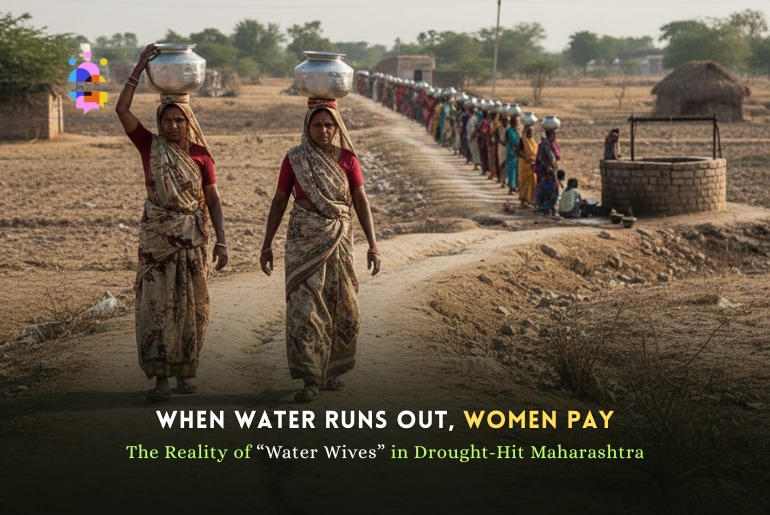
In drought-hit parts of Maharashtra, water decides the rhythm of a woman’s day. For many, the morning begins before sunrise, not with breakfast or school runs, but with a long walk across dry land and longer queues at distant sources. In this reality, Water Wives are not a metaphor. They are women pulled into exploitative, polygamous arrangements because a household needs more bodies to fetch water.
In villages where pipelines do not reach and regular supply systems are absent, families develop “solutions” that impose the greatest burden on women. Men marry a second, sometimes a third woman, so the labour of water collection can be split. When one wife is pregnant, sick, or exhausted, another is brought in. More wives, more trips. More trips, more water. That is the logic. That is the cruelty. These wives are known as Water Wives or Paani Bai.
The Water Wives of Maharashtra’s Denganmal Village
Under the Hindu Marriage Act, polygamy is illegal and remains a banned social practice in India. However, in the remote village of Denganmal in Maharashtra, becoming a Water Wife, or Paani Bai, is openly accepted and, in many ways, socially encouraged due to water scarcity.
Denganmal has no water pipeline and no regular supply system. The entire village depends on only two water sources. One is a small well located at the foot of a rocky hill, approximately 12 kilometres away. The other is the reservoir of the Bhatsa Dam, approximately 8 km from the village. Every household relies on what women physically carry back from these two points, and this daily task determines how families organise their water use.
Over the years, marrying twice or even three times has become common in the village, because more wives means more water. The second and third wives exist primarily for this purpose, and their roles within the household remain fixed, involving long walks, waiting in queues, lifting heavy pots, and repeating this cycle every day.
Being a Water Wife was a survival choice.
Most women who become water wives were those who were shunned in a patriarchal society. They are often widows, divorced women, single mothers, infertile women, or women from extremely poor families who cannot afford dowries. Marriage offers them a means of reentering social life. That is because in conservative rural India, being unmarried or abandoned carries heavy stigma.
The village panchayat and local authorities continue to support this system, as they view it as a form of social rehabilitation. They believe it provides women with shelter and legitimacy, which would otherwise be denied, and that it mitigates the risk of isolation and poverty. However, this is far from the truth of exploitation and social injustice these women face.
Being a water wife does not confer equal status on these women within the family. They seldom participate in decision-making, and in many homes, they do not even have the rights typically associated with marriage. Their value does not come from love or companionship. It depends on how many trips they can make to collect water and how much physical pain their bodies can tolerate.
How caste decides which woman becomes a Water Wife
Not every woman becomes a water wife, and caste plays a major role in determining who does. The women who take up this role usually come from poorer and lower-caste communities, while the first wife almost always belongs to the same caste and social group as the man. In fact, the first wife must not have been previously married. She must be an unmarried woman whose marriage conforms to social expectations regarding purity, lineage, and family honour.
Being referred to as paani bais instantly places them below the first wife. The word itself strips them of the identity as full wives and reduces their role to work.
The first wife controls decisions related to money, children, and family matters. She holds social authority and recognition. The water wives stay outside these spaces. In many cases, they cannot share a normal marital relationship, participate in religious rituals, or fully participate in festivals or social gatherings. Some families even restrict them from eating with the rest of the family.
Being a wife, even in something as exploitative as becoming a water wife, often gives these women their only chance at respect, protection, and basic acceptance in the community.
Changeincontent perspective
If “Water Wives” exist anywhere in India, it is not a story about tradition. It is a story about governance collapsing at the last mile, and women paying for it with their bodies.
No state can talk about women’s empowerment while women are walking 8–12 kilometres for a basic human need, daily, for years. The solution is not moral lectures to communities. It is infrastructure, enforcement, and dignity by design that involves functional rural pipelines, reliable tankers until pipelines are in place, community storage systems, and protected water access points closer to habitation. Moreover, it must involve accountability for failed supply. At the same time, we cannot normalise illegal polygamy under the excuse of scarcity.
The governments must provide legal protection and social security support to women pushed into these arrangements. They also deserve safe livelihood pathways that do not depend on being “accepted” through exploitation. Water is not just a resource. In rural India, it is power. And when water disappears, women are the first currency.
Also Read: Patriarchy and Women’s Income: What changes when a paycheque arrives.
The closing thoughts
The practice of water wives shows how the environmental crisis directly changes everyday life for women in unequal ways. What appears to be a strange social custom is, in fact, a survival mechanism in which the lack of a basic water supply forces women’s bodies and unpaid labour to become the primary resource.
Water wives shows how climate stress pushes caste and gender inequality further, and forces women to accept exploitation in the name of survival.
Disclaimer: The views expressed in this article are based on the writer’s insights, supported by data and resources available both online and offline, as applicable. Changeincontent.com is committed to promoting inclusivity across all forms of content. We broadly define inclusivity as media, policies, law, and history. It encompasses all elements that influence the lives of women and marginalised individuals. Our goal is to promote understanding and advocate for comprehensive inclusivity.
