
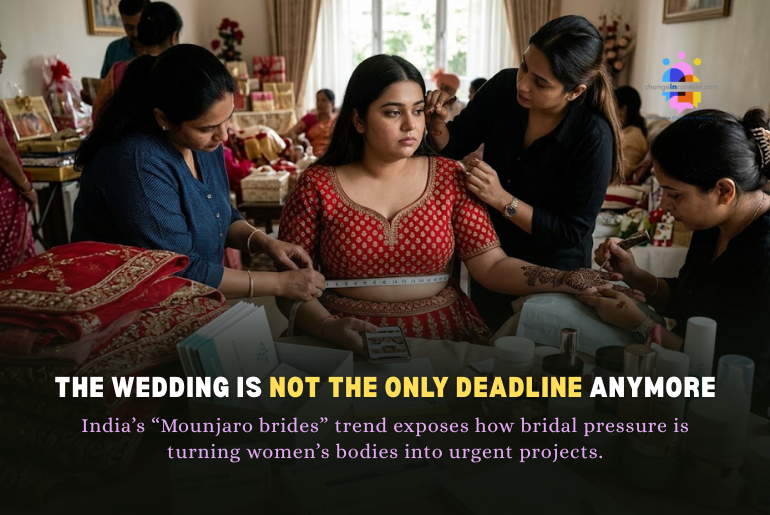
An Indian wedding has always asked too much of a bride. Not only her time, money, patience, or emotional labour, but increasingly, her body. Somewhere between the fittings, the facials, the family comments, and the endless comparison culture of the internet, the bride herself can start to disappear behind a project plan for looking “right”. That is what makes the rise of Mounjaro Brides so revealing. It is not merely about weight-loss drugs entering the market. It is about how quickly women’s milestones get turned into body deadlines.
Reuters’ recent reporting suggests that this is no longer a fringe phenomenon. Clinics in India are beginning to package and respond to wedding-linked interest in GLP-1 drugs such as Mounjaro, originally introduced for diabetes care and weight loss in medically appropriate cases. That shift matters because it shows how social pressure, aspiration, and medicine are starting to merge in ways that feel normalised long before they are fully questioned.
How “Mounjaro Brides” are becoming the new face of pre-wedding pressure in India
Pre-bridal routines have come a long way from salon visits and skincare sessions. Now, they are starting to include weight-loss injections as part of the bridal package. Reuters reported that a New Delhi clinic was promoting a “Mounjaro bride” package. Several other clinics are also catching on to this demand.
Eight doctors interviewed by Reuters said they have been receiving queries from brides, and some grooms, about using weight-loss drugs ahead of their wedding. Many specifically asked for Mounjaro by Eli Lilly, the first GLP-1 drug introduced in India for both diabetes care and weight loss. According to them, these individuals are demanding Eli Lily more often than its rival, Wegovy from Novo Nordisk.
“Over the last few months, over 20% of the queries we’ve received for obesity injections are from to-be brides, who also openly give us a timeline on how soon they are getting married,” said Rajat Goel, a bariatric surgeon at Hindivine Healthcare in New Delhi. He said he prescribed the drugs only if patients were medically eligible, not for cosmetic use.
India’s Mounjaro Brides: The wedding body rush and the business behind it
Doctors say this mindset builds slowly through what people keep seeing online. Every scroll offers content like “lose weight in weeks” videos, bridal glow-up content, and influencers/celebs talking about fast changes as if it’s normal. However, you do not see the medical checks, the side effects, or how hard it is to keep that weight off later.
Over time, this kind of content makes quick weight loss feel like something everyone should be able to do.
Ads, movies, and even small, backhanded comments from people around them keep repeating the same message about how a woman should look. When a wedding comes up, all of it comes together at once. There is a deadline, there are expectations, and there is constant comparison with others online.
Now brands and clinics are stepping right into this moment. They are not creating insecurity, but they are using it. Perhaps “profiting” is the right word. When someone already feels they need to change their body fast, a product that promises quick results becomes easier to sell.
This pressure around bridal appearance also connects to what we explored in our article on the Band Baja Bitiya Goel TMT campaign, where the wedding itself becomes a site for exposing how deeply women’s worth is still negotiated through social expectation.
Mounjaro Brides, booming demand, and the health risks behind the rush
Demand for appetite-suppressing drugs like Mounjaro, Wegovy, and Ozempic has gone up sharply since they entered the Indian market last year. What started as a treatment for diabetes and obesity is now being widely discussed as a quick weight-loss option.
Reuters reported in November 2025 that Mounjaro had become India’s top-selling drug by value, overtaking even widely used antibiotics. It underscores just how quickly weight-loss and diabetes injections have expanded in the country.
India’s anti-obesity drug segment, encompassing both injections and pills, has grown from approximately $16 million in 2021 to nearly $100 million currently. Pharmarack also estimates that this number can reach $860.34 million by 2030. The lowest Mounjaro injection pen dose in India costs 13,125 rupees ($139.50) per month, while the highest dose costs 25,781 rupees.
As more Indian drugmakers bring in lower-cost versions, access is increasing, but so are concerns. Reports of misuse and unauthorised sales are starting to come up, raising questions about the use of these drugs outside proper medical guidance.
The drugs are real. So are the side effects
These drugs can help in medical cases, but they also come with side effects like nausea, vomiting, and stomach issues. In some cases, there are more serious risks. Even so, many people just want quick weight loss, often within weeks.
Once you fix one thing, something else gets pointed out. Today it is weight, tomorrow it could be skin, hair, or something else entirely. There will always be something new to fix, and someone ready to sell that fix.
The Changeincontent perspective
The most disturbing part of the Mounjaro Brides trend is not only that weight-loss injections are becoming part of pre-wedding routines. It is how little surprise that now causes. That normalisation tells us a great deal about the culture surrounding women and weddings in India.
A bride is still expected to be glowing, slim, transformed, and “worth the occasion”, as though marriage is not only a life event but a final public exam in femininity. That is the pressure. The drug is only the latest tool entering it.
That is also where the issue becomes bigger than a single medicine or a single clinic. Medical treatment for obesity and diabetes has a legitimate place. But when the language of health starts to blend with the language of urgency, aesthetics, and social approval, the line can become dangerous.
A body should not need a deadline to become acceptable. And no milestone should teach women to earn celebration through shrinking. The real challenge is not only stopping misuse. It is disrupting the culture that makes misuse marketable in the first place.
Conclusion: The real problem is the deadline culture around women’s bodies
If you think this stops at weddings, it doesn’t. Post-pregnancy, before vacations, ahead of parties, any event where people (the majority will be women) feel they have to look a certain way within a short time. What we are seeing now is just the beginning of a larger trend in which quick fixes are being normalised at every milestone.
At some point, the focus has to shift from quick results to basic well-being. No event is worth risking your health or making you feel like your body is never enough. Your body is not a last-minute project before a big day. It is something you live in every day, and it deserves more than quick fixes.
Disclaimer: The views expressed in this article are based on the writer’s insights, supported by data and resources available both online and offline, as applicable. Changeincontent.com is committed to promoting inclusivity across all forms of content. We broadly define inclusivity in terms of media, policies, law, and history. It encompasses all elements that influence the lives of women and marginalised individuals. Our goal is to promote understanding and advocate for comprehensive inclusivity.
