
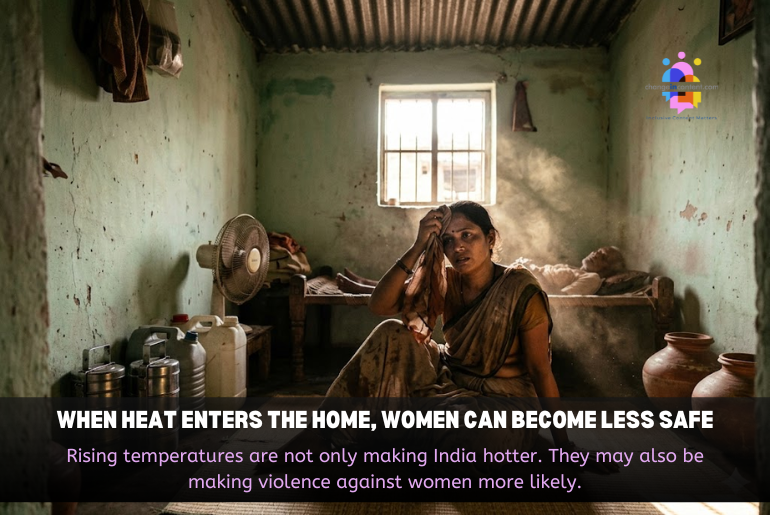
When people think about heatwaves, they usually think about dehydration, blackouts, crop loss, or unbearable afternoons. What they rarely think about is violence. And yet that is exactly what makes this conversation so urgent. The connection between rising heat and violence against women sounds surprising at first, but the more closely researchers look at climate stress, the harder it becomes to ignore.
Heat not only affects bodies and infrastructure. It affects behaviour, livelihoods, households, and the fragile conditions in which power already operates unequally.
In India, that matters enormously. Women already face a high baseline of intimate partner violence, economic dependence, water insecurity, and unpaid care work. When extreme heat worsens financial stress, reduces incomes, increases time spent indoors, and stretches access to essentials like water, it does not create gender inequality from scratch. It intensifies what is already there. That is why rising temperatures can become not just a climate story, but a domestic safety story too.
It also builds on what we explored in our earlier article on the Gendered Impact of Rising Temperatures, where heat was already shown to deepen women’s health, labour, and survival burdens.
Rising heat as a trigger for intimate partner violence
A study covering 194,871 women aged 15 to 49 across India, Pakistan, and Nepal between 2010 and 2018 examined incidents of physical and sexual violence alongside temperature changes over the same years.
The study found that a 1°C increase in average annual temperature is associated with a rise of more than 6.3% in domestic violence incidents across the three countries. India reported the highest levels among them, which raises concern given its population size and existing gender inequalities.
“With a one-degree increase in heat came an 8% rise in physical violence and 7.3% rise in sexual violence“, the report said.
Why hotter conditions can worsen household risk
Another report by M. S. Swaminathan Research Foundation found that intimate partner violence was more widespread and intense in districts classified as highly heat-vulnerable.
The 2025 MSSRF study on women and children across agroecological zones in India reported that violence was more prevalent in highly heat-vulnerable districts. That is where 38% of women reported experiencing violence at least once in their lifetime. At the same time, 72% in these districts reported higher violence during the summer months of April to June. [The Hindu]
The latest report by Nikkei Asia also found that women in smaller households, with up to four members, reported the highest levels, at 77%, in highly heat-vulnerable districts.
Income loss, longer hours at home, and rising risk
Heat also reduces women’s economic room to breathe. A 2025 MSSRF survey covering more than 3,300 women across seven states found that 97% reported income losses during peak summer months. The average wage losses exceed ₹1,500. That matters even more in a country where about 92% of women in paid work are in the informal sector and have little social protection. [NY Times].
One survey also found that over 40% of women home-based workers reported reduced work hours and earnings due to rising temperatures.
When lost wages increase dependence
This loss of income changes daily life at home. When women cannot work outside, they spend more hours indoors. In homes where relationships are already tense or abusive, this increases exposure to harm. Less income also means greater financial dependence, which makes it harder for women to leave or resist abusive situations.
Reports show that women in such conditions face different forms of violence. These include physical, sexual, and emotional abuse. Physical violence often takes the form of slapping, punching, and pushing. Women from low-income households face a higher risk because financial stress adds pressure, and dependence limits their choices.
Why staying home longer is not always safer
Researchers also point to how heat affects behaviour. High temperatures can increase anger and aggression, which can lead to more violence. The heat-aggression hypothesis posits that high temperatures increase violent behaviours through various biological and psychological mechanisms.
These include triggering angry feelings, aggressive thoughts, and physiological arousal, or modifying daily activities to create more social interaction situations. People stay indoors for longer periods, which increases contact and can raise the chances of conflict.
How water scarcity makes rising heat and violence against women intersect more sharply
Rising temperatures are drying up wells, ponds, and other local water sources in many parts of India. In drought-hit areas, women can no longer rely on nearby water. They have to walk longer distances, sometimes several kilometres, to collect water for daily use. In some cases, they travel beyond their villages.
As heat and drought push water sources farther away, women and girls often have to spend more time fetching water. Global evidence shows that longer journeys for water can increase exposure to harassment, assault, and other forms of gender-based violence. In India, too, researchers have noted that walking far from home or village spaces to access water can heighten women’s vulnerability to sexual violence.
Long distances and isolated routes increase exposure. Women spend more time alone or in small groups, often without any protection. That makes them more vulnerable to harassment and sexual assault. The risk of violence is higher in areas with poor transport, weak policing, or limited public presence.
Why India faces a particularly dangerous future of rising heat and violence against women
The link between heat and violence shows that the climate crisis is not only about weather, but about women’s safety and inequality. India is estimated to experience a larger increase in the prevalence of physical and sexual violence associated with climate warming. By the 2090s, India is estimated to experience the largest increase in IPV prevalence, by 23.5%, compared with Nepal (14.8%) and Pakistan (5.9%).
Nearly one in three ever-partnered women in India report experiencing intimate partner violence (IPV), pointing to how widespread the issue already is. At the same time, a significant level of social acceptance of marital violence persists, with some people continuing to view abuse as justifiable under certain circumstances, more so than in many other parts of the world.
This combination of high prevalence and lingering acceptance of IPV in India creates a dangerous baseline. As climate change intensifies, bringing heat stress, water shortages and economic strain, these pressures can escalate tensions within households. In such conditions, women who are already at risk become even more vulnerable.
The Changeincontent perspective
The most disturbing part of this conversation is how invisible it still is. Most people can imagine heat causing exhaustion. Few can imagine it worsening violence. But that is exactly what climate injustice looks like in real life: it does not stay confined to temperature charts and weather alerts. It enters homes, relationships, incomes, and routines that were already unequal.
That is why we must treat rising heat and violence against women as a serious policy concern, not a surprising side note. When women lose income because work becomes unsafe, when they spend longer hours inside tense households, when they walk farther for water, and when hotter conditions heighten stress and aggression, the risk environment changes around them.
Climate policy that talks about cooling centres and warnings but ignores domestic safety, income protection, and women’s exposure to violence is not complete. It is an incomplete imagination.
A better response would mean building heat action plans that include women’s safety, protecting incomes in informal work, ensuring safe and accessible water sources, and recognising that violence prevention also belongs inside climate resilience planning.
Conclusion: Climate policy cannot ignore rising heat and violence against women
Climate change disproportionately impacts people with low incomes, with the greatest impact on women in lower-income and rural households. Policies must directly address the specific risks women face. It includes better access to safe water sources closer to homes, so women do not have to travel long distances.
Heat action plans must include income protection for women in the informal sector and safe working conditions.
Addressing heat stress without addressing inequality will leave many women at risk. A more effective response must recognise that climate, safety, and gender are closely linked and must be tackled together.
Disclaimer: The views expressed in this article are based on the writer’s insights, supported by data and resources available both online and offline, as applicable. Changeincontent.com is committed to promoting inclusivity across all forms of content. We broadly define inclusivity in terms of media, policies, law, and history. It encompasses all elements that influence the lives of women and marginalised individuals. Our goal is to promote understanding and advocate for comprehensive inclusivity.
