
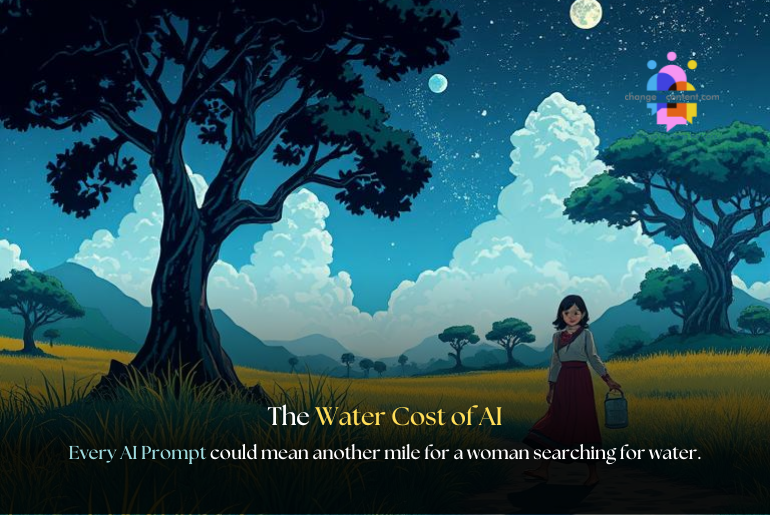
Water scarcity and its burden on women is not a future crisis. It is already here, and AI is quietly accelerating it. As we marvel at Ghibli-style art and AI creativity, the unseen cost is being paid by women who have no water, no time, and no choice.
While everyone is busy turning their selfies into Ghibli-style art, few stop to think about the real-world cost of that simple command. A single 100-word email generated by an AI chatbot like GPT-4 uses about one bottle of water. A 10-minute shower uses about 25 gallons of water. It is equivalent to 156 AI prompts. By 2027, AI’s water consumption is expected to match the total usage of New Zealand.
As water scarcity worsens, the first to feel its impact won’t be the tech companies rolling out these models. It will be women and girls. Across the globe, women and girls lose 200 million hours daily to water collection. We are not even counting the additional hours spent searching for basic sanitation.
Why water and women?
In many Indian households and water-scarce regions, water is women’s business. The responsibility of fetching water falls to women and girls in the household. According to a detailed analysis of gender inequalities in drinking water, sanitation, and hygiene (WASH), women and girls fetch water in 7 out of 10 households without on-premises water supply.
Globally, 1.8 billion people live in homes without direct water access. In 70% of those households, women and girls aged 15 and above handle the task, while only 30% of men and boys do. Even among children under 15, girls (7%) take on responsibility more often than boys (4%).
Women standing in long queues with colorful plastic pots, waiting at a community pipe or water tanker, is a familiar sight in India. However, few acknowledge the physical strain and exhaustion they endure. Whether they’re menstruating, unwell, or overwhelmed with other domestic duties, no matter their health or physical strength, women are still the default water carriers.
Because, somehow, that’s just the way it is.
Water crisis & education for girls
In Asia and Africa, women and girls walk an average of six kilometers (3.7 miles) every day to fetch water. Women in Sub-Saharan Africa spend 40 billion hours a year collecting water. That is the same as the entire workforce of France working for a year but with no salary, benefits, or even recognition. It is time lost that women could have spent earning an income, starting a business, or getting an education.
For millions of women and girls, collecting water is a time-consuming daily responsibility that leaves little room for education. As a result, 35 million girls remain out of school worldwide. Even for those who manage to attend, nearly 29% of all schools lack access to essential drinking water. In many impoverished, water-insecure communities, menstruation becomes yet another reason girls stop attending school. Without access to safe water and sanitation, managing their periods becomes difficult for them.
Water scarcity and its burden on women: The real issue
The issue is not just about education but also about lost opportunities. When girls spend hours fetching water instead of attending school, their future earning potential diminishes. The cycle of poverty continues, and gender inequality rises.
Access to water and sanitation directly impacts a girl’s education and future earning potential. When clean water and proper sanitation are available at home and school, girls can stay in school longer, and with each additional year of education, their income as adults is expected to increase by 20%.
Water insecurity and gender-based violence
In groundwater-dependent regions, such as parts of sub-Saharan Africa and South Asia, households lacking safe water access rely on women and children to fetch water from distant or isolated sources. Girls, in particular, often travel alone during unsafe hours, facing threats of rape and harassment. In extreme cases, these incidents lead to forced child marriages, as documented in Eastern Cape, South Africa, where abduction and sexual violence during water collection are dismissed as “bridal abduction” under the guise of cultural norms.
Access to what kind of water sources also determines how much abuse a woman might face. In parts of India, households rely on privately owned wells. Women who visit these wells often share disturbing accounts of verbal abuse, humiliation, and coercion by the male owners.
Fixing this issue takes more than just building more water systems. It needs better planning that considers women’s safety, strong legal action to protect them, and a clear move away from accepting violence as part of culture or poverty.
“Tech leaders need to stop treating resources like they are infinite and women like they are invisible. Every AI model trained without sustainability in mind is another litre stolen from a woman’s daily life.” — Saransh Jain, Founder, Changeincontent.com
Water scarcity and its burden on women: Final thoughts
As digital tools become more integrated into daily life, the resource demands of AI systems continue to rise. However, the impact of this growing water usage does not affect all populations equally. Women, especially in water-scarce regions, are the ones most affected. They already spend hours each day collecting water for their families.
When AI’s rising water use adds more pressure on already limited water resources, it’s women who must walk farther, wait longer, and work harder to meet basic household needs. Their time, energy, health, safety, and opportunities are put at risk.
The cost of water insecurity is not measured in liters. It is measured in lost futures, compromised safety, and inequality faced by women and girls.
Disclaimer: The views expressed in this article are based on the writer’s insights, supported by data and resources available both online and offline, as applicable. Changeincontent.com is committed to promoting inclusivity across all forms of content. We broadly define inclusivity as media, policies, law, and history—encompassing all elements that influence the lives of women and marginalised individuals. Our goal is to promote understanding and advocate for comprehensive inclusivity.
