
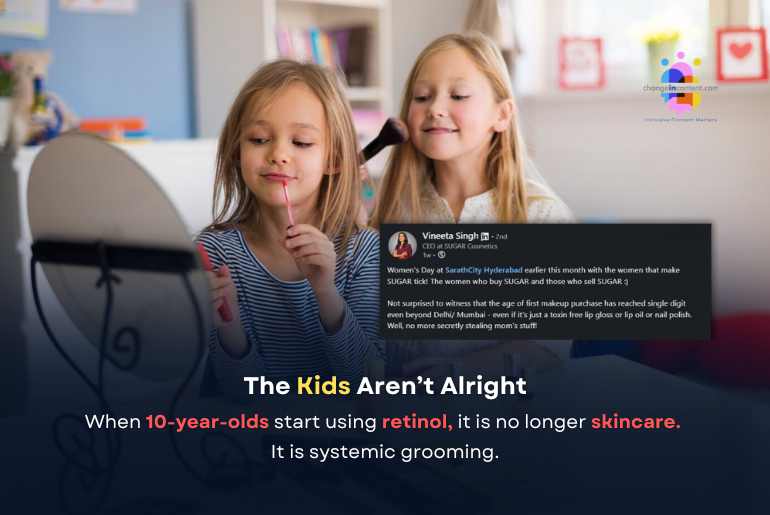
The beauty industry is no longer just selling to women; it is eyeing children as its next big market. The trend of makeup for kids is growing faster than ever, and no one seems to be hitting the brakes.
In our previous article, we talked about the growing skincare obsession among tweens. The 10-step routines and even the use of anti-ageing products have become the new norm for girls barely old enough to understand what a wrinkle is. As skincare products fill shelves, makeup is also finding its way into younger hands.
Growing up, many of us couldn’t resist playing with our mothers’ makeup. Smearing on lipstick, striking a dramatic pose, then rushing to clean up the mess. But today, that sense of innocent fun seems to be fading. Instead of a playful experiment, makeup is becoming an expectation.
Makeup for kids: 65% of girls start wearing makeup between ages 8 and 13
A survey by The Renfrew Center Foundation found that 20% of girls who wear makeup feel insecure without it. Unfortunately, these girls end up describing themselves without makeup as self-conscious (20%), unattractive (17%), or as if something is missing (15%). Only 5% feel more attractive bare-faced. Nearly 58% of young girls wear makeup, with 65% starting between ages 8 and 13.
Over a quarter (27%) rarely or never leave home without it. Moreover, they feel most comfortable without makeup at home (89%), the beach (84%), or the gym (82%), but less so at school (58%) or even at a friend’s house (67%). Girls as young as six are being asked to wear makeup. The reasons for doing so range from bullying for not wearing it (24%) to social media influence (19%) and feeling ugly (13%). Adding to the concern, 89% of parents have caught their daughters secretly wearing makeup, with the average starting age being just seven.
At least one in five girls between the ages of 8 and 18 who have worn makeup report feeling insecure or unattractive without it. Using makeup as a form of self-expression is not a problem in itself. However, the growing pressure on girls to meet beauty standards at a younger age is definitely concerning.
If CEOs are proud of kids wearing makeup, we have a problem
Cosmetic brands, both local and international, are no longer just selling products. They are influencing how children see beauty and when they start using makeup. With targeted ads, social media trends, and influencers promoting “must-have” products, these brands are even treating children as potential customers.
Vineeta Singh, CEO of Sugar Cosmetics, proudly shared on LinkedIn how the age of first makeup purchases has dropped to single digits. She casually justifies it with the claim that it is just “toxin-free lip gloss or nail polish.” The argument that these products are kid-friendly does not change the reality that children never needed them in the first place. Previous generations grew up just fine without applying lip balm.
What kind of message does it send when a CEO highlights the declining age of first-time makeup buyers as if it is a milestone worth celebrating? It raises a more significant issue about responsibility.
Rather than questioning if a six-year-old needs lip gloss, brands are creating a market where she believes she does. When brands and the people behind them have the power to influence young minds, they must be responsible with their messaging.
The ethics of beauty marketing
Market Research Future estimates that the global children’s cosmetics market will reach $1.79 billion by 2026. Out of this, the Asia Pacific region accounts for $408 million, or about 7.25% of the market.
Parents are struggling to shield their children from the relentless influence of beauty brands. Unlike past generations, who mainly saw ads on TV, today’s kids encounter beauty marketing everywhere. Whether it is their favourite YouTube channels, social media feeds, or even in schools through peer influence, beauty marketing is everywhere. The messaging is relentless, which makes it nearly impossible for parents to block it out completely.
A changeincontent.com study on the growing trend of makeup for kids: Innocence lost
In an informal yet revealing one-on-one study conducted by changeincontent.com, we spoke to 20 girls aged 10 to 15 from Mumbai. These girls are the daughters of urban, educated parents earning an average of ₹2 lakh per month. The results were unsettling.
- 17 of the 20 girls use more than two active skincare ingredients: mainly Vitamin C and even Retinol, which a product designed for ageing skin.
- 15 admitted they created their skincare routines after watching influencers on Instagram or YouTube, many of whom are not even skincare professionals.
- 13 were aware of a viral skincare trend called “Morning Shed,” which involves taping their faces, layering unnecessary products, and “prepping” skin like it is a science experiment.
- The most heartbreaking finding? Every single girl said she thought her skin was “bad” or that she “looked terrible” without products.
Twelve of them follow a 7-step skincare routine every day, including techniques like face shaving and LED therapy. On weekends, they go beyond by adding sheet masks, skin-lightening hacks, and even mini facials.
They are not influenced by Bollywood. They follow a global mix of Indian and international influencers. What they all share is this deep-seated feeling that they are not enough as they are.
This is not a rebellion. It is a result of a system built to exploit.
Marketing to children: It is not innocent when it is strategic
Beauty brands are not stumbling upon a child customer base by accident. They invest millions into researching how kids think, what they want, and how to trigger a fear of missing out. By the time a child asks for a lip gloss, a brand has already convinced her that not having it makes her less worthy.
Even when parents say no, the seed has been planted. And it grows.
Imagine if these brands simply chose not to target kids. Imagine if they picked ethics over expansion. But that would mean giving up a lucrative audience—and let’s face it, in today’s capitalism, addiction is more profitable than empowerment.
Instead of selling confidence, beauty brands are selling dependence. And the younger the customer, the longer the hold.
Makeup for kids: The final thoughts
Perhaps it is time to rethink what we are normalising. If we continue to let beauty standards pressure our children, we risk raising a generation that feels incomplete without cosmetics. There is no universal rule for when someone should start wearing makeup, as it should always be a personal choice. However, the growing trend of younger children being drawn into beauty routines is not happening by accident.
When six-year-olds start seeing makeup tutorials and “kid-friendly” beauty products on their social media feeds, it is also not by accident. This is because algorithms are designed by industry leaders who focus on profit over ethics.
Addressing this issue means holding both the technology and the decision-makers behind it accountable.
Disclaimer: The views expressed in this article are based on the writer’s insights, supported by data and resources available both online and offline, as applicable. Changeincontent.com is committed to promoting inclusivity across all forms of content. We broadly define inclusivity as media, policies, law, and history—encompassing all elements that influence the lives of women and marginalised individuals. Our goal is to promote understanding and advocate for comprehensive inclusivity.
