
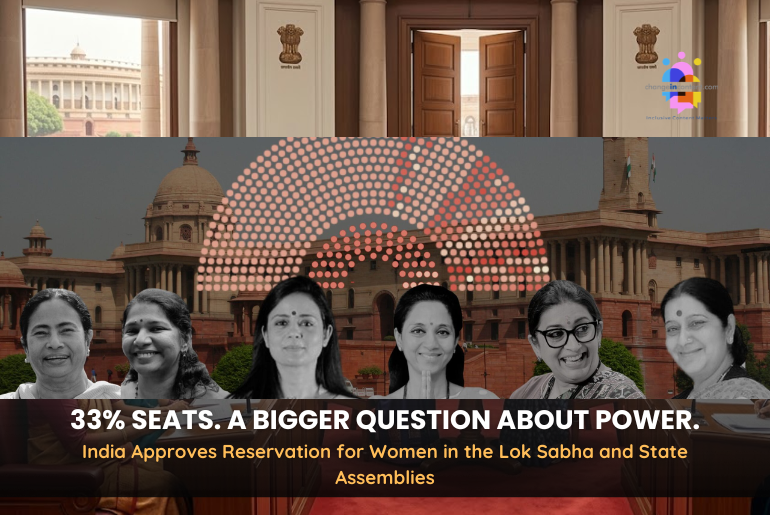
The debate around the Quota for women in the Lok Sabha and State Assemblies is not only about seats. It is about what happens when an institution that has historically underrepresented women is finally required to make room for them.
As India moves toward the 2029 general election, the Women’s Reservation Act, formally the Constitution (128th Amendment) Act, 2023 or Nari Shakti Vandan Adhiniyam, brought renewed focus on women’s representation in politics. For the first time, 33% of seats will be reserved for women, which is expected to increase their representation in Parliament significantly.
The goal is to make the 2029 Parliament the most gender-diverse in the country’s history. This moment revives a long-postponed question: if women make up half the country, why has political power remained so unevenly male for so long?
At Changeincontent, we feel that this moment matters beyond electoral math. Representation changes what gets noticed, what gets prioritised, and what institutions stop treating as peripheral. It also brings focus to long-overlooked concerns that directly affect women’s lives. These include the absence of a gender lens in policies on India’s ageing population and the unequal burden of unpaid caregiving that women continue to carry.
In politics, that can mean bringing care work, ageing, health, safety, and basic services closer to the centre of lawmaking. In organisations, the same principle applies: when leadership remains narrow, so do the assumptions shaping policy, culture, and strategy.
How the Quota for Women in Lok Sabha could reshape parliament, from 2029
Women’s representation in India’s Parliament remains low. In the 18th Lok Sabha elected in 2024, women account for 74 of 543 members, or about 13.6%. That was among India’s highest-ever shares. However, it remained well below the global average of 26.9% on 1 January 2024.
That will change from 2029 with the implementation of the Nari Shakti Vandan Adhiniyam.
What could reservation mean at full scale?
The law will reserve 33% of seats for women in the Lok Sabha and State Assemblies. With a proposed increase in the total number of Lok Sabha seats from 543 to 816, about 273 seats could be reserved for women. Moreover, the Budget session of Parliament has been extended by three days, allowing for the implementation of the 2023 law providing 33% reservation for women in the Lok Sabha and state assemblies from 2029.
At the local level, reservation has already shown its scale. The 73rd and 74th Constitutional Amendments opened the door to more than 1.4 million elected women representatives in panchayats and urban local bodies across India. In many states, reservations for women in these bodies have even reached 50%. It shows that higher representation is possible when backed by policy.
Why the 33% Quota for Women in Lok Sabha could change what power pays attention to
There is enough global and local data to show why such a step is needed. 64 countries have already introduced similar provisions. These countries include the likes of Belgium and Rwanda.
What global quota experience already shows
In Rwanda, the 2003 Constitution set a 30% quota for women in elected positions. Within ten years, women came to hold about 64% of parliamentary seats. That places the country among the highest in the world for women’s representation in politics.
The World Economic Forum states that a 10-percentage-point increase in women’s parliamentary representation is associated with a 0.7-percentage-point increase in GDP growth. When women hold political office, they often give more attention to social policies that support economic growth, including education, healthcare, paid parental leave, and childcare.
In Iceland, where women make up about 48% of Parliament, the country has introduced one of the world’s most progressive parental leave systems. They now offer equal paid leave for both parents. That is another example of what more power to women representatives can do.
What has women’s leadership changed in India before?
Within India, the impact of women’s leadership is already visible at the local level.
Research on panchayats shows that women’s reservation changes the types of public goods prioritised. Female-led local councils are investing more in infrastructure that addresses women’s needs, especially in drinking water.
Women-led councils saw 62% more drinking water projects compared to those led by men. When women are in positions of power, public spending and local priorities can shift in meaningful ways.
But barriers within politics still hold women back.
Even as more women enter politics, several barriers continue to limit their role and influence. The internal party structures remain a major hurdle. Many political parties continue to operate in ways that favour male candidates. In fact, most major parties have struggled to move beyond 10–12% women candidates without legal pressure. For instance, in the upcoming Kerala Assembly elections, out of more than 1.39 crore women voters, only around 40 women are contesting.
In addition, social attitudes still affect how women are seen in positions of power. The “Sarpanch-Pati” issue is one example in which male relatives often take over decision-making, while the elected woman remains only the official face.
These challenges show that increasing the number of women in politics is only one part of the process. Without changes within parties and shifts in how power is shared on the ground, women’s participation may not fully translate into real decision-making roles.
Read next: Women in Panchayat: Bridging the gender gap in governance.
The Changeincontent perspective
The Quota for Women in the Lok Sabha should not be read only as a parliamentary reform. It is also a powerful institutional metaphor.
Quotas do not emerge because merit failed. They emerge because institutions kept confusing familiarity with merit for too long. When leadership remains overwhelmingly male decade after decade, the problem is rarely that qualified women do not exist. The problem is that systems were built to keep selecting from the same kind of profile, the same networks, and the same comfort zone.
That is where the lesson for organisations and corporates becomes impossible to ignore.
Reservation in Parliament is one way of forcing an institution to stop waiting for fairness to happen on its own. That should provoke difficult but necessary reflection elsewhere, too.
Conclusion: The Quota for Women in the Lok Sabha is also a lesson for every institution that still hoards power
The prime minister urged all parties that this is an issue related to women’s empowerment. Hence, they should, with an open mind and without any political calculations, fully support it. He insisted that they become partners in winning the trust of the country’s mothers and sisters.
This moment is also a chance to bring everyday issues into the centre of policy.
Questions around ageing, care work, health, safety, and access to basic services have stayed at the margins for too long. With more women in office, there is an opportunity to push these into mainstream political priorities. However, that will depend on whether the system allows women to lead, not just sit in reserved seats.
The lessons for India Inc.
Many companies say they want more women in leadership, just as parties say they support women’s political participation. But when no structural intervention follows, the numbers barely move. Women remain visible in the workforce or voter base, while power stays concentrated elsewhere.
Parliament is now being pushed to confront that contradiction through reservation. Corporate India should pay attention. Because the same question applies there too: if women are present in the system, why do they still disappear as power rises?
The real lesson is not that every institution needs the same tool. Every institution needs honesty about the gatekeeping built into its own pipeline. In politics, ticket distribution, party hierarchy, and social legitimacy shape who reaches office. In organisations, it is hiring, sponsorship, evaluations, succession planning, and who gets treated as leadership material.
Disclaimer: The views expressed in this article are based on the writer’s insights, supported by data and resources available both online and offline, as applicable. Changeincontent.com is committed to promoting inclusivity across all forms of content. We broadly define inclusivity in terms of media, policies, law, and history. It encompasses all elements that influence the lives of women and marginalised individuals. Our goal is to promote understanding and advocate for comprehensive inclusivity.
