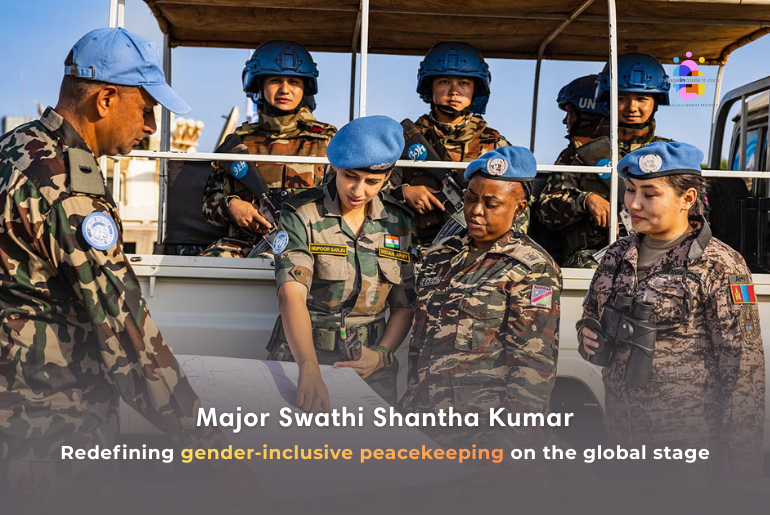
Major Swathi Shantha Kumar has just achieved something that goes far beyond personal recognition. Her work has been shortlisted and selected from nominations received across all UN peacekeeping missions and UN agencies worldwide. She received the UN Secretary-General’s Award 2025 in the Gender Category.
For India, and for women watching from afar, this moment matters. It reinforces a powerful truth: gender-inclusive peacekeeping is not a soft ideal. It is operationally effective, locally trusted, and globally acknowledged.
Major Swathi Shantha Kumar and gender-inclusive peacekeeping on the global stage
Serving with the United Nations Mission in South Sudan (UNMISS), Major Swathi’s project titled “Equal Partners, Lasting Peace” was recognised for advancing the UN’s mandate on gender parity and gender-responsive peacekeeping. The award was announced by António Guterres, who highlighted how her initiative strengthened the mission’s engagement with local communities by embedding inclusion into day-to-day operations.
What makes this achievement exceptional is its scale of competition. Her project emerged as the winner after a UN-wide voting process involving personnel across missions worldwide, securing the most votes among four international finalists.
What “Equal Partners, Lasting Peace” did on the ground
Gender-inclusive peacekeeping often sounds abstract. Major Swathi’s work was anything but.
Under her leadership, the Indian Engagement Team was deployed more deliberately and more visibly across conflict-affected regions of South Sudan. The team conducted short- and long-distance patrols. They also integrated riverine patrols and dynamic air patrols to remote and inaccessible counties. These were not symbolic deployments. They were operational decisions that placed the women peacekeepers at the centre of engagement with local populations.
The outcome was tangible. Over 5,000 women were able to participate more safely and meaningfully in community activities. Trust between peacekeepers and local communities improved. Women who had previously stayed invisible in public spaces began to engage with UN personnel, share concerns, and participate in local dialogue. In fragile regions, that trust is often the difference between temporary calm and lasting stability.
Why gender-inclusive peacekeeping works in conflict zones
The UN has long argued that peace processes are more durable when women are involved. Major Swathi’s work provides concrete evidence for that argument. In many conflict-affected societies, women are the first to experience displacement, violence, and economic disruption. Still, they are also central to rebuilding social cohesion.
By ensuring women peacekeepers were not sidelined but fully integrated into patrols and outreach, her initiative addressed a critical gap. It recognised that safety, intelligence-gathering, and conflict prevention improve when peacekeeping forces reflect the communities they serve. Gender inclusion, in this context, became a strategic advantage rather than a compliance checkbox.
Major Swathi Shantha Kumar: An Indian Army Officer, a global role model
Coming from Bengaluru and described by her family as determined from a young age to serve in the Army, Major Swathi Shantha Kumar’s journey carries deep resonance in India. Her recognition is not only a personal milestone. It is also a reminder of the evolving role Indian women play on the global stage in defence, diplomacy, and peacebuilding.
For young women considering careers in uniform, her story reframes possibility. It shows that leadership, operational command, and international impact are a lot more than exceptions reserved for a few. They are outcomes of competence, conviction, and opportunity.
The changeincontent perspective
At ChangeInContent, we see this recognition as more than a headline. It is a case study in how inclusive leadership delivers measurable outcomes, even in the most complex environments. Gender-inclusive peacekeeping is not about optics. It concerns the redesign of power, trust, and participation in spaces where exclusion has long been normalised.
Major Swathi Shantha Kumar’s work reminds institutions, governments, and organisations that inclusion strengthens systems. Whether in conflict zones or corporate boardrooms, the lesson holds: when women are equal partners, outcomes last longer.
The closing thoughts
Major Swathi Shantha Kumar’s UN Secretary-General’s Award 2025 stands as a global endorsement of gender-inclusive peacekeeping. Her work in South Sudan demonstrates that inclusion is not an added layer to security operations — it is central to their success. As her project now sets a benchmark for future missions, it leaves behind a powerful message: peace built with women is peace built to endure.
Read More: Hope for Women’s Rights: 2025 was brutal. It also quietly proved that ‘Patriarchy’ isn’t invincible.
Disclaimer: The views expressed in this article are based on the writer’s insights, supported by data and resources available both online and offline, as applicable. Changeincontent.com is committed to promoting inclusivity across all forms of content. We broadly define inclusivity as media, policies, law, and history. It encompasses all elements that influence the lives of women and marginalised individuals. Our goal is to promote understanding and advocate for comprehensive inclusivity.