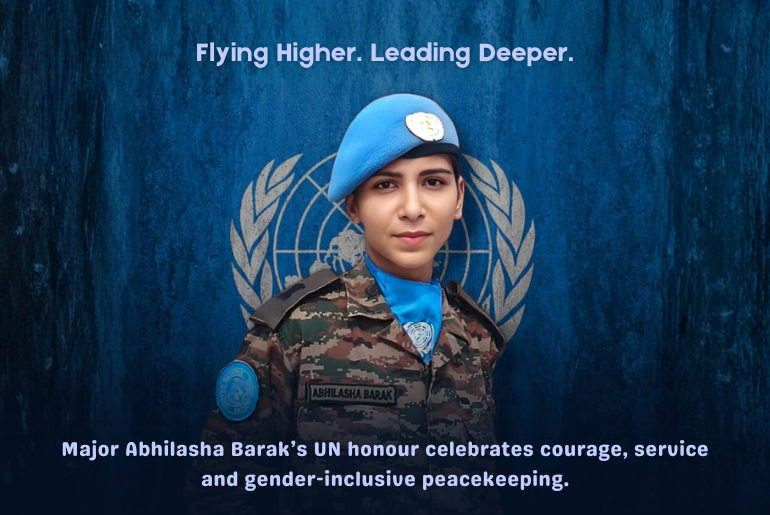
Major Abhilasha Barak has added another landmark to Indian military history. The Indian Army officer, already known as the first woman combat helicopter pilot in the Indian Army, has been honoured with the 2025 United Nations Military Gender Advocate of the Year Award while serving with the United Nations Interim Force in Lebanon.
The award recognises military peacekeepers who show exceptional commitment to promoting gender equality and implementing United Nations Security Council Resolution 1325 on Women, Peace and Security. Instituted in 2016 by the Office of Military Affairs under the UN Department of Peace Operations, the award is selected annually from nominations submitted by Force Commanders and Heads of Mission across UN peacekeeping operations.
Major Barak is currently serving with the Indian Battalion as Commander of the Female Engagement Team in UNIFIL. She has been recognised for outreach and community engagement activities with women and adolescent girls. At the same time, this honour is in recognition of her work in gender sensitisation training for peacekeepers.
For India, this is not just another award. It is a story about what happens when women are not merely included in uniformed service, but trusted with responsibility, leadership and community-facing peace work.
What is the UN Military Gender Advocate of the Year Award?
The UN Military Gender Advocate of the Year Award honours a military peacekeeper, man or woman, who has demonstrated outstanding leadership in advancing gender perspectives in peacekeeping.
Its foundation lies in UN Security Council Resolution 1325, adopted in 2000, which recognises that women must not be seen only as victims of conflict. We must also include them in peacebuilding, peacekeeping, conflict resolution and decision-making.
In practice, it means peacekeeping cannot be limited to patrols, security briefings and military coordination.
- It must also understand how conflict affects women and girls differently.
- It must build trust with local communities.
- It must make space for women’s voices.
- It must ensure that peacekeepers themselves are trained to engage in gender-sensitive ways.
That is where Major Abhilasha Barak’s work becomes important.
She was not honoured solely for breaking a glass ceiling. She was honoured for using her role to make peacekeeping more inclusive on the ground.
Why Major Abhilasha Barak was honoured
Major Barak served as the Commander of the Female Engagement Team under UNIFIL. In that role, she worked on outreach and community engagement with women and adolescent girls in Lebanon, while also conducting gender sensitisation training for peacekeepers.
Female Engagement Teams are important in peacekeeping contexts because women in local communities may not always feel comfortable speaking to male peacekeepers, especially in conflict-affected or socially conservative settings.
Women peacekeepers can build trust, hear concerns that might otherwise go unnoticed, and help missions understand the everyday security realities of women and girls.
That kind of work is often quieter than combat, but it is not smaller.
- It helps peacekeeping move from presence to trust.
- It helps international forces understand local fear, mobility, safety, health, education and gender-based risks.
- It also reminds the world that peace is not only made through ceasefire lines and negotiations. It is built on the confidence of people who finally feel heard.
Major Abhilasha Barak: The first woman combat aviator who kept going higher
Major Abhilasha Barak’s story already carried national significance before this UN honour. She is recognised as the first woman combat helicopter pilot of the Indian Army.
That milestone mattered because military aviation, especially combat aviation, has long been associated with male leadership, male physicality and male command visibility. When a woman enters that space, she does more than occupy a cockpit. She changes the imagination of who belongs there.
But her latest recognition shows another side of service. She is not only flying into history. She is also representing India in a mission where military skill and gender-sensitive peacebuilding meet.
That duality makes her story powerful.
- She is both a combat aviator and a gender advocate.
- She represents strength, but not only in the traditional sense.
- She represents the strength to listen, engage, train, include and lead in spaces where women’s concerns have often been treated as secondary.
India’s growing footprint in gender-inclusive peacekeeping
Major Abhilasha Barak is the third Indian peacekeeper to receive this honour, after Major Suman Gawani, who received the 2019 award for service with the UN Mission in South Sudan, and Major Radhika Sen, who received the award for her work with the UN Stabilisation Mission in the Democratic Republic of the Congo.
That continuity matters. It shows that Indian women in uniform are increasingly recognised not only for their participation but also for their leadership in gender-responsive peacekeeping.
India has long been one of the major contributors to UN peacekeeping missions, and the recognition of Indian women officers adds a new layer to that legacy.
Changeincontent has previously covered another powerful example of gender-inclusive peacekeeping through Major Swathi Shantha Kumar, whose work in South Sudan highlighted how women-led engagement can shift trust, participation and community dialogue.
Together, these stories show that women peacekeepers are not symbolic additions. They are operationally valuable, socially necessary and strategically important.
Why women peacekeepers matter
Women peacekeepers often improve access to communities that may otherwise remain distant from formal missions. They can engage women and children, support reporting of gender-based concerns, help reduce communication barriers, and bring gendered realities into mission planning.
That does not mean women peacekeepers should be restricted only to community-facing or gender roles. That would be another form of limitation.
The point is broader.
Peacekeeping becomes stronger when women are present across roles: pilots, commanders, medical officers, engineers, observers, engagement officers, trainers, patrol leaders and decision-makers.
Major Abhilasha Barak’s recognition matters because it challenges two narrow ideas at once.
- First, that military excellence belongs mainly to men.
- Second, that gender advocacy is soft work.
In conflict and post-conflict spaces, gender advocacy can be life-saving work. It can shape how protection is delivered, how we build trust, and how communities interact with peacekeepers.
What her recognition means for young women in India
Stories like Major Abhilasha Barak’s do more than inspire. They expand possibilities.
For a young girl in India, the message is simple but powerful: the uniform is not closed to you. The cockpit is not closed to you. Peacekeeping is not closed to you. Leadership is not closed to you.
But inspiration alone is not enough.
Institutions must continue to build pathways for women in defence, aviation, combat roles, leadership, international missions, and peace operations. Visibility must become policy. Firsts must become pipelines. Awards must become institutional learning.
When one woman breaks a barrier, the next question must be: how do we make sure she is not the last?
Changeincontent perspective: She did not just break a ceiling. She expanded the mission.
Major Abhilasha Barak’s story deserves to be seen as more than a proud national moment. It is also a reminder that women in uniform are changing what service looks like.
At Changeincontent, we believe the language around women in defence must move beyond “first woman” headlines. Firsts matter because they open doors. But the bigger change happens when women are trusted with command, community engagement, gender advocacy, aviation, peacekeeping and operational responsibility.
Major Barak’s UN honour tells us that women are not just entering institutions built without them. They are improving those institutions from within.
She stands at the intersection of courage and care, combat and community, uniform and humanity. That is what makes this recognition powerful. Not just that she flew. But she helped peacekeeping listen.
Methodology and editorial note
This article is based on reports by News On AIR, Drishti IAS, Times of Oman, and public information on the UN Military Gender Advocate of the Year Award. The article focuses on Major Abhilasha Barak’s recognition, the purpose of the award, and the larger significance of women’s leadership in peacekeeping.
Sources
Times of Oman report carrying the India at UN announcement and details of the recognition.
UN Peacekeeping page on the Military Gender Advocate of the Year Award