
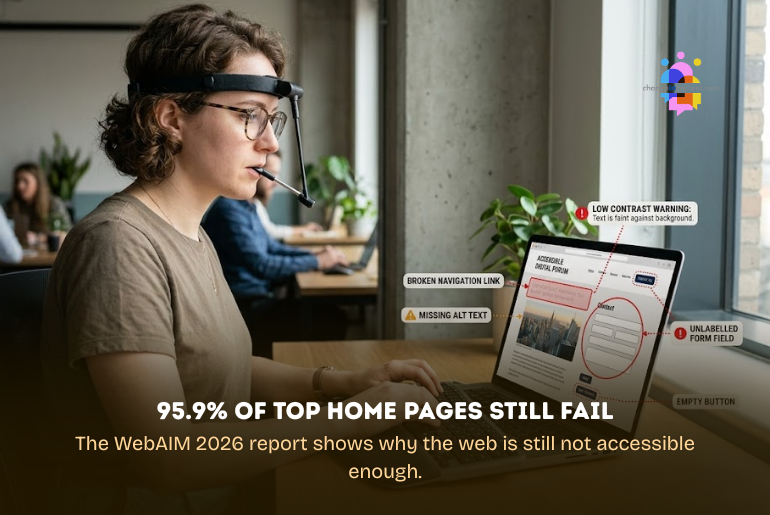
Web accessibility in 2026 presents a troubling picture of the internet. According to the latest WebAIM Million report, 95.9% of the home pages of the world’s top one million websites had detectable Web Content Accessibility Guidelines failures. In simple terms, most of the web still creates barriers for persons with disabilities, even on the most visible and influential websites.
For the eighth year in a row, WebAIM reviewed the home pages of the world’s top one million websites using automated accessibility scans. The report found 56,114,377 distinct accessibility errors, averaging 56.1 errors per home page. That was a 10.1% rise from 2025, when the average stood at 51 errors per page.
We take a closer look at what the latest report reveals, where the web currently stands and how much work still needs to be done to make online spaces more inclusive.
Key takeaway
Web accessibility affects whether people can read content, submit forms, shop online, apply for jobs, access government services, use banking websites, learn online, or navigate digital life independently. Accessibility now matters even more because search engines and AI systems reward content and websites that are structured, usable, clear, machine-readable, and people-first. A website that excludes users also weakens its trust, reach, and discoverability.
Web accessibility in 2026: The report shows that a bigger web is not always a better web
The WebAIM report offers a detailed look at how accessible the internet really is today, based on automated scans of these websites.
The findings show that accessibility barriers remain a major problem across the web. Although there has been some improvement over the years, progress has been slow and uneven.
- In 2020, 98.1% of home pages had detected accessibility errors.
- That number dropped to 94.8% in 2025.
- However, the 2026 report found that 95.9% of home pages still had detectable failures under WCAG 2 standards.
One major reason behind this rise is the growing complexity of modern websites. The one million Home pages analysed together contained more than 1.4 billion page elements. In February 2026, the average Home page had 1,437 elements. That is a 22.5% increase in just one year. Compared to seven years ago, the number of elements on home pages has nearly doubled.
As websites become larger and more crowded with features, accessibility issues are also increasing. According to WebAIM, 3.9% of all Home page elements had an accessibility error. It means users with disabilities could expect to encounter an accessibility problem in about 1 in every 26 elements they interact with on a home page.
What this means for a real user
A technical error on a website may appear minor in a report. But for a real user, it can become a locked door.
- Low contrast can make text hard to read.
- Missing alternative text can leave a screen-reader user without important information.
- An unlabelled form field can make it difficult to fill out an application.
- An empty button can stop someone from completing a payment.
- A broken link can interrupt access to healthcare, education, banking, shopping, public services, or employment.
That is why web accessibility cannot be treated as a compliance-only issue. It is about whether people can participate in digital life without asking for help at every step.
95.9% of Home pages still fail detectable WCAG checks
The report found that 95.9% of home pages had detectable failures under WCAG 2 accessibility standards. That is slightly worse than 2025, when 94.8% of home pages showed errors, reversing the slow improvements seen over the previous six years.
Since the study only examined accessibility problems that can be automatically detected, the actual state of accessibility may be worse. Automated scans are useful, but they cannot catch every accessibility issue that a disabled user may experience. They can identify several common failures, but they do not fully replace manual testing, assistive technology testing, or lived-experience testing.
At the same time, the report also shows that improvement is possible. Around 20.5% of home pages had five or fewer detected errors, while 30.4% had ten or fewer. That means many websites could become significantly more accessible by fixing a small number of repeated issues.
The report also highlighted that 96% of all detected accessibility errors fall under just six common categories. These are the same issues that have consistently appeared across the last several years. Fixing these repeated problems alone could make a major difference for users with disabilities.
The most common issues
As per the report, the most common accessibility issues found were:
| WCAG Failure Type | % of home pages |
| Low contrast text | 83.9% |
| Missing alternative text for images | 53.1% |
| Missing form input labels | 51% |
| Empty links | 46.3% |
| Empty buttons | 30.6% |
| Missing document language | 13.5% |
(Source: https://webaim.org/projects/million/)
Web accessibility in 2026: 6 fixable problems are causing most of the damage
The most frustrating part of the report is that many failures are not rare, complex, or mysterious. They are basic.
- Text should be readable.
- Images should have meaningful descriptions where needed.
- Forms should tell users what information is required.
- Buttons should have labels.
- Links should make sense.
- Pages should declare their language.
These are not advanced accessibility luxuries. They are foundational to digital hygiene.
For brands, publishers, e-commerce companies, government bodies, education platforms, and employers, this should be a wake-up call. Accessibility failures are not only technical mistakes. They can damage trust, reduce conversions, weaken user experience, increase legal and compliance risk, and exclude people from essential services.
That is also why Changeincontent recently explored the wider digital inclusion conversation in our article on GAAD 2026 and the continuing challenge of digital accessibility. Awareness matters, but awareness without implementation keeps disabled users waiting outside the digital door.
Which industries are still failing web accessibility in 2026?
The WebAIM report found major differences in accessibility performance across industries. Some sectors performed better than the overall average, while others continued to show very high numbers of accessibility errors on their home pages.
The best performers
Government websites had the lowest average number of errors, at 42.4 per page. The non-profit and charity websites follow with an average of 43 errors per page. Science, personal finance, careers, and education-related websites also performed better than the average across the one million sites studied.
The worst performers
Shopping and sports websites ranked among the worst performers. Shopping websites averaged 71 accessibility errors per page, while sports websites averaged 71.4 per page. That means both performed significantly worse than the overall average home page analysed in the report.
What about the other industries?
Other industries with high accessibility error rates included style and fashion, home and garden, hobbies and interests, real estate, travel, entertainment, and news websites. These categories often rely on visually heavy designs, interactive features, advertisements, complex layouts, pop-ups, media modules, and fast-changing content, all of which can lead to accessibility failures if not carefully designed.
The data highlights that accessibility gaps are not evenly spread across the web. Depending on the type of website people visit, their online experience can vary greatly, especially for users with disabilities.
A government service may be more accessible than a shopping website. A careers platform may perform better than a fashion website. A news site may publish public-interest information, but still make it hard for disabled readers to access.
That contradiction is exactly why web accessibility must become part of digital strategy, not a repair job after launch.
The Changeincontent perspective
The Web Accessibility 2026 numbers should bother anyone who believes the internet is public infrastructure.
The web is no longer a luxury space. It is where people study, search, work, bank, shop, apply for jobs, book healthcare appointments, access government services, read the news, run businesses, and participate in society. If 95.9% of leading home pages still show detectable accessibility failures, then exclusion is not happening at the margins. It is built into the everyday internet.
The most painful part is that many of these failures are fixable. Low contrast text. Missing alt text. Unlabelled forms. Empty buttons. Empty links. Missing page language. These are not impossible problems. They are signs that accessibility is still being treated as someone else’s responsibility.
That has to change.
Designers must think beyond aesthetics. Developers must test beyond visual appearance. Content teams must write for clarity and structure. Founders must treat accessibility as product quality. Marketers must understand that reach means little if people cannot use the page. SEO teams must recognise that accessibility, discoverability, and user experience now sit closer together than ever.
For AI search, this matters too. The future of discoverability will reward content that is structured, readable, accessible, and trustworthy. A website that is difficult for people to use is also often difficult for systems to interpret well.
Accessibility is not a favour to disabled users. It is a standard that improves the internet for everyone.
The web does not need more beautiful barriers. It needs digital spaces that people can actually use.
Editorial Note and Disclaimer
This article is part of Changeincontent’s DEI Insights section, where we examine inclusion, accessibility, digital equity, public systems, and workplace participation through an evidence-led editorial lens. The article is based primarily on the WebAIM Million 2026 report, which used automated scans of the home pages of the world’s top one million websites to detect selected WCAG 2 accessibility failures.
Changeincontent has interpreted the findings for public-interest discussion and practical understanding. Automated testing does not identify every accessibility barrier, so the report should be seen as an indicator of large-scale digital accessibility patterns, not a full manual accessibility audit of each website.
Sources
WebAIM Million 2026 Report: Primary source for the 2026 accessibility scan of the top one million website home pages, including WCAG failure rates, error totals, page complexity, common issues, and industry categories.
WebAIM Million 2025 Report: Source for comparison with 2025 findings, including the previous 94.8% WCAG failure rate and common accessibility failures.
Level Access article on common accessibility errors: Supporting source on common accessibility issues and the concentration of errors across recurring categories.
