
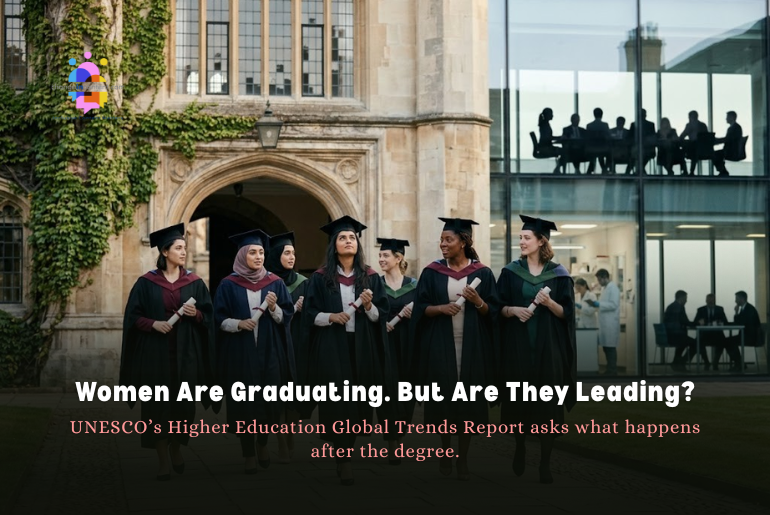
UNESCO’s Higher Education Global Trends Report has found that women now outnumber men in higher education across most parts of the world. In 2024, there were 114 women enrolled in higher education for every 100 men globally, and gender parity had been reached in every region except sub-Saharan Africa.
The report shows undeniable progress. However, it also exposes a familiar contradiction. It shows that women are entering universities, completing degrees, and performing well. Still, many disappear before they reach leadership, research, and decision-making spaces.
That is the part that should make us pause. The story is no longer only about whether women are capable, qualified, or ambitious. The data already answers that. Women are proving themselves in classrooms and universities across countries. The harder question is what happens after graduation, when the world outside education still runs on unequal care work, biased promotion systems, pay gaps, insecure employment, and leadership cultures that often reward men faster.
Key takeaway from UNESCO’s Higher Education Global Trends Report
Women’s educational success is real, but education alone does not guarantee power. The gap is moving from access to outcomes. If women are graduating in larger numbers but still underrepresented at the doctoral level, senior academic leadership, high-paying jobs, and institutional decision-making, then the problem is no longer women’s readiness. It is the system’s refusal to keep pace with women’s progress. The
Higher Education Global Trends Report shows women rising in classrooms but not in leadership.
According to UNESCO’s first Higher Education Global Trends Report, gender parity in higher education has been reached in every region except sub-Saharan Africa.
More women are enrolling in universities, completing degrees, and performing well academically. In many countries, women are now more likely than men to enter and finish higher education. The report, based on data from 146 countries, found that in 2024, there were 114 women enrolled in higher education for every 100 men globally.
The progress
The study also highlighted major progress in Central and Southern Asia. In 2000, the region had only 68 women enrolled for every 100 men in higher education. By 2023, it had reached gender parity.
The report further noted the massive growth in higher education worldwide over the past two decades. The number of students enrolled globally more than doubled, rising from around 100 million in 2000 to 269 million in 2024.
At one level, this is a remarkable education story. For generations, the society has told girls and women that classrooms were not always for them. Moreover, higher education was optional for girls, ambition demanded negotiations with family expectations, and that education mattered only up to a point. The global numbers now tell a very different story.
The persistent gender gaps
But the report also shows that gender gaps continue beyond enrolment. Women remain underrepresented at the doctoral level. They account for 47% of students, even though they make up the majority at the Bachelor’s and Master’s levels. UNESCO also notes that women hold only about one-quarter of senior leadership positions in academia.
The degree is not the end of the pipeline
That is where the celebration becomes complicated.
If women are doing better in higher education, why are they not equally visible in research, leadership, academic governance, workplace power, and decision-making?
The answer is that a degree can open a door, but it does not remove the systems waiting outside it. Women may graduate in larger numbers, but after graduation, they enter labour markets, institutions, families, and workplaces that still operate under older rules.
The result is a familiar pattern.
Women rise in education, then thin out in doctoral pathways. They enter professional spaces, then slow down in promotion pipelines. They build expertise, then remain underrepresented where authority is concentrated.
That is why the education-to-employment gap matters. Changeincontent has previously examined this challenge in India, where women’s educational progress does not always translate into equal workforce participation, leadership, or economic independence. You can read the analysis here.
Why do women disappear after educational success?
Even though women are outperforming men in education and earning more degrees globally, many still struggle to stay, grow, and lead in professional spaces later on.
Unpaid care and domestic work
One major reason is the unequal burden of unpaid care and domestic work. Across the world, women perform at least two and a half times as much unpaid care and domestic work as men. That leaves women with less time, flexibility, and support for career growth, higher studies, research, networking, travel, long-hour roles, or leadership tracks.
This burden does not always appear in a résumé. It appears in missed conferences, rejected fellowships, delayed doctoral work, shorter work hours, lower geographic mobility, slower promotions, and the quiet pressure to choose “manageable” careers over ambitious ones.
Lower-paid jobs
Women are also more likely to be in insecure or lower-paid jobs compared with men. Even when qualifications are equal, workplace systems often continue to favour men in promotions, visibility, leadership opportunities, and long-term career stability.
The global gender pay gap remains around 20%, according to UN reporting. That means women still earn less than men on average despite their educational gains. Over time, lower pay, limited promotion pathways, and unpaid caregiving responsibilities can push women out of spaces where their qualifications should have advanced them.
That is not a failure of individual women. It is the cost of systems that still treat women’s work as supplementary, women’s time as flexible, and women’s ambition as conditional.
What must change after women graduate?
The UNESCO report makes it clear that improving access to education alone is not enough. Women are already proving themselves in classrooms and universities. The bigger challenge now is making sure they receive equal opportunities after graduation.
Many experts say workplace systems still reward men differently from women. OECD analysis has found that a significant share of the gender wage gap stems from differences within firms. That includes unequal tasks, responsibilities, pay structures, and possible discrimination among people with similar qualifications.
There are also deep-rooted assumptions around work and caregiving. Men are more likely to be seen as “ready” for management and leadership roles. In contrast, women are often viewed as less available because of family or caregiving responsibilities.
Claudia Goldin, who won the 2023 Nobel Prize in Economics, has pointed to the role of “greedy jobs.” That demands long, inflexible working hours and rewards constant availability. These roles are still largely filled by men, partly because women continue to carry a larger share of unpaid care and domestic work at home.
From education access to career power
The solutions need to go beyond education.
Better parental leave, affordable childcare, equal pay policies, flexible work options, safer workplaces, pay transparency, mentorship, leadership sponsorship, and stronger support for women in research and senior roles can help reduce these gaps over time.
Universities also have a role to play.
If women outnumber men in higher education but are dropping off at the doctoral and leadership levels, institutions must examine what happens within academic pipelines.
- Who gets encouraged to pursue research?
- Who gets funded?
- Who gets published?
- Who gets invited to conferences?
- Who gets mentored for leadership?
- Who is expected to pause when family responsibilities appear?
Employers must ask similar questions.
- Who gets hired into high-growth roles?
- Who is trusted with visible projects?
- Who receives promotions after motherhood?
- Who has access to flexibility without penalty?
- Who gets leadership training?
- Who is allowed to be ambitious without being judged?
Women are not disappearing because they lack talent, ambition, or education. Many are still being held back by systems that have not kept pace with women’s advancement.
The Changeincontent perspective on the Higher Education Global Trends Report
The Higher Education Global Trends Report gives the world a powerful reason to celebrate.
Women are entering higher education in larger numbers. They are completing degrees. They are outperforming old assumptions. In many regions, they have already changed the face of university classrooms.
But celebration without accountability can become a trap.
If women are graduating in greater numbers but still missing from doctoral pipelines, academic leadership, boardrooms, research institutions, policymaking spaces, and high-paying jobs, then we need to stop asking whether women are ready. The evidence says they are.
The better question is whether the world after graduation is ready for them.
For too long, people have presented education as the great equaliser. Study hard. Earn the degree. Prove yourself. Enter the workforce. Rise.
But for many women, the story does not move that cleanly.
- The degree comes home with them, but so does unpaid care.
- The qualification enters the office, but so does bias.
- The ambition arrives, but the workplace still rewards constant availability.
- The talent exists, but leadership pipelines remain narrow.
The next phase
The next phase of gender equality cannot stop at university gates.
A society that educates women but does not employ them fairly is wasting talent. A workplace that hires women but does not promote them is performing inclusion. An academic system that enrols women but does not move them into research leadership is celebrating the pipeline while ignoring the leak.
Women have done their part. They have entered, studied, graduated, and proved the point. Now institutions must prove theirs.
Editorial Note and Disclaimer
This article is part of Changeincontent’s Mosaic section, where we examine social change, gender, education, work, inclusion, and public data through an editorial lens. The article is based on UNESCO’s first Higher Education Global Trends Report and related public information from UNESCO on higher education enrolment, gender parity, doctoral participation, and academic leadership.
It also draws on credible international sources on unpaid care work, gender pay gaps, and workplace inequality to explain why women’s educational gains do not automatically translate into equal career outcomes.
Changeincontent has used these findings for public-interest analysis and does not claim that patterns are identical across all countries, institutions, disciplines, or communities.
Sources
1. UNESCO: Reported findings from the first Higher Education Global Trends Report, including 114 women enrolled for every 100 men globally, gender parity in all regions except sub-Saharan Africa, Central and Southern Asia’s progress, and women’s underrepresentation in doctoral and senior academic leadership roles.
2. UNESCO Higher Education Page: Lists the 2026 Higher Education Global Trends Report titled Towards inclusive, equitable and quality higher education in an internationally mobile landscape.
3. UNESCO on X: Highlighted that women remain underrepresented at the doctoral level and hold only around one-quarter of senior leadership positions in academia.
4. UN Women/Asia-Pacific report on unpaid care and domestic work: States that women perform at least two and a half times more unpaid care and domestic work than men globally.
5. United Nations, International Equal Pay Day: Notes that the global gender pay gap is estimated at around 20%.
6. UN Women Economic Empowerment Facts And Figures: Notes that the gender wage gap is estimated at 20% and discusses the motherhood wage penalty.
7. OECD Ecoscope: Explains that a large share of the gender wage gap reflects differences within firms, including differences in tasks and responsibilities, and possible discrimination.
