
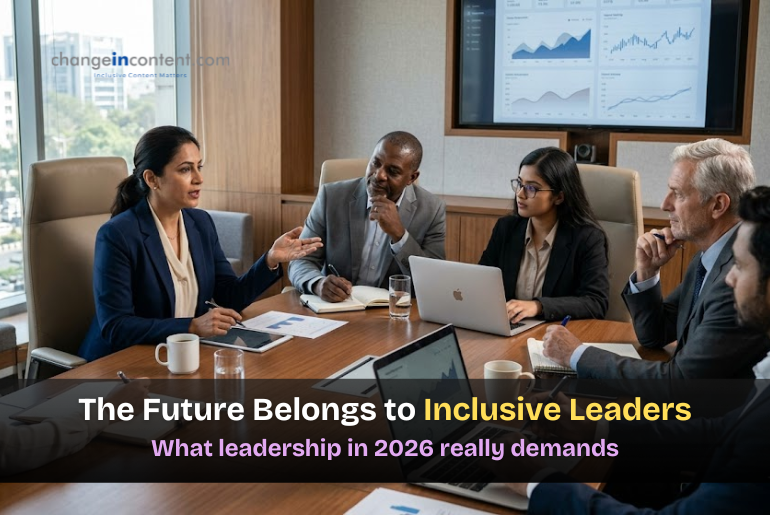
Inclusive leadership in 2026 is no longer a forward-looking concept for conference panels and annual reports. It is a present-tense leadership test. Across industries, the assessment of a leader is not limited to what they build. Instead, what defines them is who gets heard in their team, who gets left behind, and whether their teams feel safe enough to contribute fully.
In a workplace shaped by artificial intelligence, economic anxiety, social polarisation, hybrid work, and widening inequality, inclusion is no longer a soft skill. It is a strategic infrastructure. The companies that understand this are not just building better cultures. They are building stronger institutions.
This article is for founders, CXOs, people managers, HR leaders, board members, and anyone whose decisions shape workplace culture. It examines what inclusive leadership looks like now, how it is evolving, and what trends are defining 2026. It also discusses areas where leaders are still failing, and what must change if organisations want to build workplaces where people can actually thrive.
The article also shows the role of platforms like Changeincontent, which are attempting to shift the conversation from symbolic inclusion to institutional accountability.
Why inclusive leadership in 2026 has moved from culture talk to business reality
For years, we framed inclusive leadership as an extension of workplace ethics. It was sitting alongside conversations about empathy, representation, and values. That framing is no longer sufficient. The evidence now points to something much more practical.
Organisations that invest in gender equality and inclusive systems report stronger outcomes in innovation and decision-making. They are more attractive to clients and investors and promote broader employee fairness. Grant Thornton’s 2025 Women in Business research found that:
- 33% of leaders saw cultural benefits in the form of employees feeling more equally treated
- 23% reported stronger innovation
- 20% reported improved client and investor attractiveness
- 19% reported better decision-making linked to gender equality strategies.
Why does it matter?
It matters because the external environment has become less forgiving. The World Economic Forum’s Future of Jobs Report 2025 makes clear that business leaders are operating in a labour market being reshaped by technological change, geoeconomic fragmentation, demographic transitions, cost pressures, and the green transition. It shows that:
- More than two-thirds of employers expect to hire for AI-specific roles
- 77% plan to upskill workers
- 63% identify skills gaps as the biggest barrier to transformation
The significance of these numbers
The findings of these reports are not just workforce issues. They are leadership issues. If organisations are going to navigate these shifts fairly and effectively, leaders will need to know how to manage change without reinforcing old inequalities.
Inclusive leadership, then, is no longer just about being respectful or progressive. It is about whether a leader can build trust during uncertainty, distribute opportunity fairly, and question bias embedded in systems. Moreover, whether a leader can create an environment where different people can contribute without having to shrink, perform, or assimilate.
What inclusive leadership looks like in 2026
In practice, slogans, values posters, or the occasional listening session do not define inclusive leadership today. Instead, inclusive leadership is visible in daily behaviours, structural choices, and the quality of decision-making.
A truly inclusive leader does not merely say that all voices matter. They redesign meetings so that quieter voices can find a space. These leaders do not speak vaguely about fairness. Instead, they examine who gets stretch assignments, who gets informal sponsorship, and who gets judged more harshly for the same behaviour.
That is where many organisations still get it wrong. They assume inclusive leadership is mainly about tone. It is not. Tone matters, but structure matters more.
The issues with organisational design
McKinsey and LeanIn’s Women in the Workplace 2025 report shows that women still receive less career support, fewer advancement opportunities, and less manager advocacy. For the first time, the report also flags a notable ambition gap.
It also makes a crucial point that too many leaders miss: when women receive the same levels of support as men, the gap in desire to advance disappears. That means the issue is not simply individual aspiration. It is organisational design.
Inclusive leadership in this context means recognising that talent does not rise in a vacuum. It rises in systems that either support it or suppress it. A leader who understands inclusion will therefore ask uncomfortable but necessary questions.
- Who is not speaking in this room and why?
- Who gets coached and who gets criticised?
- Who is being prepared for influence, not just performance?
The forces shaping inclusive leadership in 2026
If 2025 was the year many organisations realised that inclusion could no longer be delegated, 2026 is the year leaders will have to internalise that truth.
Artificial intelligence
The first major force shaping Inclusive Leadership 2026 is AI. Artificial intelligence is already influencing hiring, task allocation, performance evaluation, skills expectations, and workplace visibility. The risk is not only technological disruption. It is a biased disruption.
McKinsey’s latest research shows that entry-level women are more worried than men about AI’s impact on their jobs. Unfortunately, they receive less encouragement from their managers than men to use AI tools. Data shows that only 21% of entry-level women report being encouraged by their managers to use AI, compared with 33% of men at the same level.
If leaders do not intervene deliberately, AI could deepen opportunity gaps rather than close them.
Generational change
The second force is generational change. Deloitte’s 2025 Gen Z and Millennial Survey found that these generations are prioritising money, meaning, and well-being. They are also placing strong emphasis on learning and development.
Only 6% of Gen Z respondents say reaching senior leadership is their primary career goal. It would be incorrect to look at that as a sign of disengagement. It is a sign that younger workers are rejecting leadership models that look exhausting, extractive, or ethically thin.
If leaders want to attract and retain this workforce, they must ensure that inclusion is not just policy. The younger workers must feel it in culture, growth pathways, and everyday management.
Trust
The third force is trust. The 2025 Edelman Trust Barometer shows that institutions are operating in a climate of grievance, fear, and declining public faith. That gives employers unusual influence, but it also creates responsibility.
Leaders can no longer assume trust comes from hierarchy. It now comes from fairness, competence, and transparency. It also comes from whether employees believe leadership is willing to address discrimination and inequity honestly.
Psychological safety is the foundation, not a trend.
If one leadership capability deserves more serious attention in 2026, it is psychological safety. Too many leaders still treat it as a vague people concept. In reality, it is one of the clearest predictors of whether diverse teams will actually function well.
Google’s re:Work research on team effectiveness, drawing on the widely cited concept developed by Amy Edmondson, found that teams with a strong culture are:
- more likely to harness varied ideas
- less likely to lose people
- more likely to be rated effective by executives.
In other words, inclusion only becomes useful when people feel safe enough to contribute their real thinking. It has serious implications. A team can be diverse on paper and still intellectually narrow in practice if members do not feel safe challenging authority, exposing uncertainty, or naming bias.
The role of inclusive leadership in ensuring psychological safety
Inclusive leadership requires more than civility. It requires leaders to lower the interpersonal cost of honesty. That means:
- Responding to dissent with curiosity instead of defensiveness
- Setting clear expectations for respectful disagreement
- Demonstrating that speaking up will not quietly damage someone’s reputation.
That is also where performative inclusion begins to unravel. Leaders often say they want candour, but reward predictability. They say they welcome different perspectives, but only when those perspectives arrive in acceptable tones.
Inclusive leadership in 2026 will require a more disciplined self-awareness than many leaders are used to. It will require them to examine not just what they say they value, but what they repeatedly reward.
Where inclusive leadership is still failing in 2026
For all the talk of progress, the gaps remain obvious.
Senior leadership pipelines continue to narrow sharply for women and other underrepresented groups. McKinsey reports that women still hold only 29% of C-suite roles. Moreover, they remain underrepresented at every stage of the pipeline.
Grant Thornton’s 2025 research notes that parity in senior management globally is still decades away at the current pace. And in the UK, even where women now hold 44% of FTSE 100 board seats, progress in the top executive roles remains slow. Only 9 female FTSE 100 chief executives reported in early 2026.
Distribution, not representation
The problem is not only representation. It is role distribution. Women are still more visible in staff or support functions than in enterprise authority roles. Inclusion efforts are also often rolled back precisely when organisations face pressure.
McKinsey’s 2025 findings show some organisations scaling back remote and hybrid work, bias training, allyship training, formal sponsorship, and targeted development programmes. When you treat inclusive supports as optional in difficult times, leaders reveal what they truly consider core.
That is why inclusive leadership cannot depend on personal goodwill alone. A leader has to embed that in decisions about promotions, flexibility, AI use, pay transparency, succession planning, and manager evaluation.
We have already explored part of this business case in our earlier article on how companies investing in gender equality see measurable returns. That conversation remains essential here because inclusion without executive seriousness quickly becomes theatre.
What leaders must do differently now?
Inclusive leadership in 2026 will require leaders to move from symbolic commitment to deliberate design. That begins with how they think, not how they brand themselves. Leaders need to become more rigorous about asking better questions.
- Who is benefiting from this system?
- Who is invisible in this process?
- What friction does this policy create for someone with a different lived reality than mine?
They will also need to become more literate in the systems shaping inclusion today. They must consider the fact that, as a leader, they:
- Cannot leave AI governance to technical teams alone
- Cannot discuss flexible work only as a productivity issue
- Cannot analyse career progression without looking at sponsorship, pay, access to networks, and caregiving realities.
Inclusive leadership is increasingly interdisciplinary. It sits at the intersection of ethics, business, technology, and culture.
There is also a more personal demand. Leaders must get more comfortable with uncertainty and correction. The old model of authority rewarded certainty. The next model will reward intellectual humility.
The strongest leaders in 2026 will not be the ones who always have the right answer. They will be the ones who can create the conditions for better answers to emerge from more people.
What the future of inclusive leadership will likely look like
The future of inclusive leadership will be less performative and more measurable.
- Stakeholders will expect clearer reporting, not just value language.
- Employees will expect evidence that fairness exists in opportunity, not only in communication.
- Younger workers will continue to ask whether organisations are helping them grow, protecting their well-being, and giving them meaningful work.
- AI will force leaders to confront whether efficiency is coming at the cost of equity.
- Trust will remain fragile, which means leadership legitimacy will increasingly depend on the extent to which fair decision-making holds under pressure.
The leaders who matter in this environment will not be those who simply say the right things about diversity. They will be those who can integrate inclusion into hiring, product design, performance management, technology adoption, and strategic communication.
These leaders will know that culture is not separate from business performance. It shapes it.
The Changeincontent perspective
At Changeincontent, we do not believe inclusive leadership is an admirable trend cycle to be appreciated and moved on from. We see it as one of the defining questions of workplace evolution.
If content shapes culture, then leadership shapes the content of an organisation’s daily life: what is rewarded, what is ignored, what is tolerated, and what becomes normal.
That is also where our role becomes crucial. We are not trying to decorate the inclusion conversation; we are trying to deepen it. We write about policies, labour realities, women’s work, leadership pipelines, bias, health, finance, and representation.
You cannot think of building inclusive leadership in abstraction. Leaders need context. They need data. They need language to understand structural issues that are too often individualised. And they need to be pushed, respectfully but firmly, beyond symbolic optimism.
Inclusive leadership will not be built by a single workshop or a single leader. It will be built by organisations willing to see inclusion as a strategy, and by public platforms willing to keep the conversation honest.
Conclusion: Inclusive leadership in 2026 will be defined by what leaders are willing to change
Inclusive leadership in 2026 will not be judged by intention. It will be judged by design, discipline, and courage.
The leaders who will matter are the ones willing to question systems that seem efficient but exclude people, metrics that appear neutral but reproduce bias, and cultures that call themselves open while quietly punishing candour.
The workplace is changing too quickly for old leadership habits to survive untouched. AI is changing decisions. Younger workers are changing expectations. Trust is changing shape. Inclusion can no longer sit in the background.
The future belongs to leaders who understand that fairness is not weakness, curiosity is not indecision, and shared power is not loss. It is how modern institutions stay legitimate.
Disclaimer: The views expressed in this article are based on the writer’s insights, supported by data and resources available both online and offline, as applicable. Changeincontent.com is committed to promoting inclusivity across all forms of content. We broadly define inclusivity in terms of media, policies, law, and history. It encompasses all elements that influence the lives of women and marginalised individuals. Our goal is to promote understanding and advocate for comprehensive inclusivity.
