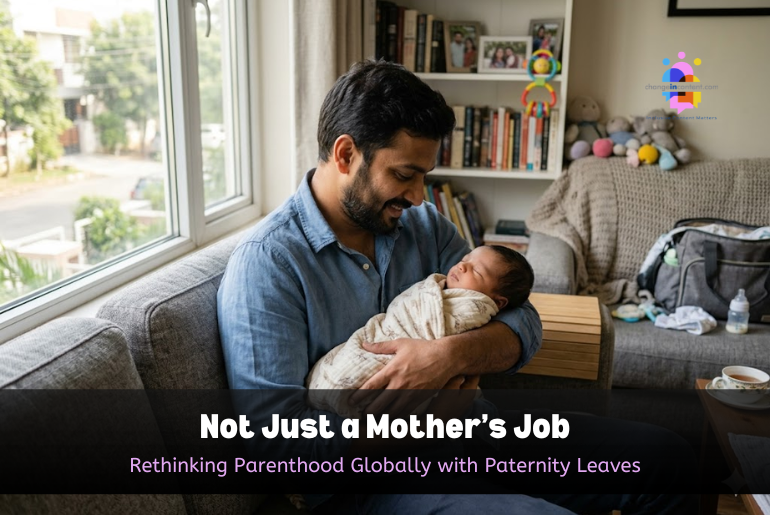
Paternity leave around the world is no longer a fringe policy conversation. It is fast becoming a defining marker of how societies understand parenting, gender roles, and workplace equity. The question is no longer whether fathers should be present after childbirth. The real question is whether systems (legal, corporate, and cultural) are designed to make that presence possible.
Because here is the reality. When a child is born, biology may briefly differentiate roles. But beyond that, caregiving is not gendered. And yet, across most parts of the world, systems continue to treat it as if it is.
Why paternity leave is not a “Nice-to-Have” policy?
For decades, the society and laws have framed maternity leave as a necessity. Conversely, they treat paternity leave as optional, almost symbolic. This distinction has quietly shaped the distribution of caregiving responsibilities.
When fathers are not given structured time off:
- Mothers absorb the physical and emotional burden of recovery and caregiving
- Women’s careers are disproportionately impacted
- Fathers remain peripheral in early parenting stages
The result is not just unequal households, but unequal workplaces.
Research across OECD countries consistently shows that when fathers take leave early, long-term outcomes shift. Women return to work sooner. Childcare becomes more balanced. And most importantly, caregiving stops being seen as a woman’s default responsibility.
Paternity leave, therefore, is not just a family policy. It is an economic and social correction.
Paternity leave around the world: A snapshot of the policies
The global landscape of paternity leave reveals a clear pattern. It shows that countries that prioritise equality have moved beyond token leave and built structured parental systems.
Paternity leave in Sweden
In Sweden, one of the most progressive models, parents are entitled to 480 days of paid parental leave. They have a fixed portion reserved exclusively for each parent. This “use-it-or-lose-it” model ensures that fathers actually take their leave, rather than transferring it to mothers.
Paternity leave in Iceland
Iceland goes a step further. They offer a shared parental leave system with equal quotas. It means that each parent gets dedicated time that they cannot transfer. The design itself enforces equality.
Paternity leave in Norway
In Norway, parents can access extensive parental leave. The structure balances flexibility with responsibility. Fathers are encouraged, and in many cases expected, to take a defined portion of leave.
Paternity leave in Spain
Spain has emerged as one of the most striking examples in recent years. The country offers equal paternity and maternity leave (currently 16 weeks each). It is not just progressive; it is transformative, because it removes the employer bias of hiring women over men.
Paternity leave in Japan
Japan, often seen as conservative in workplace culture, offers up to one year of parental leave, with wage compensation through social insurance. However, uptake among men remains low. That highlights a key lesson: policy alone is not enough. Culture must follow.
Paternity leave in Denmark and the Netherlands
In Denmark and the Netherlands, structured parental leave systems offer flexibility, with an increasing emphasis on encouraging fathers to take time off.
Across these examples, one idea stands out: The most effective systems are not the most generous. They are the most intentional.
The corporate world is moving faster than the governments
Interestingly, in many countries (including India), corporates have begun to move faster than legislation. Global companies like Google, Microsoft, Netflix, and Deloitte offer paternity leave ranging from several weeks to several months. These policies are not driven purely by goodwill. They are strategic.
Organisations have realised that:
- Supporting fathers improves employee retention
- Shared caregiving reduces burnout among women employees
- Inclusive policies enhance employer branding
In many ways, corporate policies are becoming a testing ground for what future legislation might look like.
India’s position: Between policy gaps and cultural expectations
India presents a unique case.
Legally, paternity leave exists only for government employees. They are entitled to 15 days of fully paid leave under the Central Civil Services Rules. However, they must take this leave within a limited timeframe and only under specific conditions.
In the private sector, there is no law mandating it. Policies vary widely across organisations, often depending on leadership mindset rather than legal obligation.
This creates a fragmented reality:
- Some employees receive structured leave
- Others rely on informal arrangements
- Many receive no support at all
At the same time, cultural expectations continue to position fathers as secondary caregivers. We explored this imbalance in detail here.
The gap, therefore, is not just legislative. It is philosophical.
The real barrier: Not policy, but perception
Even in countries with strong policies, uptake among men is not always high. Why? Because paternity leave challenges deeply embedded ideas:
- That caregiving is “natural” for women
- That men must prioritise work over family
- That taking leave signals a lack of ambition
This is where many systems fail. They create policies but do not address perception. And perception shapes behaviour far more than policy.
What paternity leave around the world teaches us
When we step back and look at global trends, a few lessons become clear.
- First, equality cannot be optional. If leave is transferable, it often ends up being used by mothers. Structured, non-transferable leave for fathers creates participation.
- Second, policy must align with incentives. Wage compensation and job security play a critical role in ensuring uptake.
- Third, cultural change must accompany legal change. Without it, even the best policies remain underutilised.
- And finally, paternity leave is not just about fathers. It is about redesigning how societies view care, work, and responsibility.
The Changeincontent perspective
At Changeincontent, we see paternity leave as a mirror. It reflects how seriously a society takes equality. Because equality is not tested in boardrooms or policy documents, it is tested in everyday life, such as inside homes, during vulnerable moments, when support is needed the most.
If systems continue to assume that women will “manage,” then no amount of workplace inclusion will truly level the field.
Paternity leave forces a shift. It asks organisations, governments, and families to recognise that caregiving is not a favour men extend. It is a responsibility they share. And until that shift happens, conversations around equality will remain incomplete.
Conclusion: Paternity leave around the world is a signal, not just a policy
Paternity leave around the world is telling us something important. The countries that are getting this right are not just supporting families. They are redesigning society. They are recognising that:
- Work and care must coexist
- Equality must be built into systems
- Parenthood must be shared
For India, the opportunity is clear. The question is whether we will treat paternity leave as an add-on or as a foundational step toward real equality.
Because in the end, this is not about leave. It is about who carries the weight of raising the next generation.
Disclaimer: The views expressed in this article are based on the writer’s insights, supported by data and resources available both online and offline, as applicable. Changeincontent.com is committed to promoting inclusivity across all forms of content. We broadly define inclusivity in terms of media, policies, law, and history. It encompasses all elements that influence the lives of women and marginalised individuals. Our goal is to promote understanding and advocate for comprehensive inclusivity.