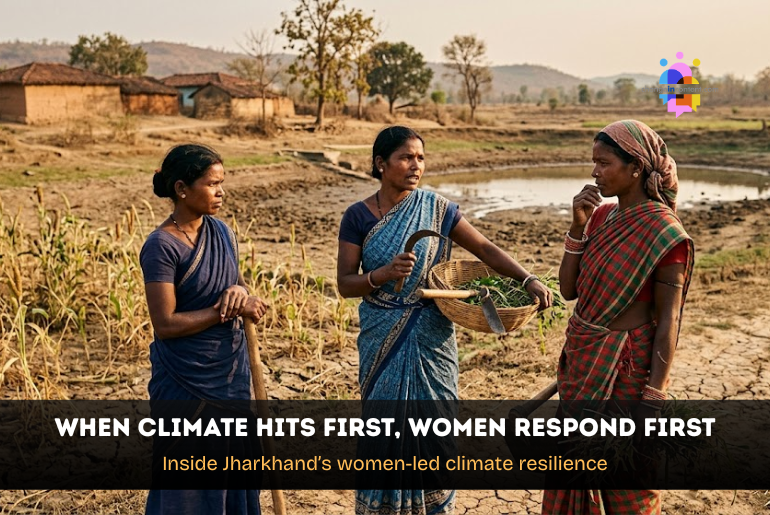
‘Gender and Climate’ are inseparable in stories about women in Jharkhand. That is because climate stress does not arrive as an abstract environmental event. It arrives as a failed crop, a weakened forest economy, a longer journey to collect water, a smaller meal, a delayed school day, or another unpaid burden added to a woman’s life. In a state where livelihoods remain deeply tied to land, forest produce, rain cycles, and local ecological stability, climate change is not just altering the weather. It is rearranging the terms of survival.
This article examines how women in Jharkhand, particularly through self-help groups and community institutions, are emerging as frontline actors in climate resilience. We look closely at the link between gender and climate, the role of the Jharkhand State Livelihood Promotion Society, the significance of women-led climate planning, the economic role of programmes such as Palash, JOHAR, and Birsa Harit Gram Yojana, and what leaders, policymakers, and institutions can learn from this model of grassroots adaptation.
The larger point is not about praising women for enduring climate pressure. It is that systems must recognise, support, and scale the leadership they are already showing.
Women in Jharkhand show why one cannot separate Gender and Climate.
Generally, we treat the phrase ‘Gender and Climate’ as a policy category. However, in reality, it describes a power imbalance. Climate change does not affect everyone equally. That is because access to land, credit, technology, time, and decision-making is not equally distributed.
Women and girls are often more exposed to climate shocks. And that is not because women are inherently more vulnerable, but because the systems around them have made them carry a disproportionate share of care work, resource collection, and household survival.
The United Nations notes that women and girls bear disproportionate impacts from climate change. That is especially true in rural settings where they are often responsible for securing food, water, and fuel. When drought deepens, or rainfall becomes erratic, women tend to work longer, walk farther, and shoulder more unpaid labour.
That broader global reality becomes even sharper in a state like Jharkhand.
The Jharkhand story
The Government of Jharkhand notes that Scheduled Tribes formed 26.3% of the state’s population in the 2001 census. Over 91% of them lived in villages. That underlines how deeply questions of ecology, livelihood, and social identity remain intertwined in the state.
In such a setting, climate change is not merely an environmental challenge. It is a social stress test. And in the case of natural resource depletion, women often bear the first and hardest shock.
Women in Jharkhand are responding where the climate crisis is most real
The dominant climate narrative still tends to privilege conferences, policies, and corporate commitments. But the most immediate responses to environmental instability often emerge much lower down, in everyday local institutions.
In Jharkhand, one of the strongest such institutions is the self-help group network enabled by the Jharkhand State Livelihood Promotion Society. It functions as the state’s nodal livelihood agency under the Rural Development Department. Moreover, it implements the National Rural Livelihood Mission in Jharkhand.
Why does JSLPS matter?
A single intervention can rarely build climate resilience. That requires social infrastructure. Self-help groups provide precisely that.
SHGs create spaces where women discuss water, crops, debt, forest produce, nutrition, and local risk in collective rather than isolated ways. Nationally, India mobilises more than 10 crore women into over 90 lakh self-help groups under DAY-NRLM. (Source: PIB)
Jharkhand’s network operates within that much larger ecosystem. What makes the state distinctive is the strong connection of those women’s institutions to climate adaptation, livelihood planning, and local governance.
How women in Jharkhand connect ‘Gender and Climate’ at the grassroots
One of the most important developments in this area is the creation and rollout of specialised training modules on the interlinkages of gender and climate change. JSLPS developed these modules in partnership with Asar and the Child in Need Institute. They were launched in Ranchi in August 2025.
According to Asar, the modules aim to build awareness among women’s self-help groups about the gendered impacts of climate change. At the same time, these modules strengthen women’s leadership in shaping context-specific solutions. They also train women to support climate-resilient action rooted in local realities.
That is where the Jharkhand model becomes more interesting than a standard awareness campaign.
How does that make Jharkhand stand out?
The value of the modules lies not simply in explaining climate change. Their value lies in the fact that they allow women to name climate risk in relation to food, water, health, financial security, sanitation, and social protection.
In other words, they translate “climate change” from a distant concept into a set of visible pressures that women are already managing. Once that shift happens, women are no longer treated only as recipients of adaptation. They become analysts of local risk.
The use of trained community resource persons, often referred to as Setu Didis in the field, is especially significant because it localises climate learning. Advice does not arrive only from external experts. It moves through women who already understand village rhythms, local vulnerabilities, and the social realities of those they are working with.
That increases trust, usability, and the chances that action plans actually reflect lived conditions.
Why local climate planning matters more than generic resilience language
The strength of grassroots women’s groups lies not just in their ability to discuss problems. It is that they can identify patterns before formal systems do. Water stress, crop uncertainty, forest degradation, changing temperatures, livestock burdens, and seasonal income shocks are often first tracked socially before they are quantified administratively. That is one reason the emphasis on local climate action plans matters so much.
When women in self-help groups map vulnerability, they are not performing a symbolic exercise. They are identifying which households are most exposed, which water sources are failing, which crops are no longer dependable, and which local institutions can be leveraged. When such knowledge feeds into village-level planning and eventually into Gram Panchayat Development Plans, climate policy becomes less top-down and more ecologically honest.
The political importance of ‘Gender and Climate’
That is also where the connection between ‘Gender and Climate’ becomes politically important. If women’s experiences are absent from local planning, adaptation funds and interventions may still be deployed. However, they will often be poorly targeted. Climate resilience built without women’s knowledge tends to be incomplete because it misses where care work, resource scarcity, and survival burdens actually sit.
Women in Jharkhand and the economics of resilience
No discussion of climate resilience can remain at the level of awareness alone. A climate-vulnerable household also needs income stability, market access, and livelihood diversification. Jharkhand’s women-led institutions are increasingly operating in exactly that space.
PALASH by JSLPS
One of the most visible examples is Palash. It is the state-backed brand created through JSLPS to connect women’s products and produce to wider markets. Palash, launched in 2020, was designed to help women’s self-help groups in various ways:
- Consolidate indigenous and naturally derived goods
- Process and package them more effectively
- Sell them through Palash Marts and online platforms
The model spans production, collectivisation, packaging, branding, and market access. The same report notes that ownership remains with SHG women and their institutions. (Source: TOI)
Another report notes that the Palash model has gained wider recognition. The initiative is affecting millions of women through self-help groups. At the same time, it is creating thousands of roles in processing, packaging, and marketing.
Why does it matter for climate response?
When households depend on a single fragile income stream, climate shocks hit harder. Diversified livelihoods create buffer capacity.
A household earning income from food products, forest-based goods, or women-led market networks can often absorb seasonal shocks more effectively than one tied to a single crop cycle. Climate adaptation is therefore not only about water conservation or crop planning. It is also about redesigning local economies so they can survive disruption.
The significance of JOHAR and Birsa Harit Gram Yojana
While exploring the details of these projects, a broader pattern emerges. Women in Jharkhand are not simply being inserted into existing climate programmes. They are becoming central to the practical link between resilience and livelihood. That is a meaningful shift that redefines the link between ‘Gender and Climate.’
The JOHAR project adds another layer to this story.
JOHAR is a livelihood-focused project that aims to raise the income of rural households. It does so by linking them to producer groups and companies through advanced farming, fisheries, irrigation, livestock, and minor forest produce. The project aims to double the incomes of two lakh families.
The project also explicitly mentions resilient technologies, climate-risk reduction in paddy, and community-based micro-irrigation. That is not peripheral to the climate discussion. It is central. Climate resilience is far stronger when producers are organised, irrigated, and connected to value-added sectors.
The Birsa Harit Gram Yojana
The Birsa Harit Gram Yojana deepens that logic by linking afforestation to livelihoods. Official district information in Jharkhand describes it as a scheme that promotes tree planting and the enhancement of natural resources while also supporting livelihoods. The implementation happens through MGNREGA and local selection via Gram Sabhas.
Research on the scheme points to its role in combining environmental restoration with income generation for vulnerable households. Orchard-based livelihoods on degraded land matter not only because they restore green cover but also because they create medium- and long-term income opportunities in communities facing climate stress.
What the role of women in Jharkhand reveals about ‘Gender and Climate’ in practice
The biggest lesson from Jharkhand is that the relationship between gender and climate is not only about disproportionate harm. It is also about disproportionate leadership that often goes unrecognised.
When women organise through self-help groups, they generate forms of resilience that formal systems struggle to replicate. They bring local memory, social trust, labour coordination, and practical prioritisation. Women do not begin with abstract targets. They begin with what has stopped working and what must be made possible again.
It also aligns with wider evidence. A 2026 study published in the Journal of Rural Development, based on survey data from self-help groups in Giridih district, found that participation in SHGs was strongly linked to women’s economic autonomy, social mobility, and greater participation in decision-making.
That matters because climate action is rarely durable where women have no decision-making power. Resilience grows when women have organisational voice, social legitimacy, and income leverage.
What leaders, governments, and organisations should learn from Women in Jharkhand?
The first lesson is that climate action must stop treating women as a secondary audience. Women are not a vulnerable subgroup to be added later. In many places, they are the frontline managers of household adaptation. Policies that fail to account for that are not merely incomplete. They are inefficient.
The second lesson is that collective institutions matter. Too much climate programming still privileges individual beneficiary logic. The example of women in Jharkhand suggests that self-help groups, federations, producer collectives, and community resource persons may be among the most practical vehicles for climate adaptation. That is because they combine trust, scale, and embeddedness.
The third lesson is that we must address resilience and income together. Climate vulnerability is rarely just ecological. It is financial, nutritional, and social. Programmes that build orchard livelihoods, diversify produce, create market access, and train women in risk planning are doing more than “empowerment.” They are redesigning household resilience.
For readers who want to go deeper into policy thinking on women in agriculture, this earlier Changeincontent analysis remains highly relevant.
The Changeincontent perspective
One of the biggest failures in climate discourse is its distance from lived gender realities. Too often, climate coverage treats women either as passive victims or as convenient symbols of resilience. Neither is enough. What women in Jharkhand show is something more important. Women are already building climate responses through institutions, labour systems, local planning, and livelihood innovation.
That should change how we write about climate and how we design policy. The conversation must move beyond “including women” to recognising where women already hold the most practical knowledge about adaptation. It must also move beyond praising sacrifice.
Women should not have to prove resilience through greater hardship. They should have access to finance, infrastructure, decision-making, and institutional recognition because that is what an effective climate strategy requires.
Women in Jharkhand show that the gender-climate connection is all about who we trust to lead.
Gender and climate are not future-facing concepts for women in Jharkhand. They are actual questions about water, forests, markets, labour, and survival. The state’s women-led response offers a lesson far bigger than Jharkhand itself. Climate resilience is strongest when it is local, collective, and economically grounded. They are even more powerful when those who understand the terrain most intimately shape it.
If governments, donors, and institutions are serious about climate adaptation, they should stop searching only for new models in distant policy spaces. Some of the most effective responses are already visible in villages, self-help groups, and women-led livelihood networks. The real question is whether the rest of the system is ready to treat that leadership with the seriousness it deserves.
Disclaimer: The views expressed in this article are based on the writer’s insights, supported by data and resources available both online and offline, as applicable. Changeincontent.com is committed to promoting inclusivity across all forms of content. We broadly define inclusivity in terms of media, policies, law, and history. It encompasses all elements that influence the lives of women and marginalised individuals. Our goal is to promote understanding and advocate for comprehensive inclusivity.