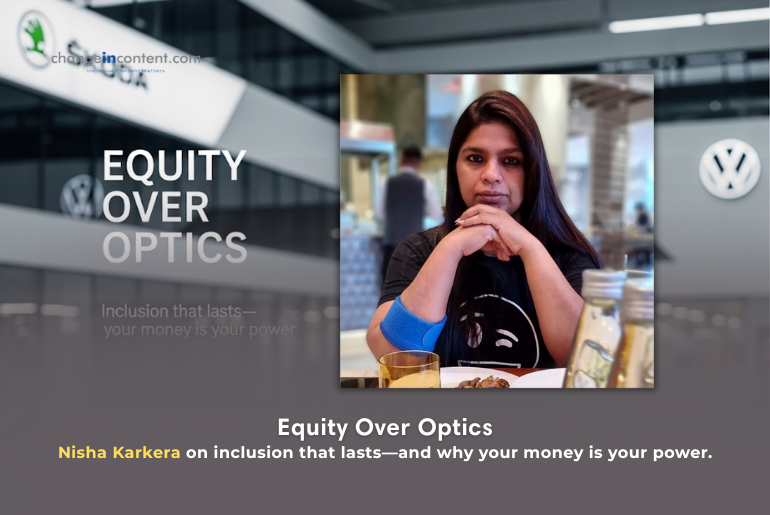
Nisha Karkera doesn’t mince words: equity is the engine, inclusion is the drive, and financial independence is the seatbelt every woman needs. In a candid conversation with ChangeinContent, Nisha Karkera, Head of Talent Management and Training Academy at Škoda Auto Volkswagen India, reflects on her career journey into HR and her leadership in driving diversity, equity, and inclusion. She reflects on why equity must stand at the core of DEI, how organisations can move beyond symbolic celebrations, and what it takes to build workplaces that nurture both talent and trust.
Meet Nisha Karkera, Head of Talent Management and Training Academy at Škoda Auto Volkswagen India
From preparing for the UPSC exam to finding her footing in the corporate world, Nisha’s career has spanned over two decades of growth, learning, and leadership. With 22 years of experience, including 13 at Volkswagen Group, she has risen from a coordinator role to leading talent management and DEI initiatives at one of India’s leading automobile manufacturers. Over the years, Nisha has built robust proficiency in people development, leadership recruitment, and employee lifecycle management, playing a pivotal role in developing and retaining top-tier talent.
Leadership, equity, and inclusion: The Nisha Karkera Way
Nisha Karkera begins by sharing that leadership is less about hours spent in the office and more about the impact and quality of work delivered.
Q: As a woman in a senior leadership position within the automobile industry, how have you navigated your career path? Were there any specific challenges or biases you encountered along the way?
I would divide my career into two phases: before joining the Volkswagen Group and within the Volkswagen Group. Out of my 22 years of work experience, this year marks my 13th year at Volkswagen. I started as a coordinator for headquarters processes, moved across multiple roles, and today I serve as Head of Talent Management and Training Academy at Škoda Auto Volkswagen India, while also leading diversity and inclusion initiatives.
When it comes to bias, at junior levels, you don’t feel it much because you’re one among many, and your presence doesn’t really challenge anyone. But as you grow into senior roles, the number of positions becomes fewer, and that’s when biases and barriers start surfacing.
For women, especially, career milestones often overlap with personal milestones, such as marriage, children, and family responsibilities. I experienced that myself. In my 30s, when I was transitioning into middle management, I often had to leave meetings after 5:30 because my child was in daycare, while my counterparts were free to stay until 7. However, I think I have also realised that one should judge performance by the quality of work delivered, rather than the hours spent in the office.
Travel was another challenge. With a nuclear family setup, managing work trips while ensuring childcare wasn’t easy. But over time, I learned how to handle such situations and create a balance. Those things were there, but they eventually grew out of it. You also realise various ways to deal with it.
Q: You mentioned that you oversee the company’s DEI initiatives. As an inclusive leader, what does DEI mean to you? And what kind of initiatives do you believe are most crucial for the automobile sector today?
We are in the automobile and manufacturing industry, and we build cars, some of the safest in the world. But it’s also one of the most male-dominated industries. Currently, approximately 12% of our workforce consists of women. Numbers are important, but I believe what truly matters is how we support and retain that 12%. It’s about creating supportive career paths that enable women to grow within the organisation and, in turn, become role models for others. I’m one such case, as I joined in a junior role and progressed into leadership, which demonstrates that these pathways are indeed possible.
For me, as someone deeply committed to DEI, equity is the most important aspect. Diversity and inclusion are essential, but they must not come at the cost of forced quotas or token representation. We focus on building an equitable environment where opportunities are genuinely open to all, regardless of gender. That way, we avoid creating resentment and instead build a work culture where men and women support each other’s growth.
Making DEI work beyond tokenism
In her role as a leader of talent and DEI initiatives, Nisha emphasizes that true diversity and inclusion extend beyond occasional celebrations or one-off programs. She discusses how DEI is not static and leaders must continuously adapt initiatives to create an inclusive, safe, and supportive environment for everyone.
Q: Many companies publish DEI policies, but fewer succeed in making the right kind of change. For example, we often see companies launching initiatives on Women’s Day, but many of them feel tokenistic. How do you address that?
I believe a holistic approach is required. Simply celebrating Women’s Day and labeling it a DEI initiative is a naïve way to approach it. For us, the focus goes much deeper. While we do hire talent from the market, our real emphasis is on building women within the organisation rather than relying only on external hiring.
Right from the junior level, we identify women with potential through structured tools and assessments. Once identified, they enter rigorous development programmes, not just one- or two-day workshops, but six to nine months of continuous learning. These programmes include mentorship, coaching, and health coaching to help them manage both professional and personal challenges. We also focus on leadership skills, such as executive presence, networking, and influencing, to prepare them for senior roles.
Alongside this, we’ve created strong internal communities and networks that encourage numerous conversations, discussions, and exchanges. These aren’t one-off initiatives; that way, women don’t just feel included on special occasions.
Q: Could you share any successful strategies or initiatives at Volkswagen aimed at increasing the hiring and retention of women?
We don’t have a quota-based approach. For us, equity is the primary goal. We don’t earmark roles only for women or promote people based on anything other than merit. Instead, we focus on building a strong retention strategy for top talent, which includes women in leadership roles.
For example, women returning from maternity leave receive the support and flexibility they need. Many of them use our flexible working hours and support systems to balance their careers and personal lives. We also run “Women in Mobility” (WIM), a community within the organisation where women come together for engagement, networking, and support. But this is just one nano part of a larger strategy.
We strongly believe in investing in women’s development. Recently, we launched a programme specifically for senior women leaders. While we don’t have many in this category yet, nurturing them is extremely important. For this programme, we partnered with an external organisation that connected each of our senior women leaders with a mentor, successful women achievers from outside the company. These mentorships lasted for six months, providing our leaders with fresh perspectives and guidance. Additionally, this type of sustained investment ensures that our female employees not only stay but also grow and take on leadership roles.
Q: Looking ahead, are there other areas of DEI that Volkswagen wants to work on?
For several years, our primary focus has been on women. Going forward, we also want to widen the scope of diversity. One area we see as very important in our industry is generational diversity, valuing both the knowledge of experienced employees and the fresh ideas brought in by younger talent.
Another area is geographical and cultural diversity. As part of a global organisation, we work with people from many countries, including Germany, the Czech Republic, South America, Africa, and others. Even within India, our workforce comprises individuals from diverse regions and cultures. It creates a cultural melting pot, and we want to ensure that we provide a safe and inclusive space for everyone to work and grow together.
While our current initiatives have been more women-focused, we are working towards expanding DEI to include age, culture, and geography, and we see this as an important part of our future plans.
Adapting to change through learning and upskilling at any age
With new technologies and opportunities coming up, upskilling has become essential for all employees. Nisha shares how companies can create supportive environments for employees to learn and upskill, regardless of their age or life stage.
Q: So with new opportunities opening up, upskilling becomes important. However, women who take career breaks, such as for maternity leave, often face challenges with upskilling. How can organisations help them?
I just feel that the skills are, you know, going out of our radar so fast, and new skills are coming in so fast that there is no other way out but to upskill yourself. This isn’t just about women because upskilling is relevant for everyone, at all stages of life.
I think we should not focus only on maternity. That is just one phase of a woman’s life, typically a couple of years in a career spanning 30 to 35 years. When I look back at my maternity days, it feels like a short period. It’s important to respect that time and give them the space they need. Upskilling doesn’t have to happen during that phase. Let women take care of their responsibilities first. Once they’re back, comfortable, and confident, that’s the right time to work on skill development.
What matters most is creating a sensitive and supportive environment. Managers and colleagues should provide understanding, not constant questioning or pressure. From my experience, when women are supported during this phase, they become loyal, dedicated, and diligent employees. In my team, which comprises approximately 65% women at various stages of life, this approach has worked very well.
It’s also important to provide psychological safety, a space where women can say, “I need some extra time today”, and know they will be supported.
Q: As EVs, AI, and machine learning are becoming a major part of the industry, how do we address the risk of ageism? What happens to experienced professionals who are used to more traditional ways of working, and how can organisations support them in adapting to these new technologies?
I’m not sure if learning new skills and age are really related. I wouldn’t say so. More than ageism, what I’ve noticed is a lot of apprehension. There’s a lot of conversation and chatter surrounding questions like, “Will AI take our jobs?”
To address this, we have created something called a skill pyramid. The idea is to define essential skills that the organisation needs. For example, one of the essential skills today is data science, as well as general AI knowledge. In this space, we are completely age-agnostic, gender-agnostic, and position-agnostic. We believe that everyone should have at least a basic understanding of these skills. Similarly, there are several essential skills that we define.
We make it possible for employees to learn at their own pace. When an organisation provides platforms like this, where there’s no judgment about who should be doing it, it removes a lot of apprehension. Beyond the fear of learning, people often wonder what happens if they don’t learn. That’s where encouragement and support come in. We also have coaches whom employees can consult about how a particular skill is relevant to their future role. These conversations help clarify doubts.
The main point I want to make is that at any age, when teaching new skills, it’s important to explain both the benefits and the consequences of not learning. I think everyone is smart enough to decide the path they want to take once they have the right information.
Addressing gender bias in automotive marketing and sales
Q: Currently, women make up only 10–15% of automobile buyers, showing they remain underrepresented as both drivers and owners. Could this be because advertising and campaigns still focus largely on male consumers? How can the industry make advertising, product positioning, or test-drive initiatives more inclusive to better engage women as a consumer group?
I think many stereotypes are being broken now. If you look at our ads, you’ll see that we actively feature women driving our cars and even opening the bonnet or handling maintenance themselves. There has been a massive shift in marketing, and it’s not just limited to our brand; many auto companies today recognize that they can’t ignore women customers. After all, they make up 50% of the population.
Even in product positioning, while there’s still room for improvement, progress is being made. These changes take time. But at the same time, am I saying that no effort is made? No, not at all. We host customer clinics where we specifically invite women to ask about what they would be excited to have in a car.
Yes, auto companies are making efforts to engage women as buyers. It’s not just possible to ignore 50% of the population of this country.
Q: Similar biases are seen in physical showrooms, where sales teams often assume the man is the primary buyer. How can dealerships be trained and sensitised to engage women customers equally and fairly?
I believe this bias exists at a foundational level across society, not just in one specific industry. Every time I go to a restaurant, the attendant almost always hands over the bill to my spouse, not me. It suggests the assumption that decision-making, or “power,” as people often refer to it, lies with men.
It will take years to change. I think it’s not about training programs. More and more women need to enter the workforce, and more and more men in families would understand that this is going to be a new life. That is the way it is going to be. I think that’s the only solution to all these things, not any training programme. It has to be the culture of life.
Whatever the current number, approximately 20% of women are working. Suppose that the percentage increases to 50%, with women contributing to households and the GDP. In that case, you will see a noticeable difference in how people perceive women, whether it’s at a car dealership, a restaurant, or anywhere else. It will take time, but the pace is there. I’ve seen it over the last 20 years of my career. Things have changed, and they are continuing to change.
Guidance for women aspiring to lead in male-dominated fields
As part of the conversation, Nisha Karkera shared her perspective on what it takes for women to grow and lead in industries where men have traditionally held the majority of positions.
Q: What one change would make the biggest difference for women in the automobile field?
The automobile industry is already moving in the right direction. Some of our competitors, such as Tata Motors and Ola, have established entire production lines run exclusively by women, demonstrating the possibilities that exist. However, the change has to begin much earlier, with education. More women need to choose engineering majors like mechanical, automobile, and electronics, because that is where the pipeline begins. If more women choose these fields, companies like ours will have the opportunity to hire them into manufacturing roles.
If more women start working in manufacturing roles, their presence itself will give them the power to influence the workplace. They would bring in their perspectives, ask for facilities or policies that support them, and in doing so, they would gradually change the industry’s culture to be more inclusive. Currently, the numbers remain low, making it challenging for women to advocate for changes or push for workplace policies that support them.
It’s also a mindset issue. Traditionally, women were encouraged to pursue arts or roles considered “nurturing,” while only a few professions were genuinely open to them. That mindset limited choices. But that’s changing. Half the students in a classroom are girls, and companies have close to 45% women in certain fields, but most of them are still in computer science. We also need women to explore mechanical and other automotive streams. No field of education should be tied to a specific gender.
That’s why we’ve partnered with ITI colleges, adopted five institutes, and consistently support women studying automobile and mechanical engineering. We recently set up a paint lab in ITI Nashik, traditionally a male-dominated space, and trained about 100 girls there. It is just one step, but it shows that when women are given access and training, they can excel in every part of the industry.
Q: What advice would you give to young women aspiring to leadership roles in traditionally male-dominated industries, such as the automobile sector?
I would say women need to be less hesitant and not shy away from asking for what they truly deserve. Men do this very naturally, even if in a room where they’re not always the most competent, they still raise their hands with confidence. Many women, even when they’re more talented and capable, hold back. That’s where the difference comes in. If you know you’re competent, if you’re skilled and ready to put in the effort, then there is no reason not to step up. Building that confidence is something we must do for ourselves. It can’t come from anyone else.
I think another very important thing I want to tell all women is to hustle, regardless of their field, whether they aspire to be an entrepreneur, a teacher, a professional, or a leader. Hustle means continuously building your skills, networking, staying confident, and putting in consistent effort. But alongside that, one point I always emphasise is financial independence.
Your money is your power. When you have your own income, it gives you respect, a voice in decisions at home, and the confidence to express your opinions. It doesn’t matter how much you earn, but always have something that is yours, not dependent on anyone else. I think that part of it is important for every young woman to understand.
Nisha Karkera: Leading with purpose, growing with equity
Our conversation with Nisha Karkera offered a deeply insightful look into how leadership and equity can truly reshape workplaces. Across her two decades of experience, she has shown that leadership is less about position or hours clocked, and more about creating impact, opening doors, and ensuring people grow together. What stands out in her journey is the reminder that inclusion is not about token gestures, but about building systems where every individual, regardless of gender, age, or background, feels valued and supported.
As Nisha says, “Equity is most important. Diversity and inclusion are essential, but they must not come at the cost of forced quotas or token representation.”
Changeincontent perspective
At ChangeInContent, we champion leaders who trade slogans for systems. What stands out in Nisha’s approach is the insistence on equity as a design principle, not a day on the calendar. When organisations pair structured upskilling with psychological safety and clear career paths, women don’t just stay, they lead. That’s the difference between “we hired women” and “we built a place where women thrive.”
Also Read: How Pee Safe is championing hygiene and inclusivity: Exclusive interview with Mr Vikas Bagaria.
Disclaimer: The views expressed in this article are based on the writer’s insights, supported by data and resources available both online and offline, as applicable. Changeincontent.com is committed to promoting inclusivity across all forms of content. We broadly define inclusivity as media, policies, law, and history. It encompasses all elements that influence the lives of women and marginalised individuals. Our goal is to promote understanding and advocate for comprehensive inclusivity.