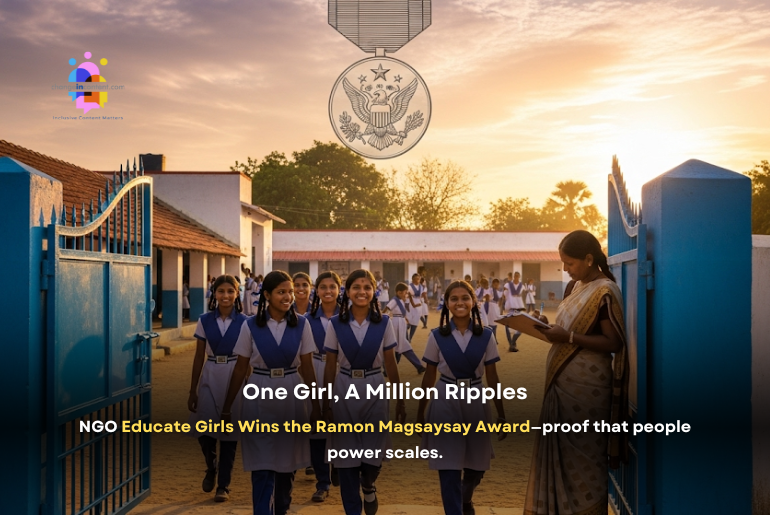
The news that Educate Girls Wins the Ramon Magsaysay Award is more than a trophy moment; it’s proof that community-first solutions can move mountains. From door-to-door persuasion to second-chance schooling for young women, the NGO’s playbook shows how lasting change is built: one village, one family, one girl at a time.
Educate Girls wins the Ramon Magsaysay Award
The Indian non-profit Educate Girls has made history as the first organisation from India (not an individual) to receive the prestigious Ramon Magsaysay Award in 2025. Often described as “Asia’s Nobel Prize,” the award celebrates exceptional courage, integrity, and service to humanity. This recognition places Educate Girls alongside a legacy of remarkable Indian winners, such as Mother Teresa, Satyajit Ray, Kiran Bedi, and Ravish Kumar.
The Ramon Magsaysay Award: A legacy of service
Established in 1957 by the Rockefeller Brothers Fund in memory of Philippine President Ramon Magsaysay, the award honours individuals and organisations across Asia who demonstrate what the foundation calls “greatness of spirit in selfless service to the people.” Each year, awardees receive a medallion bearing Magsaysay’s image, a certificate, and a cash prize.
Over the decades, the award has recognised leaders who transformed society through courage and compassion. Among the Indian recipients are social reformer Jayaprakash Narayan (1965), filmmaker Satyajit Ray (1967), activist Aruna Roy (2000), politician Arvind Kejriwal (2006), and environmentalist Sonam Wangchuk (2018). With Educate Girls joining this list, the award acknowledges the impact of a community-driven organisation working to empower rural girls through education.
The journey of Educate Girls
Educate Girls was founded in 2007 by Safeena Husain, a graduate of the London School of Economics. While working in San Francisco, Husain felt compelled to return to India to address the deeply rooted issue of female illiteracy. What started in 50 remote villages of Rajasthan has expanded into a nationwide mission that today reaches more than 30,000 villages.
The organisation’s vision is to break the cycle of poverty and illiteracy through girls’ education. Its motto, “One girl at a time,” reflects its grassroots approach of engaging families, communities, and governments to ensure girls stay in school and complete their education.
In its citation, the Ramon Magsaysay Foundation commended Educate Girls for identifying communities most in need, bringing unschooled or out-of-school girls back into classrooms, and ensuring they remained until they could pursue higher education or employment.
Calling the honour a “historic moment,” Husain said the award shines a global spotlight on India’s people-powered movement for girls’ education, one that began with a single girl in one of the remotest parts of the country.
Project Pragati: A second chance in education for women
Among its many initiatives, Educate Girls launched Project Pragati, an open-schooling programme for young women between 15 and 29 who had dropped out of formal education. The programme allows them to complete Class 10 and Class 12, opening doors to better employment and further education. Pragati began with 300 learners and has since grown to over 31,500.
Earning a Class 10 certificate in India can create a lifetime wealth gain of nearly USD 60,000. Yet, the COVID-19 pandemic led to a sharp increase in the number of adolescent girls leaving school. To address this urgent challenge, Educate Girls introduced immediate measures through Project Pragati. “For us, 2022 was about progress, about pushing our ambitious goal to provide education to every girl in India,” shares Safeena Husain, Founder & Board Member of Educate Girls. “With Project Pragati, it is our aim to ensure young women who have no hopes of being in school get a second chance at education and build a better life for themselves.”
The programme combines technology with community action. Local volunteers, known as Preraks, play a crucial role. They identify girls who have left school, enrol them in open schooling, and run village-based learning camps to help them prepare for exams. They also guide them in building life skills and encourage families to support their daughters’ education.
A vision to reach 10 million girls and women by 2035
The success of Educate Girls comes from its people-driven model. Local volunteers go door-to-door, convincing families to prioritise their daughters’ education despite financial pressures, cultural barriers, or household duties. Retention strategies include remedial learning, peer mentoring, and life-skills development. With a retention rate of more than 90%, the organisation proves that long-term change is possible when communities themselves support women’s education.
Today, the organisation has worked with more than two million girls so far. By combining grassroots action with government partnerships, Educate Girls has shown that large-scale change is possible. By 2035, Educate Girls aims to reach 10 million girls and expand into new regions, including Northeast India. The organisation also plans to expand internationally, sharing its model with other countries facing similar challenges in girls’ education.
Celebrating 2025 Ramon Magsaysay Awardees
The 67th Ramon Magsaysay Award Presentation will take place on November 7, 2025, at the Metropolitan Theatre in Manila. Alongside Educate Girls, this year’s laureates include Shaahina Ali from the Maldives, honoured for her efforts to combat plastic pollution and protect fragile marine ecosystems. It also honours Father Flaviano Antonio L. Villanueva from the Philippines. He has been recognised for restoring dignity to thousands of poor and homeless residents in Manila.
RMAF Chairperson Edgar O. Chua remarked that each generation of awardees demonstrates how integrity, courage, and compassion can reshape societies. “For 67 years, the Ramon Magsaysay Award has celebrated transformative leaders who have become enduring beacons for Asia and the world. Each generation of Ramon Magsaysay Awardees has shown us that integrity, courage, and compassion can shape societies for the better. This year’s recipients stand firmly by that proud tradition,” Chua said.
Educate Girls Wins the Ramon Magsaysay Award: Conclusion
The story of Educate Girls demonstrates that meaningful change often begins with small steps. These steps involve convincing one family, enrolling one girl, or hosting one learning camp. As the organisation expands its reach, it carries forward the message that every girl’s education matters. What began in a handful of villages in Rajasthan now prepares to reach 10 million girls by 2035.
Change often begins and grows from consistent effort. It begins with individuals and communities choosing to act, even when challenges seem overwhelming. Each step toward inclusion and gender equality builds a society that is fairer, stronger, and more hopeful.
We at ChangeinContent proudly congratulate the team at Educate Girls on their continued commitment to ensuring every girl has the opportunity to receive a proper education.
Changeincontent perspective
At ChangeInContent, we view this as a turning point. It is a validation that dignity-led, hyperlocal action can scale nationally without compromising its soul. If India is serious about inclusive growth, we must fund, learn from, and replicate models like Educate Girls. That is where data meets trust, and outcomes follow.
Also Read: Inclusive Education Policy: Bridging the gap for a truly inclusive society.
Disclaimer: The views expressed in this article are based on the writer’s insights, supported by data and resources available both online and offline, as applicable. Changeincontent.com is committed to promoting inclusivity across all forms of content. We broadly define inclusivity as media, policies, law, and history. It encompasses all elements that influence the lives of women and marginalised individuals. Our goal is to promote understanding and advocate for comprehensive inclusivity.