ICRIER report on women’s workforce: A Brief Note
India has made a substantial gain in women’s participation in the workforce. But the new ICRIER report asks us to look inside that gain. Working on a family farm, running a small enterprise and drawing a regular salary can all count as employment, while offering very different levels of income and independence. The task now is to expand women’s opportunities and improve the terms on which they work.
At a Glance
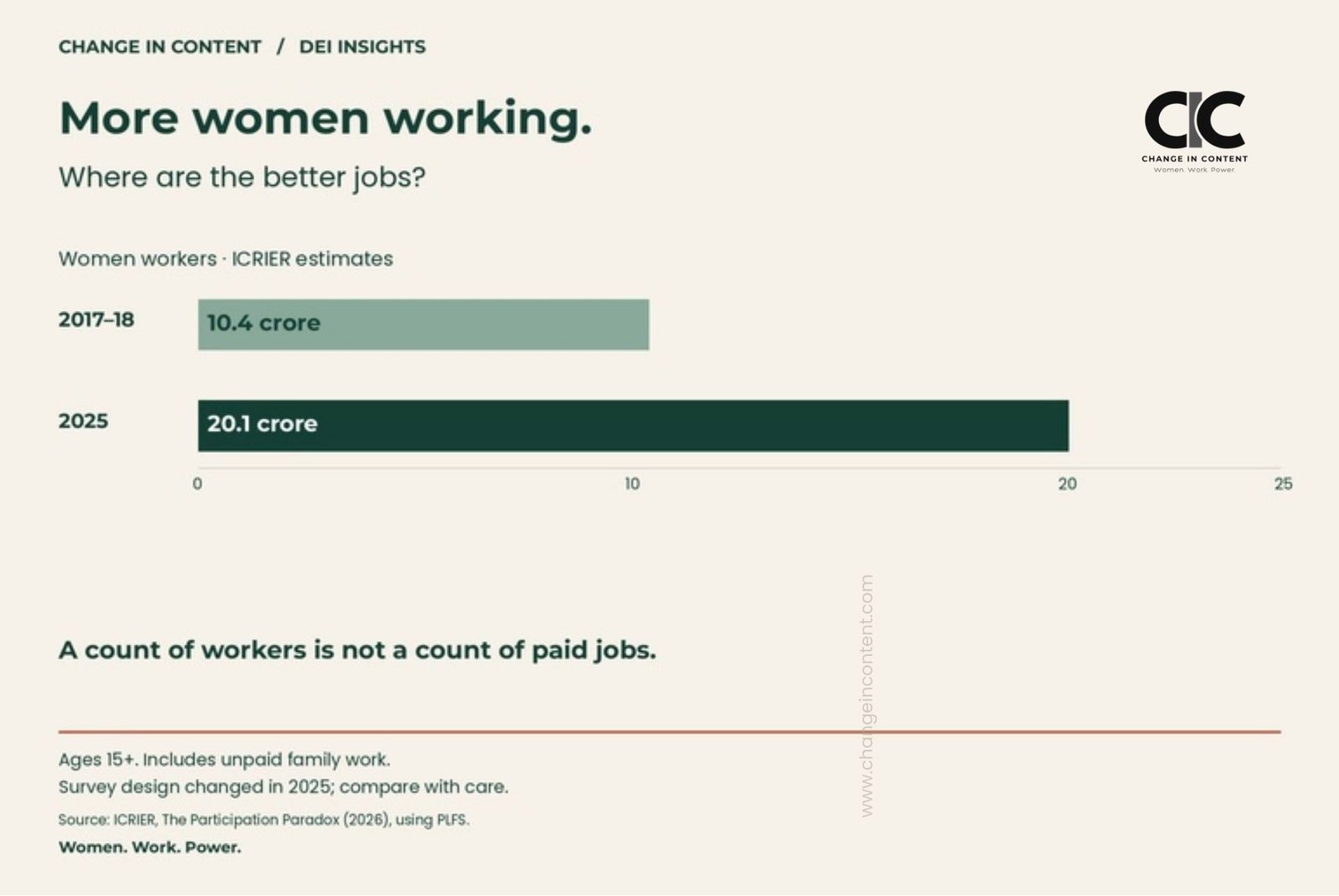
- ICRIER estimates that India’s women’s workforce rose from 104 million in 2017–18 to 201 million in 2025: from 10.4 crore to 20.1 crore.
- Employment includes unpaid help in a household enterprise. It does not necessarily mean a personal wage.
- Rural regular salaried employment grew in number but lost share as other forms of work expanded faster.
- Quality work can exist on a farm, in a business or in a salaried role. The test is earnings, security and opportunity.
- Employers and public programmes should track what happens after a woman joins, trains or receives a loan.
What does nearly doubling the workforce actually mean?
An unpaid worker in a family shop can be counted as employed without ever receiving a wage of her own. That is where the story of India’s growing women’s workforce becomes more complicated, and where the ICRIER report deserves attention beyond its headline.
Its estimate of nearly twice as many working women is significant. It records economic activity too often hidden behind words such as “helping”. Yet being recognised in a statistic and being able to rely on an income are different experiences.
The original report, The Participation Paradox: Women’s Work and Time-Use in India (2017–18 to 2025), was published in October 2026. Its authors are Tanu M. Goyal, Shravani Prakash, Ketaki Gaikwad and Arjun Tandon.
They examine both participation and the conditions surrounding it. The picture warrants optimism about the scale of women’s contribution, alongside a much harder look at the opportunities available to them.
One qualification belongs beside the headline: these are estimates, using population projections and survey data for women aged 15 and above. The Periodic Labour Force Survey changed its design in 2025, so comparisons with 2017–18 require care. The figures should not be described as a precise count of new salaried jobs.
Where has the additional work appeared?
The report finds the expansion concentrated in agriculture, own-account work and unpaid family work. Its rural estimates make the shift visible:
| Rural women’s employment | 2017–18 | 2025 |
| Own-account workers | 1.39 crore | 5.60 crore |
| Unpaid family workers | 2.88 crore | 4.93 crore |
| Regular salaried workers | 79 lakh | 1.39 crore |
Source: ICRIER, Table 2 and accompanying analysis. Selected categories, not the entire rural workforce. Crore/lakh conversions are ours.
Regular salaried work did expand. Its share nevertheless fell from 10.5% to 9.3%. A falling share should not be mistaken for a fall in the number of women doing those jobs.
That is why a broad account of India’s working women needs more than a participation figure. The composition tells us whether the opportunities are changing as quickly as the numbers.
Unpaid family work has a specific meaning here: assisting in a household enterprise, such as a farm or shop, without regular remuneration. It is separate from unpaid domestic work such as cooking or caring for a relative. Both contribute to a household’s life; labour statistics classify them differently.
Is every small business or agricultural job a poor job?
Certainly not. Treating agriculture as failure or every self-employed woman as a disguised unemployment statistic would erase enterprise, expertise and choice.
A dairy producer with reliable buyers, control over receipts and money to reinvest may have a stronger livelihood than a worker in an insecure salaried role. A home-based business can offer flexibility and growth. It can also leave someone dependent on irregular orders, weak bargaining power and payments she cannot predict.
The label does not settle the question.
A regular salary, meanwhile, does not automatically establish that a job is formal, protected or fairly paid. We should ask about the employment terms rather than assume a category guarantees them.
The report’s larger concern is that participation has expanded without a comparable improvement in quality. The next question for a programme, employer or buyer is therefore very practical: what can this woman now earn, negotiate or plan that she could not before?
Why does more work not always mean getting ahead?
ICRIER reports average monthly earnings of ₹6,596 for rural women and ₹14,632 for rural men in 2025. These are broad averages across different workers and work arrangements. They are not evidence that a woman receives that percentage of a man’s pay for an identical job.
Earnings depend on the kind of work available, the hours a person can secure and the return on those hours. Improving one while ignoring the others can produce disappointing results.
Consider a woman who completes a skills course but finds that the available job starts before childcare opens. Or a small producer who receives an order but has to purchase materials upfront and wait months for payment. These are illustrative situations, not interviews from the report. In each, an opportunity exists; its terms make it difficult to use.
The ICRIER study discusses both necessity-driven and opportunity-driven explanations for rising participation. Household financial pressure and better access to infrastructure, markets or public programmes can coexist. The aggregate trend cannot establish why every woman entered work.
Care also deserves a place in the calculation. A longer paid working day is not an uncomplicated improvement if it comes on top of an unchanged domestic workload. Investment in care can make a job usable, while predictable hours help a family organise the care it still provides.
What does a quality job give a woman?
A quality job offers more than the chance to be busy. For an employee, that includes clear pay terms, safe conditions, dependable hours, access to applicable protections and a fair route to advancement. For a business owner, it includes viable margins, reliable payments, market access and control over business decisions.
There is a dignity issue here as well. Women should not have to be grateful for any available work, however uncertain its terms, simply because participation is considered progress.
Nor should the responsibility for improving those terms fall entirely on them. Advising a woman to negotiate harder will achieve little if there is only one buyer in reach or if a shift change can cost her the job.
A useful job-quality review asks five questions:
- Income: Is the return adequate and dependable after necessary work costs?
- Time: Are hours sufficient, predictable and compatible with rest and care?
- Protection: What happens during illness, injury, pregnancy or a dispute?
- Control: Can she access her earnings and make decisions about her work?
- Progression: Is there a realistic route to better pay, skills, responsibility or business margins?
These are editorial tests, not a new official index. They help expose what a placement, loan or training-completion figure leaves out.
Where does ignorance become an operational problem?
Sometimes the missing information is convenient. An organisation knows how many women attended training but has not checked whether they found work. A buyer celebrates women suppliers but does not examine whether its payment terms leave those businesses short of cash. An employer counts recruitment while overlooking why women leave before their first promotion.
Those examples describe risks to investigate, not accusations against specific organisations. They point to the same weakness: recording the entry point and losing interest in the outcome.
The appropriate response is to follow the opportunity through.
| Who can act? | A practical change | What to check afterwards |
| Employers | Publish pay and shift terms before hiring; make transport and childcare requirements part of job design. | Retention, take-home earnings and access to promotion. |
| Training providers and employers | Agree on actual vacancies, selection standards and paid learning opportunities before enrolling a cohort. | Placement quality and earnings six and twelve months later. |
| Buyers of women-led businesses | Offer workable order sizes, clear specifications and predictable payment dates. | Payment delays, repeat orders and supplier margins. |
| Rural livelihood programmes | Connect skills and finance to storage, equipment, buyers and market information. | Net income and business survival, alongside participation. |
| Families and workplaces | Share care responsibilities and make schedules dependable. | Whether women can use the opportunity without an unmanageable second working day. |
These measures build on the purpose of employment and livelihood programmes for women: access must lead somewhere. Schemes need resources and sound delivery; businesses need to offer work worth staying in.
For women evaluating an opportunity, asking about payment timing, costs, hours, safety and future prospects is sensible due diligence. For institutions offering it, providing those answers is part of the job.
Make the next gain worth more
India should recognise the growing scale of women’s work. It should also be ambitious about what follows.
A larger workforce becomes a deeper economic achievement when a woman can plan next month’s expenses, withstand a setback, build a business or qualify for a better role. Those are outcomes families can feel, and employers can help deliver.
The next milestone should give us more to celebrate than the number of women working. It should tell us how their work is improving their lives.
Editorial note and source information
Original report located and examined: ICRIER, The Participation Paradox: Women’s Work and Time-Use in India (2017–18 to 2025), October 2026, by Tanu M. Goyal, Shravani Prakash, Ketaki Gaikwad and Arjun Tandon.
The article distinguishes the authors’ findings from Change in Content’s interpretation and proposed job-quality tests. Workplace examples are hypothetical. This is secondary research and commentary, not original field reporting.
Sources
- ICRIER publication page: title, authors and research framing.
- ICRIER original report PDF: workforce estimates; Table 2 employment composition; Figure 12 earnings; Appendix, printed pages 67–69, methodology.
- MoSPI, PLFS changes in 2025: comparability guidance following the survey redesign.
- ThePrint, 3 November 2026: supplied news reference, checked against the primary report.
Numerical checks: 104 million = 10.4 crore; 201 million = 20.1 crore. The increase is approximately 93%, so use “nearly doubles”, never “doubles exactly”. Rural salaried employment grew in absolute terms. Self-employment, salaried status and formal protection are not interchangeable categories.