
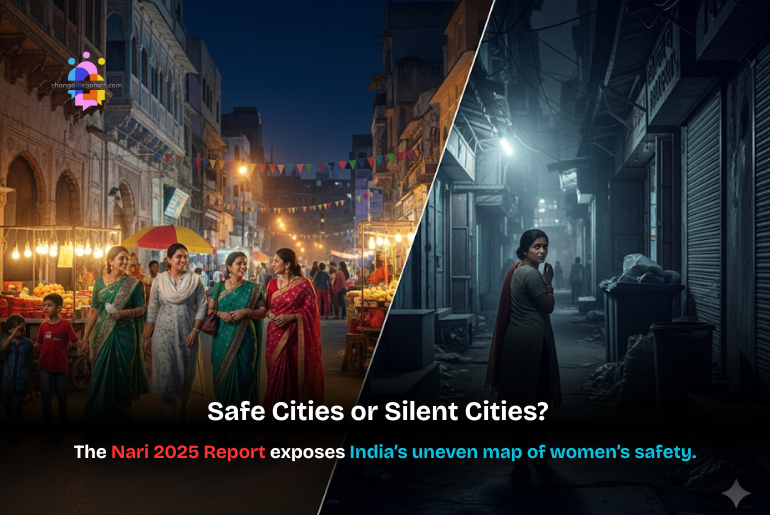
The Nari 2025 Report is a mirror, and not just another survey. It is a mirror that reflects the unevenness in women’s safety across Indian cities. While Mumbai, Kohima, and Visakhapatnam lead the way, Delhi, Patna, and Jaipur continue to expose women to fear, distrust, and silence.
Nari 2025 Report: What the numbers say about women’s safety
The National Commission for Women (NCW) has released the National Annual Report and Index on Women’s Safety (NARI) 2025. The study surveyed 12,770 women across 31 cities, looking into reported crimes as well as unreported harassment, daily experiences of Indian women in public and their workplace, and how safe women feel in their own cities.
Previous data from the Women and Men in India 2024 report revealed that cybercrimes against women have more than tripled since 2017, rising from 4,242 cases in 2017 to 14,409 in 2022. Domestic violence now makes up 31% of all crimes against women. The recently released NARI 2025 report indicates that the situation has not improved for women’s safety in India.
Safety score at 65%, yet 40% of women report feeling unsafe
The NARI 2025 survey gave India a national safety score of 65%. While 60% reported feeling safe, the other 40% or 4 in 10 women admitted to feeling “not-so-safe” or outright vulnerable. Neighbourhoods and public transport systems emerged as prime harassment and unsafe spots, with 38% of incidents occurring in local areas and 29% in transit systems.
The safety concerns are higher among younger women. Public harassment, ranging from staring and catcalling to lewd comments and inappropriate touching, was reported by 7% of all respondents in 2024. However, the number doubled to 14% among women under 24, particularly affecting students and young professionals.
The city rankings: Where are women safer?
The nationwide index recorded a safety score of 65% and grouped cities as “much above,” “above,” “below,” or “much below” this level. The safer cities, described as “much above” the national safety score, include Kohima, Visakhapatnam, Bhubaneswar, Aizawl, Gangtok, Itanagar, and Mumbai. These cities demonstrated more substantial gender equity, improved civic participation, reliable policies, and women-friendly infrastructure.
Meanwhile, Patna, Jaipur, Faridabad, Delhi, Kolkata, Srinagar, and Ranchi fared poorly due to weak institutional responsiveness, poor urban design, and patriarchal social norms.
Reporting gap and low trust in redressal systems
One of the harshest truths this report exposes is the low confidence in redressal systems. Only 1 in 3 women who faced harassment filed a formal complaint. Among all respondents, a shocking 75% said they did not trust authorities to resolve their issues. Even when women try to speak up or report, only 22% of reported cases are formally registered, and action is taken in just 16% of those.
The report bluntly states: “Two out of three women do not report harassment, meaning NCRB misses the bulk of incidents.“
There is also an apparent contradiction in workplace safety. While 91% of women say their offices feel safe, 53% admit they do not know whether their organisation has the legally required POSH (Prevention of Sexual Harassment) committee. Does this mean that the sense of security many working women feel is superficial, built more on perception than a genuine awareness of workplace protections? With more than half of women unaware of POSH, doesn’t it also suggest there is an undeniable reporting gap in workplace harassment complaints?
One aspect of the report findings that we would like to highlight is that most women who were aware of POSH felt it was effective. So, the problem isn’t that the policy doesn’t work. It does. The real issue is that many women employees don’t even know it exists. Having a law is one thing, but making sure people are aware of it is equally important.
The closing thoughts on the NARI 2025 Report
While launching the NARI 2025 report, National Commission for Women (NCW) Chairperson Vijaya Rahatkar said, “Safety cannot be seen merely as a law-and-order issue. It affects every aspect of a woman’s life—her education, health, work, and freedom of movement.“
The report argues that safety is not merely about preventing crimes. It’s about ensuring women feel secure in all aspects of their lives, including their psychological, financial, and digital well-being. Poor street lighting, patchy public transport, and infrastructure gaps leave women anxious after dark, even in otherwise “safe” areas. Laws exist, committees meet, and awareness campaigns flash across screens, yet the daily reality of many women still has hesitation, distrust, and silent endurance.
Changeincontent perspective
At Changeincontent, we believe the Nari 2025 Report forces us to confront a hard truth: safety isn’t just about laws, it’s about lived realities. Until redressal systems earn women’s trust and cities prioritise gender-sensitive infrastructure, “safety” will remain a number, not a reality.
Disclaimer: The views expressed in this article are based on the writer’s insights, supported by data and resources available both online and offline, as applicable. Changeincontent.com is committed to promoting inclusivity across all forms of content. We broadly define inclusivity as media, policies, law, and history. It encompasses all elements that influence the lives of women and marginalised individuals. Our goal is to promote understanding and advocate for comprehensive inclusivity.
