
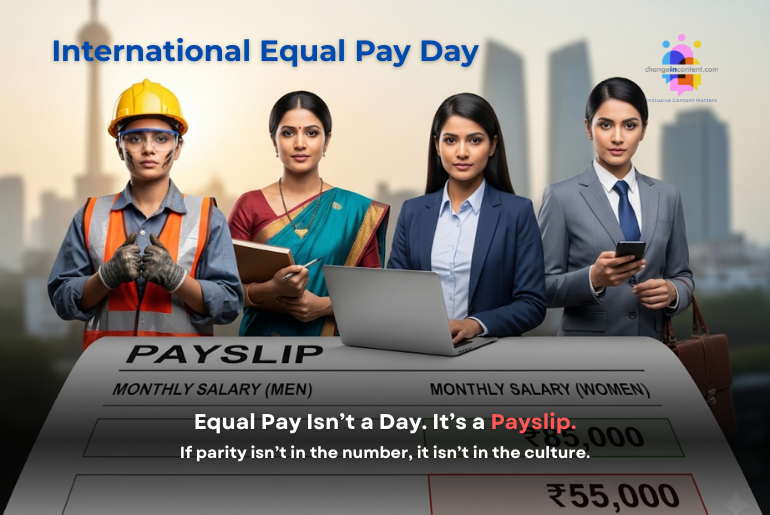
International Equal Pay Day isn’t a “feel-good” square on the calendar; it’s a pressure test. If laws and slogans were enough, we wouldn’t still be debating “equal pay for work of equal value” in 2025. India’s gender pay gap (about 34%) persists across sectors, seniority, and cities. The story behind that number is the real headline: occupational sorting, opaque pay bands, weak enforcement, and a cultural habit of calling women’s work “optional.”
International Equal Pay Day: Beyond optics, into outcomes
Every year on 18 September, the world celebrates International Equal Pay Day, a reminder that everyone must be paid equally for work of equal value. The European Institute of Gender Equality explains “equal pay for work of equal value” as paying people the same when the work they do carries the same value, without discrimination based on sex or marital status.
The right to equal pay has also been acknowledged by the International Labour Organisation since 1919. Moreover, the Equal Remuneration Convention of 1951 highlighted the importance of equal remuneration for work of equal value. In short, if two people do the same job, they should get the same pay, irrespective of their gender, caste, religion, sex, marital status, etc. However, that is not what we see happening.
India’s gender pay gap
Worldwide, women earn about 20% less than men. In India, according to the ILO, women earn only 66% of what men earn, putting India’s gender pay gap at 34%.
The Indian Constitution does mention equal pay in Article 39(d) of the Directive Principles, but not as a fundamental right. The Equal Remuneration Act of 1976 was introduced to remove wage-based discrimination, but was later replaced by the Code on Wages, 2019.
With the Code on Wages, 2019, lawmakers expanded the concept of equal pay beyond the traditional male–female binary, granting the LGBTQI+ community the right to equal remuneration. However, it left “work of equal value” undefined and in a grey area, handing courts the responsibility to decide what it actually means.
So, if one court might rule that two jobs are equal in value and deserve the same pay, while another court might not agree in a similar situation. This lack of clarity means employees and employers never have a single standard to rely on.
Despite these laws, India ranked 131st in the Global Gender Gap Index 2025, down from 129th the previous year. With a parity score of just 64.1%, the numbers reveal how far behind the country still lags.
Across industries, women earn less for the same work
Reports by the National Statistical Office indicate that in rural areas, women earn only 50% of what men earn, whereas in urban areas, they earn approximately 60%. In 2017–18, the average daily wage for men in urban areas stood at ₹644.1, compared to ₹454.8 for women.
The difference also depends on the industry. Women make up nearly a third of India’s technology workforce, yet they continue to be underpaid. In the IT and software sector, women earn only 40% of men’s wages, and in finance and banking, they earn about 50%. By comparison, the gap is narrower in education and healthcare, where women earn closer to 70–80% of men’s wages.
Even when women perform as well as men, their earnings lag behind. The Skill Impact Bond (SIB), launched in 2021, has trained over 23,700 young people, with more than 70% of them being women from marginalised communities. Women in the program matched or outperformed men in certification, placement, and job retention. Still, men reported monthly wages between ₹12,400 and ₹15,700, while women reported between ₹11,500 and ₹13,000. Performance clearly did not guarantee equal pay.
Reasons for the gender wage gap in India
Several factors contribute to this inequality. Women are still concentrated in low-paying jobs such as domestic work, agriculture, nursing, and textiles, while men dominate high-paying fields like engineering, technology, and finance. Even in agriculture, a sector that depends heavily on women’s labour, there is a very high pay disparity.
Nearly four out of five rural women work in agriculture and perform approximately 60% of the tasks, yet they earn significantly less than their male counterparts. In 2020–21, male agricultural labourers earned an average of ₹383 per day, while women labourers earned ₹294, a difference of ₹88.
Same job, different pay: Where the slippage happens
Discrimination inside workplaces is another issue. Women are often offered lower pay for the same job, face fewer opportunities for promotion, and get limited access to training. Many also work in the informal sector, where job security is limited, benefits are absent, and wages are very low.
Social expectations continue to reinforce the problem. Traditional gender roles and family pressures often limit women’s participation in the workforce. In some cases, men even discourage women from working after marriage or childbirth, treating employment as optional for women, rather than essential for their financial independence.
Education and experience reduce the wage gap, but only to a minimal extent. According to NSSO data, women with graduate degrees earn about 70% of what men with the same qualifications earn. Women with 10 to 15 years of experience earn only 60% of what men with similar experience make.
Closing the wage gap means treating women’s work as equally important, not optional.
International Equal Pay Day: Closing thoughts
Wage inequality prevents women from accumulating wealth, reduces their chances of achieving financial independence, and perpetuates economic inequality across generations. Rural women, despite their significant contribution to sectors like agriculture, remain trapped in cycles of poverty because wages fail to reflect the work they do.
Not just India, but many countries, probably all of them, have a gender pay gap. Declaring a day to honour equal wages is easy. However, ensuring that women actually receive equal pay in offices, factories, farms, and technology hubs is the more challenging task. Until then, International Equal Pay Day becomes just another date on the calendar.
Changeincontent perspective
At ChangeInContent, we measure progress by payslips, not posters. The fixes are practical and overdue: publish role-wise pay bands, audit promotions and performance scores for bias, tie leadership bonuses to closing internal pay gaps, and make salary history bans and transparent JD ranges the default. Until we price women’s work fairly, we’re celebrating equality while budgeting inequality.
Also Read: Gender pay gap: Why is equal pay still a pipe dream?
Disclaimer: The views expressed in this article are based on the writer’s insights, supported by data and resources available both online and offline, as applicable. Changeincontent.com is committed to promoting inclusivity across all forms of content. We broadly define inclusivity as media, policies, law, and history. It encompasses all elements that influence the lives of women and marginalised individuals. Our goal is to promote understanding and advocate for comprehensive inclusivity.
