
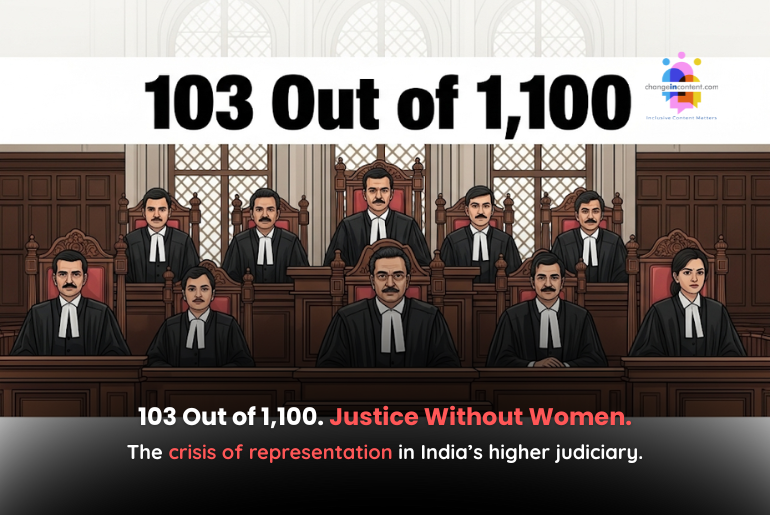
The debate on the representation of women in higher judiciary is no longer academic; it is a glaring crisis. Out of more than 1,100 High Court judges in India, only 103 are women. Four High Courts (Tripura, Manipur, Meghalaya, and Uttarakhand) have none at all. When the Supreme Court Bar Association questions this imbalance, it is not just a matter of numbers. It is about fairness, credibility, and the very face of justice in India.
Representation of women in higher judiciary: The issue
The Supreme Court Bar Association (SCBA) has voiced deep concern over the glaring absence of women in the higher judiciary. In its recent resolution, the SCBA President and Executive Committee urged the Chief Justice of India and the Collegium to give urgent consideration to appointing more women judges in both the Supreme Court and the High Courts.
The association noted with disappointment that, despite numerous discussions about diversity in judicial spaces, the actual representation of women judges remains alarmingly low. Some High Courts, including those in Uttarakhand, Tripura, Meghalaya, and Manipur, currently do not have a single woman judge.
Out of 1,100 High Court judges, only 103 are women
The statistics presented by the SCBA indicate that there are approximately 1,100 sanctioned posts for High Court judges in India. Out of these, nearly 670 are occupied by men, while women hold only 103.
The Supreme Court’s position is equally troubling. Since 2021, no woman has been appointed to the apex court, leaving Justice B.V. Nagarathna as the only woman currently serving on its bench. The SCBA expressed disappointment that in the most recent round of appointments, no woman from either the Bar or the Bench was considered, despite several highly qualified candidates being available.
Concerns over fairness in judicial appointments arose after the appointment of Justice Vipul Pancholi to the Supreme Court. Critics questioned why he was chosen ahead of at least three senior women judges who were equally eligible. The incident also raised questions about the Collegium’s selection process and the lack of clarity regarding how authorities make the decisions.
The SCBA made it clear that merit should remain the main standard in choosing judges. It does not mean lowering standards, but rather recognising that women deserve equal chances. Many women in the legal profession have the skills, experience, and achievements needed for higher positions, yet they are not appointed in proportion to their presence in the field. Having fewer women also means the judiciary misses out on different viewpoints and experiences that women bring.
High Courts with zero women judges
Another key point raised by the SCBA was the uneven representation of women judges across states. While some High Courts have at least a few women judges, others have none. Tripura, Meghalaya, Manipur, and Uttarakhand High Courts are currently functioning without a single woman on the bench.
In 2023, women formed only 13% of High Court judges, a slight rise from 11% in 2011. Eight High Courts have only one woman judge each. The Allahabad High Court, the largest in the country, has just three women judges, which comes to barely 2%.
The problem is not only the low number of women but also the delay in their appointments. Men are usually appointed at an average age of 51.8 years, while women are appointed later, at about 53 years. This delay prevents women judges from holding senior roles. Out of the 25 High Courts in India, only the Gujarat High Court currently has a woman Chief Justice.
Women from marginalised backgrounds face greater barriers
Even within the already low numbers of women in the judiciary, representation of those from marginalised backgrounds, Dalit and Adivasi women, Muslim and Christian women, first-generation lawyers, and women from disadvantaged socio-economic groups, remains almost absent.
The gap is more pronounced when examining the promotion of women lawyers from the Bar to higher courts compared to the promotion of women judges from the lower judiciary to the High Courts and the Supreme Court.
One of the biggest barriers is the appointment system itself. The process lacks transparency, has no open application, and does not have a national judicial appointment commission. Instead, senior judges themselves appoint judges through the collegium system. This closed method works against women, and it especially shuts out women from marginalised communities who already face limited access to networks and opportunities.
Recommendations from the SCBA
In its resolution, the SCBA proposed several steps to address gender imbalance in judicial appointments. It urged the Chief Justice of India and the Collegium to give urgent consideration to women candidates in upcoming selections. The association also pressed for proportional representation, suggesting that appointments should reflect women’s contribution and potential in the legal profession.
The SCBA further recommended that High Courts with no or very few women judges receive special attention during future appointments. It argued that only focused efforts can correct these regional gaps. Transparency in the appointment process was another key recommendation. The association called for clearer criteria and communication to ensure fairness and to counter any perception of bias.
Representation of women in higher judiciary: Conclusion
We cannot dismiss the lack of women in the higher judiciary as a minor issue. It is a serious problem that affects both the credibility of the institution and the quality of justice delivered. When women, particularly those from marginalised backgrounds, are excluded, the judiciary misses out on perspectives that can form better, more inclusive decisions.
Merit should remain the core principle, but it must coexist with equity. At the same time, it must ensure that opportunities are reflective of both talent and representation.
Changeincontent perspective
At ChangeInContent, we believe that justice without representation is incomplete justice. When women (especially those from Dalit, Adivasi, and minority backgrounds) are shut out of the higher judiciary, the system loses voices that can redefine fairness. Diversity on the bench is not charity; it is strength. Until judicial appointments reflect the India they serve, the call for equality will remain unanswered.
Disclaimer: The views expressed in this article are based on the writer’s insights, supported by data and resources available both online and offline, as applicable. Changeincontent.com is committed to promoting inclusivity across all forms of content. We broadly define inclusivity as media, policies, law, and history. It encompasses all elements that influence the lives of women and marginalised individuals. Our goal is to promote understanding and advocate for comprehensive inclusivity.
