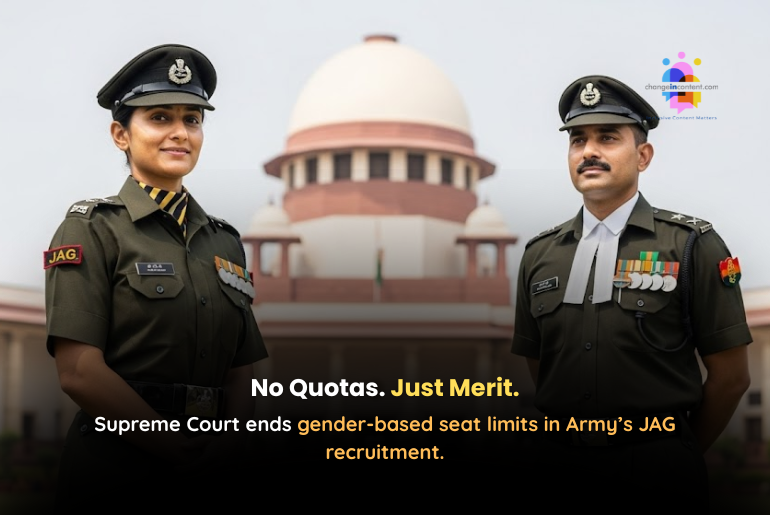
The Supreme Court’s decision on the Gender Cap in JAG Recruitment is a sharp reminder that equality in the armed forces cannot be conditional. By declaring the fixed seat ratio for men and women unconstitutional, the Court has affirmed that merit (not gender) must decide who serves in India’s Judge Advocate General branch.
The Supreme Court has ruled that limiting the number of women in the Indian Army’s Judge Advocate General (JAG) branch is a violation of the constitutional right to equality. In a decisive judgment delivered on August 11, the Court challenged the Army’s policy of reserving six posts for men and only three for women. It directed the Union government to prepare a single merit list for all candidates. Moreover, the Army must select officers purely on merit, regardless of gender.
A bench of Justices Dipankar Datta and Manmohan declared that the policy was “arbitrary” and incompatible with the principles of gender neutrality. The judges stressed that no country can claim security if it upholds discriminatory recruitment practices.
Gender cap in JAG recruitment: Background of the case
The ruling came after two women, both high-ranking candidates, challenged the 2023 recruitment notification that capped the number of women’s JAG vacancies at three. Their counsel argued that the petitioners had secured the fourth and fifth ranks overall. Still, the Army denied them appointments because of the gender-based limit.
In August 2023, the Supreme Court issued a notice to the Union government on the matter. The court directed that the two advertised vacancies remain unfilled until the case is decided. Earlier this year, while reserving its verdict in May, the Court had already ordered the induction of the first petitioner into the JAG branch. The court notes that her case had substantial merit.
During hearings, the bench questioned why the Army was excluding meritorious women candidates despite their higher scores compared to selected male counterparts. Justice Datta asked whether such restrictions could be legally or constitutionally justified when women were already permitted to serve in the JAG branch. “Once you have allowed women to join, can you restrict how many will be taken?” he asked.
Petitioners’ stand
Senior Advocate Gopal Sankarnarayanan, representing the petitioners, argued that the policy amounted to an unconstitutional reservation in favour of men. He highlighted the example of petitioner Arshnoor Kaur, who had scored higher than several male candidates. Still, Ashnoor was excluded under the gender cap.
The petition sought a combined merit list to ensure transparency in recruitment. It also challenged the Army’s claim of gender parity. The petition notes that the revised 50:50 ratio still imposes limits.
Fixed ratios vs true equality: Judges challenge Army Policy
JAG officers hold significant responsibilities in the armed forces. They provide legal advice to the military. They also represent the Army in judicial proceedings, oversee compliance with military law, and conduct court-martials and disciplinary actions.
The Indian Army defended its recruitment policy by pointing to operational requirements. It argued that JAG officers are sometimes attached to infantry battalions and expected to perform combat-related duties. The Army claimed that its original 70:30 male-to-female ratio was intended to maintain combat readiness.
Additional Solicitor General Aishwarya Bhati told the Court that from 2024 onwards, the intake ratio had been revised to 50:50. The idea is “to bring gender parity” in the JAG branch. However, the bench challenged this interpretation. The judges observed that true parity meant eligibility without gender-based limits, not enforcing a fixed ratio.
The Army also cited its policy of not deploying women in combat zones such as the Line of Control, stating that this decision applied to JAG officers as well. Bhati argued that women should not be stationed in areas where they could fall into enemy hands.
The bench was unconvinced. Justice Datta pointed out that women in the Air Force already fly combat aircraft like the Rafale, which carries its own risks. “If a woman can command a fighter jet, why can’t she serve in the Army when she is more meritorious than her male counterparts?” he asked.
Court’s observations on gender neutrality
The Court emphasised that the principles of gender neutrality and equality require recruitment to be based solely on merit. Arbitrary caps on women’s participation undermine this principle. The judges stated that the Union cannot reserve vacancies for men while claiming gender-neutral policies.
The bench rejected the idea that operational concerns justified limiting women’s entry into the JAG branch, especially when these officers do not serve in front-line combat roles. It held that if women meet the merit standard and their inclusion does not compromise operational efficiency, there is no legal ground to restrict their numbers.
SC’s final ruling on the gender cap in JAG recruitment
In its judgment, the Supreme Court directed the Union to conduct JAG recruitment through a unified merit list. It must happen without any gender-based reservations. The court confirmed its earlier order to appoint the first petitioner to the next available training course for the JAG branch. However, it declined to extend similar relief to the second petitioner. That is because her case did not meet the same criteria.
The bench made it clear that gender-based recruitment caps contradict constitutional guarantees. Moreover, merit must be the sole criterion for selection. “Restricting the seats of women is violative of the right to equality,” the judgment stated.
The final thoughts
While women have made gradual progress in military service, policies often continue to limit their roles and promotion. By removing arbitrary limits on women’s entry into the JAG branch, the Court has signalled that equal opportunity must be more than a slogan. It must be enforced in practice. The Army will now need to align its recruitment procedures with the Court’s directions. They will have to ensure that future JAG intakes reflect a unified merit-based system. This change could influence other branches and services where gender restrictions still exist.
By insisting on merit-based selection, the Court has taken a step toward ensuring that the armed forces benefit from the best talent available, regardless of gender.
Gender cap in JAG recruitment: Changeincontent perspective
At Changeincontent, we believe that every time an arbitrary gender barrier falls, institutions grow stronger. The Supreme Court’s stand against the Gender Cap in JAG Recruitment is about unlocking the full potential of the armed forces. True equality in uniform means removing outdated restrictions wherever they remain. It will ensure that the military reflects both merit and modern constitutional values.
Disclaimer: The views expressed in this article are based on the writer’s insights, supported by data and resources available both online and offline, as applicable. Changeincontent.com is committed to promoting inclusivity across all forms of content. We broadly define inclusivity as media, policies, law, and history. It encompasses all elements that influence the lives of women and marginalised individuals. Our goal is to promote understanding and advocate for comprehensive inclusivity.