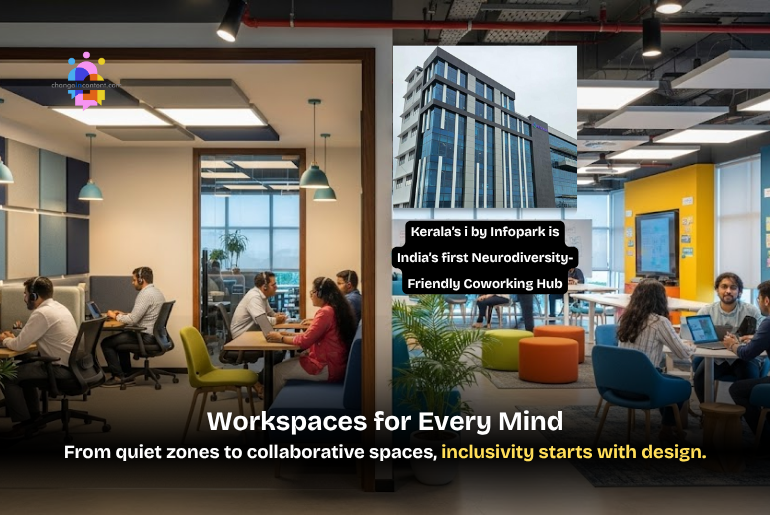
The opening of the first Neurodiversity-Friendly Coworking Hub in Kerala is not just a new real estate story. Instead, it is a shift in how India thinks about workspaces. Nestled inside the Kochi Metro’s Ernakulam South Station, i by Infopark sets out to prove that office design can actively support people with autism, ADHD, dyslexia, dyspraxia, and other neurological differences. That is making inclusion a built-in feature, not an afterthought.
Kerala has taken a major step towards inclusive workspaces with the launch of its first neurodiversity-friendly coworking hub at Ernakulam South Metro Station. The facility, called i by Infopark, will be a workspace that supports people with different neurological needs, including autism, ADHD, dyslexia, dyspraxia, and other conditions. The centre covers 48,000 square feet across the 3rd to 9th floors of the metro station complex. It offers 582 seats, high-speed internet, full power backup, 24-hour security, and access to a professional reception, cafeteria, office pods, meeting rooms, and other work amenities.
Why neurodiversity-friendly coworking hubs matter
Neurodiversity refers to the natural variation in how human brains function, including differences in learning, attention, mood, and processing. It refers to conditions such as autism, ADHD, dyslexia, dyspraxia, Tourette syndrome, and certain neurological or psychiatric conditions like epilepsy and bipolar disorder.
Global estimates suggest that up to 20% of people may be neurodivergent. Dyslexia alone affects between 5% and 20% of the population, ADHD is estimated at 5–7%, and autism is present in around 1–2%. Many neurodivergent individuals already work within organisations but often go unnoticed, as workplaces may not actively accommodate their needs.
While awareness of neurodiversity has grown, actual workplace adaptation remains limited. A poll by CIPD found that only about 10% of employers consider neurodiversity in their people management practices. Small businesses (2–249 employees) were least likely to say neuroinclusion is an area of focus for their business. Almost a third (32%) of organisations say neuroinclusion is not a focus for them. This gap leaves many employees working in offices that may not support their cognitive and sensory needs.
The ‘Spectra’ concept at i by Infopark
i by Infopark follows the ‘Spectra’ design approach, which treats neurological differences as a normal part of human variation. This method aims to create an environment where people can choose work areas that match their sensory comfort.
Each floor is planned with a different sensory theme to meet varying needs. Some areas have low stimulation for those who prefer quiet, while others are more open for collaborative work. This range allows employees to choose spaces that help them work more effectively.
“Our design aims to support individuals with conditions such as autism spectrum disorder, ADHD, dyslexia, dyspraxia, and Tourette syndrome, among others. Each floor is thoughtfully designed with a specific sensory focus, creating a symphony of senses to enhance comfort and productivity for all occupants,” said Susanth Kurunthil, CEO of Infopark.
Flexible and customisable spaces
One of the standout features of the hub is its flexible rental model. Businesses can customise office spaces to suit their team’s needs, whether they require small private pods, collaborative open areas, or a mix of both. This adaptability makes it an appealing option for gig workers, freelancers, multinational companies, IT service providers, and firms looking to set up Global Capability Centres (GCCs) in Kerala.
The location inside the metro station also ensures accessibility, making commuting easier for employees. It also positions Infopark as a prime choice for companies seeking strategic, well-connected office spaces in Kochi.
The Kerala government sees this as more than a one-off project. Chief Minister Pinarayi Vijayan stated that if i by Infopark performs well, the government will develop similar centres across the state. This expansion could significantly improve access to inclusive work environments, helping both neurodivergent and neurotypical employees work in spaces designed for comfort and efficiency.
Closing the gap between inclusion and infrastructure
Inclusion does not stop or start at hiring practices. It also extends to the physical environment in which people work. Many workplaces still offer generic layouts without considering sensory or cognitive needs. It often forces neurodivergent employees to adapt to spaces that may cause discomfort or reduce productivity.
The real challenge lies in zoning work areas effectively. Some professionals may need quiet, low-light rooms to stay focused, while others may perform best in open, interactive zones. Offering a variety of sensory environments within the same facility ensures that everyone has a space where they can perform at their best.
As awareness of neurodiversity grows, initiatives like i by Infopark show that practical solutions are within reach. They demonstrate that supporting diverse needs is a way to unlock talent, innovation, and improve employee well-being.
Neurodiversity-friendly coworking hubs: The final thoughts
Kerala’s launch of i by Infopark is an important step towards making workplaces more inclusive. With nearly one in five people estimated to be neurodivergent, such facilities are an essential part of modern workplace planning. If similar centres are built across the state, Kerala could set a new example for offices in India, showing that inclusivity is not just about who gets hired but also about how the space supports them. We must have physical spaces that can be as inclusive as hiring policies aim to be.
Changeincontent Perspective
At Changeincontent, we believe inclusion should be tangible, not just a line in the HR handbook. The Neurodiversity-Friendly Coworking Hub in Kerala is proof that infrastructure can empower talent as much as policy can. For true equality, workplaces must be designed for every brain, not just the majority. This is not just about building offices, but about building environments where everyone can thrive.
Also Read: Gen Z demands diversity and inclusion, and they are not compromising.
Disclaimer: The views expressed in this article are based on the writer’s insights, supported by data and resources available both online and offline, as applicable. Changeincontent.com is committed to promoting inclusivity across all forms of content. We broadly define inclusivity as media, policies, law, and history. It encompasses all elements that influence the lives of women and marginalised individuals. Our goal is to promote understanding and advocate for comprehensive inclusivity.