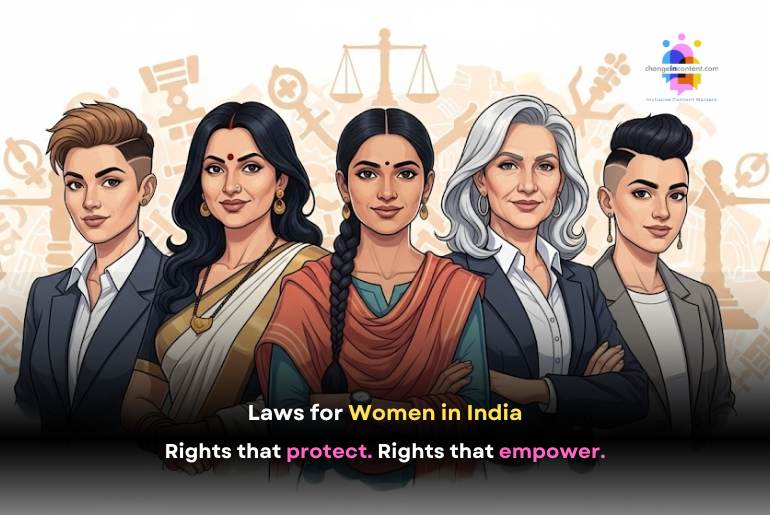
The conversation around laws for women in India often surfaces only when a crime hits the headlines. Yet, our legal framework offers provisions meant to safeguard women’s rights. These rights and laws range from protection against violence and workplace harassment to equal pay and property ownership. Many of these laws are the result of decades of advocacy, legal battles, and social movements. Still, a large section of women remains unaware of the rights they are entitled to, leaving them vulnerable to exploitation and injustice.
Knowing these laws is more than just legal literacy; it is empowerment. It enables women to stand their ground in workplaces, in homes, and in public spaces. It also pushes society to live up to its constitutional promise of equality. This article will walk you through the key rights and laws that protect women in India, not as dry legal jargon, but as fundamental tools for safety, dignity, and progress.
Rights for women in India
First, let us take a look at women’s rights in India.
The Right to Maintenance
For married women, financial security can become a matter of survival during separation or after leaving an abusive relationship. Under the Hindu Marriage Act, 1955, and the Protection of Women from Domestic Violence Act, 2005, a woman has the right to seek maintenance from her husband, even if they are living apart.
Section 24 of the Hindu Marriage Act allows either spouse to apply for monetary support, but in practice, it is often a lifeline for women who have no independent income. This right ensures that women are not left destitute while legal proceedings continue.
The Right to Equal Pay
Economic independence is one of the strongest forms of empowerment. The Equal Remuneration Act, 1976, mandates that men and women performing the same work must be paid equally. It also prohibits discrimination in recruitment, promotions, and training based on gender.
Although now replaced by the Code on Wages, 2019, the principle of pay parity remains intact. For women in India, invoking this right is crucial in industries where wage gaps persist despite equal qualifications and responsibilities.
The Right to Dignity and Decency
Article 21 of the Constitution guarantees the right to life and personal liberty, which includes dignity. For women, this translates into protection against harassment, exploitation, and degrading treatment. Section 354A of the Indian Penal Code criminalises sexual harassment, and the Sexual Harassment of Women at Workplace (Prevention, Prohibition and Redressal) Act, 2013 (POSH Act) provides a framework to report and address workplace harassment.
These laws acknowledge that dignity is not abstract, but about daily respect in how we treat women in every space they occupy.
The Right Against Domestic Violence
Domestic violence in India goes beyond physical abuse; it includes emotional, verbal, and economic abuse as well. The Protection of Women from Domestic Violence Act, 2005, gives women the right to seek protection orders, residence orders, and monetary relief from abusers.
It empowers women to approach the court without the stigma or procedural delays of criminal trials. It provides quicker, civil remedies while still allowing criminal charges to be pursued when necessary.
The Right to a Safe Workplace
Workplace safety is not negotiable. Along with the POSH Act, the Maternity Benefit Act, 1961, and the Equal Remuneration Act collectively ensure that women have the right to a safe, discrimination-free environment.
Employers are required to set up Internal Complaints Committees, display policies prominently, and conduct awareness sessions. For women, this right is essential not just for safety, but for building careers without fear of bias or harassment.
The Right Against Dowry
The Dowry Prohibition Act, 1961, makes the giving and taking of dowry a punishable offence. Despite this, dowry harassment remains one of the most reported forms of violence against women.
The law provides for imprisonment and fines, but enforcement challenges persist. For women and families, awareness of this law is critical to resisting dowry demands and reporting violations without fear of social backlash.
The Right to Free Legal Aid
Legal battles can be financially draining. The Legal Services Authorities Act, 1987, guarantees free legal aid to women who cannot afford it. This right ensures that justice is not an exclusive right for the wealthy.
Legal services authorities exist at national, state, and district levels to help women navigate court procedures, file cases, and seek redress without incurring prohibitive costs.
The Right to Self-Defence
Under Section 100 of the IPC, women have the right to defend themselves against threats to life, severe injury, or kidnapping. It includes the use of reasonable force, even if it causes harm to the attacker.
While legal protection exists, societal attitudes and a lack of awareness often discourage women from exercising this right. Promoting self-defence training alongside legal knowledge can make this right truly effective.
Laws for women in India: The key legal protections you should know
India’s legal framework for women’s rights is not a single act or code; it is a tapestry woven from decades of activism, constitutional guarantees, and reform movements. These laws cover protection from violence, workplace safety, reproductive rights, economic equality, and representation. Yet, they are only as powerful as the awareness and enforcement behind them.
Below are the most significant laws for women in India, explained in detail with their real-life impact.
Protection of Women from Domestic Violence Act, 2005
Domestic violence in India is not limited to physical abuse. This landmark law was the first to legally recognise emotional, verbal, economic, and sexual abuse within domestic relationships. It gives women the right to:
- Seek immediate protection orders from a magistrate without prolonged criminal proceedings.
- Secure residence rights in the shared household, regardless of ownership.
- Claim monetary relief for maintenance and expenses.
For many women, especially in rural areas, abuse is often normalised as a “private family matter.” This act empowers them to take action without the lengthy delays of criminal trials and provides civil remedies that the law can enforce quickly.
The Dowry Prohibition Act, 1961
Dowry demands remain one of the most entrenched forms of gender-based violence in India. This law makes giving, taking, or even demanding dowry a punishable offence, with imprisonment and fines. It also covers harassment and cruelty linked to dowry demands, even after marriage.
While the law exists, underreporting is a challenge due to fear of social stigma or retaliation. Awareness campaigns and strong community support are essential to make this law effective in practice.
The Sexual Harassment of Women at Workplace (Prevention, Prohibition, and Redressal) Act, 2013
Popularly known as the POSH Act, this legislation provides a clear legal definition of sexual harassment. It lays down preventive, prohibitive, and redressal mechanisms for all workplaces. The law applies to all, ranging from corporate offices to factories to domestic work settings. It mandates:
- Setting up Internal Complaints Committees (ICC) in every organisation with 10 or more employees.
- Training and awareness sessions for employees and managers.
- A clear, time-bound procedure for investigation and resolution.
It shifts the conversation from “tolerating inappropriate behaviour” to making employers legally responsible for creating safe workplaces.
The Medical Termination of Pregnancy Act, 1971 (Amended 2021)
This law regulates abortion in India, balancing reproductive rights with medical oversight. Under the 2021 amendment:
- Women can terminate pregnancies up to 24 weeks in some instances (earlier limit was 20 weeks).
- Special provisions apply for survivors of rape, minors, and cases of foetal abnormalities.
- Termination requires the opinion of one registered medical practitioner up to 20 weeks, and two practitioners between 20–24 weeks.
Access to safe, legal abortions prevents unsafe procedures that endanger women’s lives, while giving them greater control over their reproductive choices.
The Maternity Benefit Act, 1961 (Amended 2017)
This act ensures job security and income continuity for women during and after childbirth. The 2017 amendment extended paid maternity leave from 12 weeks to 26 weeks for women in the organised sector, with provisions for:
- Work-from-home arrangements where possible.
- Mandatory crèche facilities for establishments with 50 or more employees.
It enables mothers to recover and bond with their newborn without the pressure of immediate work resumption, while promoting workplace retention of female employees.
The Equal Remuneration Act, 1976 / Code on Wages, 2019
The principle here is simple: same work, same pay. This law prohibits discrimination based on gender in pay, recruitment, promotions, and training. Although the ERA has now been subsumed under the Code on Wages, 2019, the principle of wage parity remains a legal right.
It directly addresses the gender pay gap, ensuring women are compensated fairly for their contributions.
The Prohibition of Child Marriage Act, 2006
This law prohibits the marriage of girls below 18 years and boys below 21 years. It also provides for annulment of underage marriages and punishment for those who solemnise, promote, or permit such marriages.
Child marriage robs girls of education, exposes them to early pregnancies, and perpetuates cycles of poverty and inequality. Enforcement is challenging in areas where it is tied to tradition, but it is a critical safeguard for girls’ futures.
The Hindu Succession (Amendment) Act, 2005
This amendment to the 1956 Act gave daughters equal rights as sons in inheriting ancestral property in Hindu joint families. The right applies regardless of whether the father was alive at the time of the amendment.
Property ownership gives women financial independence and bargaining power in personal and family matters, breaking generational cycles of economic dependence.
The Indecent Representation of Women (Prohibition) Act, 1986
This act prohibits the depiction of women in a derogatory, indecent, or sexualised manner in advertisements, publications, and other media forms.
It seeks to curb objectification and harmful portrayals that perpetuate stereotypes and normalise gender discrimination in society.
The National Commission for Women Act, 1990
This act established the National Commission for Women (NCW) as a statutory body to:
- Review and recommend reforms in laws affecting women.
- Investigate complaints and take suo motu action on rights violations.
- Promote policies and programmes for women’s empowerment.
The NCW serves as a central voice for women’s rights at the policy level, influencing legislation and government action.
Conclusion: Laws for women in India and the road ahead
Laws for women in India are not just legal instruments; they are lifelines. They represent the struggles of countless women who fought to carve out protections in a system that historically sidelined them. But having laws is only half the battle; enforcing them with sensitivity and urgency is where India still falls short.
At Changeincontent, we believe that awareness is the first step towards enforcement. Every woman who knows her rights is better equipped to demand justice, every employer who understands these laws can create safer spaces, and every policymaker who hears these voices can push for stronger implementation. The road ahead demands that we close the gap between law on paper and reality in people’s lives.
Read more: Gender equality laws paving the way for women’s empowerment.
Disclaimer: The views expressed in this article are based on the writer’s insights, supported by data and resources available both online and offline, as applicable. Changeincontent.com is committed to promoting inclusivity across all forms of content. We broadly define inclusivity as media, policies, law, and history. It encompasses all elements that influence the lives of women and marginalised individuals. Our goal is to promote understanding and advocate for comprehensive inclusivity.