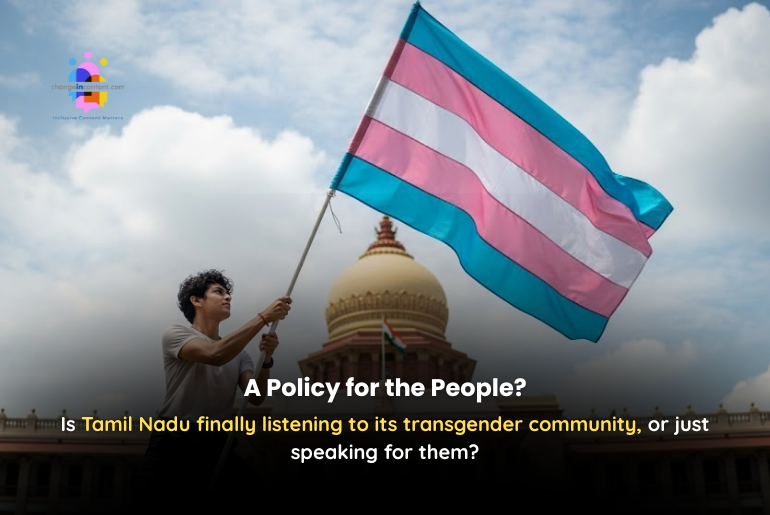
The launch of the Tamil Nadu State Policy for Transgender Persons marks a moment of hope and scrutiny. While the policy makes significant strides, it also raises important questions. Will these reforms translate into real change for the community, or will they remain unfulfilled promises? In this article, we explore how the Tamil Nadu State Policy for Transgender Persons aims to reshape inclusion.
In July 2025, the Tamil Nadu government launched a State Policy focused on the rights and welfare of transgender and intersex people. The policy, announced by Chief Minister M.K. Stalin, outlines a five-year plan to ensure equal access to education, jobs, healthcare, housing, legal services, and public schemes. The policy seeks to provide dignity, equality, and access for transgender and intersex people.
Some key data
According to the 2011 Census, Tamil Nadu had 22,364 transgender people. The current numbers are likely higher, though accurate data remains difficult to collect. The new policy may help improve data tracking and make the needs of the trans community more visible to planners and officials.
Tamil Nadu State Policy for Transgender Persons: Action Plan
The policy includes a system for follow-up and monitoring. A high-level committee, led by the Chief Secretary, will review the implementation every six months. At the district level, collectors will lead quarterly meetings to track local progress. The Social Welfare Department, which prepared the policy, released an action plan outlining the next steps.
Self-identification without medical certification
The policy allows transgender and intersex persons to choose their gender identity (male, female, or transgender) without needing medical procedures or official certification. This removes a significant hurdle created by the Transgender Persons (Protection of Rights) Act, 2019, which had made gender identity subject to approval by a district magistrate. Tamil Nadu’s new approach empowers the trans community to define their identity on their terms.
Legal rights and housing priority
The Tamil Nadu State Policy for Transgender Persons will also take steps to amend laws like the Hindu Succession Act and the Indian Succession Act to ensure transgender persons have equal inheritance rights. The state government will also be amending the Juvenile Justice Act to protect guardianship rights and provide legal backing for transgender parents and caregivers.
Legal aid will be made available, and a 24/7 helpline will respond to gender-related complaints and concerns.
Housing is another focus. Transgender persons will receive preference under state housing schemes. The state will provide free house-site pattas, rental support, and temporary shelter homes to reduce housing insecurity. These provisions apply to both individual applicants and transgender families.
Healthcare access and medical reforms
The policy addresses gaps in healthcare by introducing gender-affirmative services in both government and private hospitals. Medical and surgical support for gender-affirming procedures will be available without discrimination. Tamil Nadu will develop clear protocols for infants born with ambiguous genitalia and offer parental counselling. The medical, nursing, and allied health curricula will be revised to sensitise professionals on transgender health needs. The state also plans to provide Pre-Exposure Prophylaxis (PrEP) to reduce HIV risk and enforce standardised care in transgender clinics.
The policy clearly states that no medical practitioner or institution may carry out coercive conversion therapy. Therefore, any attempt to alter sexual characteristics or gender identity against an individual’s will is not allowed under the new policy.
Education: Inclusion, scholarships, and support
The policy lays special focus on improving access to education. District-level committees will trace gender-nonconforming students who dropped out due to bullying or social stigma and help them resume their studies. All educational institutions must now adopt inclusive policies, appoint nodal officers trained to support transgender and intersex students, and ensure safe learning spaces. Those pursuing higher education will receive scholarships and age relaxations to cover learning gaps.
This is much needed since transgender persons are among the most socially and educationally disadvantaged groups. The government plans to expand opportunities at every level of education, though it has not yet confirmed reservations.
Employment and workplace inclusion
In the employment sector, the policy requires both public and private workplaces to introduce anti-discrimination policies. All employees must undergo sensitisation training, and organisations should appoint grievance redressal officers. The state will also promote self-employment by offering subsidies, grants, and training programs. Additionally, career progression should not be affected by gender identity, and CSR funds will be routed through the Transgender Welfare Board to support these initiatives.
The transgender community still awaits horizontal reservation
While the Tamil Nadu State Policy for Transgender Persons promises fair representation in education and employment, it does not include a reservation quota. Activists and members of the transgender community have long demanded a 1% reservation in state institutions, viewing it as essential to break structural barriers. Although the policy mentions steps to ensure inclusion, the lack of a specific quota has raised concerns about whether these goals will be achieved. Activist Grace Banu acknowledged the focus on private sector inclusion as a positive sign but questioned the impact of the policy without guaranteed reservation.
Clause 3.7 of the new policy uses the term “Right to Representation in Employment and Educational Institutions.” Still, it does not clarify whether this refers to horizontal reservation for transgender and intersex persons. The community has long demanded such a horizontal reservation, and several court orders have also supported this call. The Tamil Nadu government did provide a 1% reservation for transgender people, but it was initially implemented as a vertical reservation under the Most Backwards Classes (MBC) category.
The issues that are highlighted
Without a clear statement on quotas, the policy leaves an important gap. Many feel it simply repeats what is already mentioned in the Transgender Persons (Protection of Rights) Act, 2019. That Act recognises the right to self-identify, protection from discrimination, and access to healthcare, but it does not mandate reservation.
Activists expected the state policy to go further, especially since Tamil Nadu has received specific directions from the Madras High Court to decide on the matter of reservation. In its current form, the policy reflects earlier promises but avoids committing to the one measure many believe would create real change.
Tamil Nadu State Policy for Transgender Persons: Final word
Tamil Nadu’s State Policy for Transgender Persons addresses key areas like healthcare, education, housing, and workplace inclusion, and introduces systems to track implementation and accountability. Allowing self-identification without medical proof is a much-needed change, and the efforts to improve access in schools, hospitals, and workplaces are welcome. However, even with its focus on representation, the policy leaves out horizontal reservation, a demand the trans community has never stopped raising.
Without that, many fear the promises will not lead to real change. The community has said what it needs, and the courts have supported those demands, too. It is time the government listened and acted on it.
Changeincontent Perspective
At Changeincontent, we believe that progressive policy must go beyond declarations. Inclusion is not achieved through symbolic representation but by breaking systemic barriers that have existed for decades. The Tamil Nadu State Policy for Transgender Persons is a promising framework, but the lack of horizontal reservation remains a stark reminder of how equity often stops short of empowerment. The transgender community deserves more than policy; it deserves political will.
Also Read: Are symbolic roles enough for transgender inclusion in India’s workforce?
Disclaimer: The views expressed in this article are based on the writer’s insights, supported by data and resources available both online and offline, as applicable. Changeincontent.com is committed to promoting inclusivity across all forms of content. We broadly define inclusivity as media, policies, law, and history. It encompasses all elements that influence the lives of women and marginalised individuals. Our goal is to promote understanding and advocate for comprehensive inclusivity.