
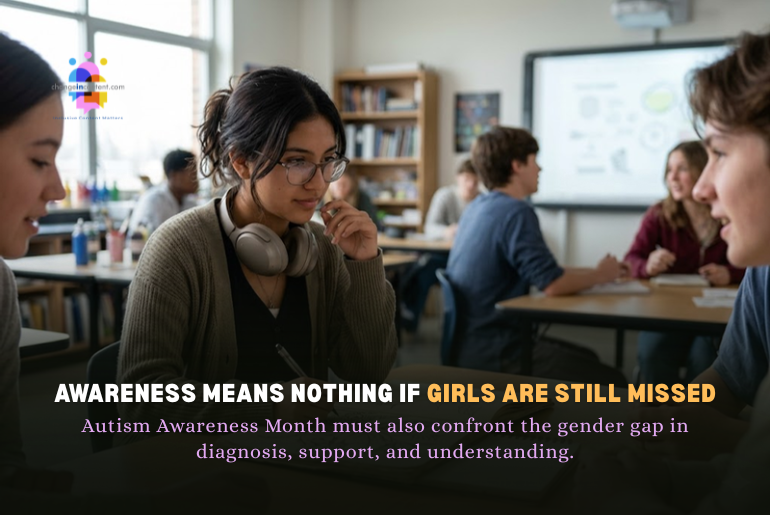
Every April, Autism Awareness Month invites conversations about recognition, inclusion, and support. April 2 is also marked globally as World Autism Awareness Day, a United Nations observance intended to advance the rights and understanding of autistic people. But awareness means very little if the people the system misses remain missing even as the conversation grows louder.
That is exactly what the gender gap in autism diagnosis reveals. For decades, autism research and diagnostic frameworks were shaped largely around boys, helping cement the idea that autism is mostly a male condition.
More recent evidence suggests that this picture is misleading. Girls and women are often diagnosed later, diagnosed less often, or misunderstood entirely. That is primarily because their presentation is more easily masked, dismissed, or read through the wrong lens.
What is Autism Awareness Month?
Autism Spectrum Disorder is a neurodevelopmental condition that affects communication, social interaction, behaviour, and sensory processing in different ways across individuals. While some autistic individuals can live on their own, others experience significant disabilities and need lifelong care and support.
Indian Paediatrics has cited an estimated prevalence of about 1 in 68 children aged 2 to 9 years in India. That underscores how significant the need for accurate diagnosis and support really is.
It also notes that boys are more commonly affected by autism than girls, with a ratio of roughly 3:1. However, are there actually more autistic boys than girls, or are we conveniently overlooking the gender gap in diagnosis and care?
Autism Awareness Month must confront how we are still missing girls and women.
Early autism research in the 1940s mostly studied boys. That led to a long-held idea that Autism Spectrum Disorder was mainly a “male” condition. However, autism is not a one-gender-specific condition. People of all genders can be autistic. Still, diagnosis rates tell something else. Studies like Loomes et al. 2017 autism prevalence study show autism is diagnosed about three to four times more often in boys than girls.
There was a study analysis where boys and girls came from similar backgrounds, including the same place of residence, family type, mother’s education, and number of children in the household. Yet, girls were far less likely to be diagnosed with Autism Spectrum Disorder before age three and more likely to be diagnosed only after age seven.
Why delayed diagnosis changes everything
Girls are often diagnosed much later than boys, with an average delay of nearly 2 years. Even when parents or teachers flag concerns early, girls tend to wait longer for proper assessment.
Many grow up without the right support, only getting diagnosed in their late teens or adulthood. By then, they have already spent years trying to cope without support, often being misunderstood in school, at home, and in social spaces.
This pattern also echoes what we explored in our article on medical gaslighting and healthcare bias against women, where women’s symptoms are often minimised, misread, or explained away instead of being taken seriously.
The Gender Gap: Why Autism diagnosis still looks different for girls
A big part of the problem lies in how we define autism. Diagnostic criteria largely focus on how autism shows up in boys. It means more visible social difficulties, repetitive actions, or clear speech delays.
Girls do not always present in the same way. Their struggles can be quieter or read differently. That makes them easier to dismiss. Instead of being recognised as autistic, they are often labelled shy, sensitive, or just adjusting.
When “shy” or “sensitive” replaces proper assessment
One key reason is something called “camouflaging” or masking. That is when autistic girls consciously or unconsciously hide their struggles in social situations. They might copy how others speak, rehearse conversations in their head, or push themselves to blend in.
There is also a deeper gender bias at play. Social expectations often push girls to be more socially adaptable, polite, and emotionally aware. Because of this, their behaviour is more likely to be seen as normal or dismissed as personality traits, such as shyness or sensitivity.
We need more inclusive research and diagnosis of autism.
Awareness cannot stop at campaigns if girls, women, and non-binary people continue to be missed or diagnosed late. Much of the existing research still focuses on boys. That gap continues to affect how autism is identified and understood.
We also need gender-sensitive diagnostic tools that actually reflect these differences, instead of forcing everyone into the same narrow checklist.
At a time when healthcare, technology, and research are constantly updating, it is hard to justify why autism diagnosis is still lagging. If systems can evolve in so many other areas, they can do the same here.
The Changeincontent perspective
If Autism Awareness Month is to mean anything, awareness has to become structural. That means updating diagnostic tools to reflect a wider range of autistic presentations, especially those more commonly seen in girls and women. It means training clinicians, teachers, and mental health professionals to recognise masking, delayed identification patterns, and gendered misreadings that keep many autistic people unsupported for years.
Awareness campaigns alone cannot fix a system that still looks for autism through an outdated lens. The solutions also have to extend beyond medicine.
- Schools need screening pathways that do not reduce girls’ distress to personality.
- Families need language that helps them seek assessment earlier without shame or confusion.
- Research needs to stop treating boys as the default reference point.
- And support systems need to include girls, women, and non-binary people without forcing them first to fit a narrow stereotype of what autism is supposed to look like.
If awareness does not change recognition, it remains a slogan rather than a solution.
Conclusion: Awareness means little if the diagnosis gap stays intact
As Autism Awareness Month reminds us to talk about Autism Spectrum Disorder, it also pushes us to look at who we are still leaving out of that conversation. The gender gap in autism diagnosis and awareness affects access to care, support systems, and even self-understanding.
If awareness is to mean anything, it has to lead to better recognition, updated diagnostic tools, and research that reflects diverse experiences across genders. Until then, many will continue to be overlooked.
Disclaimer: The views expressed in this article are based on the writer’s insights, supported by data and resources available both online and offline, as applicable. Changeincontent.com is committed to promoting inclusivity across all forms of content. We broadly define inclusivity in terms of media, policies, law, and history. It encompasses all elements that influence the lives of women and marginalised individuals. Our goal is to promote understanding and advocate for comprehensive inclusivity.
