
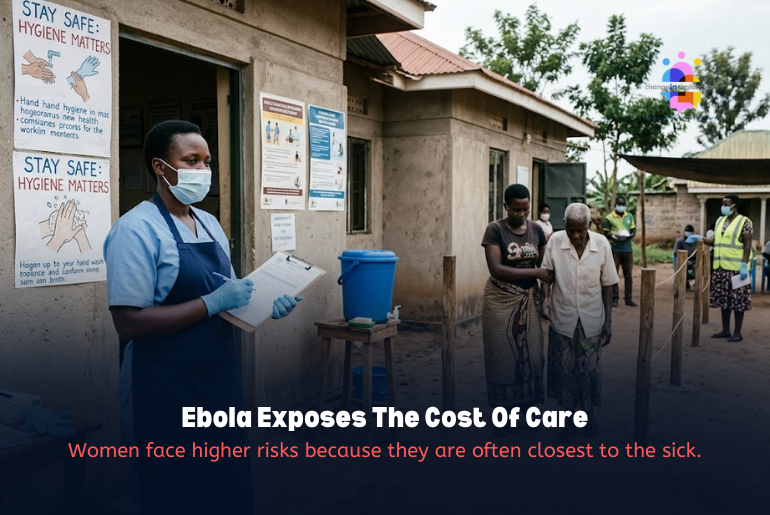
The Ebola outbreak is once again exposing a cruel pattern that public health systems often recognise too late: women are more likely to die during Ebola outbreaks. That is not because the virus becomes more deadly in their bodies, but because their roles place them at greater risk of infection in the first place. UN Women warns that the current outbreaks in the Democratic Republic of the Congo and Uganda could repeat a pattern seen over the past 50 years. It is a pattern where women are over-represented among Ebola deaths.
That is not only a story about a virus. It is a story about who bathes the sick, who changes the sheets, who sits by the bedside, who prepares food, who helps during childbirth, who works as a nurse, who cleans hospital spaces, who supports funerals, and who keeps families functioning when fear enters the home. Health crises do not land on neutral ground. They land in societies where care work is already gendered, underpaid, invisible, and expected.
The Ebola outbreak: Key findings
Ebola transmission follows social realities. When the society expects women to care first, serve first, and stay closest to the sick, they carry a higher burden of exposure. Any serious outbreak response must therefore protect women not merely as patients. It must protect women as caregivers, health workers, market workers, birth attendants, community organisers, and first responders inside homes.
The Ebola outbreak and the 50-year pattern of women’s deaths
UN Women says the higher impact of Ebola on women is not new. Similar patterns have been seen in several outbreaks over the past five decades.
“History has repeatedly shown us that women are more likely than men to die during an Ebola outbreak,” Sofia Calltorp, UN Women’s chief of humanitarian action, told reporters in Geneva.
The reason is not that Ebola becomes biologically more severe for women after infection. The reason is exposure. Women are more likely to be infected in the first place because they are often the people who care for sick family members, work in health facilities, support childbirth, sell in markets, keep households running, and participate in community-level care.
The historical reference
The pattern is not new.
- During the 2018–2019 Ebola outbreak in the Democratic Republic of the Congo (DRC), women and girls made up around two-thirds of reported Ebola cases.
- In Liberia’s 2014 outbreak, as many as 75% of the Ebola fatalities were women.
- UN sources in Sierra Leone report that women represent around 59% of the deceased.
Even 50 years ago, during one of the earliest Ebola outbreaks in the DRC, women represented 56% of those who died.
The concern is especially urgent because the current outbreak is unfolding in a region already struggling with displacement, insecurity, and overstretched healthcare systems. The World Health Organisation said that, as of May 16, 2026, the DRC had reported eight laboratory-confirmed cases, 246 suspected cases, and 80 suspected deaths in Ituri Province across health zones including Bunia, Rwampara, and Mongbwalu.
Why does caregiving put women closer to Ebola risk?
“Ebola transmission follows social realities,” Calltorp said. That line matters because it shifts the focus from biology alone to the way society organises care.
In many homes, women are the first to step in when someone falls ill.
They clean, feed, bathe, comfort, and monitor the sick.
They care for children, elderly relatives, pregnant women, and family members who need constant help.
During Ebola outbreaks, the same ordinary closeness can become dangerous because the virus spreads through direct contact with the bodily fluids of infected people or those who have died from the disease.
That is the brutal contradiction of care work. The same labour that keeps families alive can put women at higher risk when disease enters the home.
The funeral, the clinic, and the home
Ebola risk does not sit only inside hospitals. It follows people into bedrooms, kitchens, courtyards, maternity spaces, markets, and burial rituals.
The funeral
Traditional funeral practices can create major risks because Ebola can still spread from the bodies of people who have died from the disease. In many communities, women are involved in washing, preparing, and caring for bodies before burial. What is normally an act of love, grief, and respect can become a route of infection during an outbreak.
The clinic
Women also make up a large part of frontline care work. Nurses, cleaners, community health workers, birth attendants, and informal caregivers often work most closely with patients. Some have formal protection. Many do not. When protective equipment, training, transport, or infection-control systems are weak, women absorb the danger through the roles they are expected to perform.
Pregnant women
Pregnant women face additional risks. They need repeated contact with healthcare systems for check-ups, delivery, and postnatal care. Ebola infection during pregnancy has been associated with severe complications and very high risks for both mother and baby.
Research on Ebola and women has repeatedly shown that gendered roles, caregiving patterns, and pregnancy-related needs shape exposure and outcomes during outbreaks.
From Ebola to Nipah: When care work becomes a health risk
The story is not limited to Ebola.
During Kerala’s 2018 Nipah outbreak, the first identified patient was Mohammed Sabith from Perambra. But one of the names most people still remember is Lini Puthussery, the nurse who contracted the virus while caring for him.
Her story stayed with people because it carried both grief and recognition. It showed how frontline care is often spoken about as duty, compassion, and sacrifice, but rarely examined as risk. Nurses, caregivers, health workers, and women inside families are praised after tragedy, but not always protected before it.
That is the pattern we must question.
Outbreaks often reveal who stays closest when everyone else steps back. And very often, that person is a woman.
She is either a mother, a nurse, a daughter, a midwife, a cleaner, a community worker, or a neighbour.
Care saves lives. But when care is gendered, underprotected, and taken for granted, it can also place women directly in the path of disease.
This is part of a much wider conversation about how women’s health risks are underestimated until they become visible through crisis. Changeincontent has explored this pattern earlier in our piece on thyroid disorders in working women, where we looked at how women often carry invisible health burdens while continuing to work, care, and perform normalcy.
Why women-led Ebola responses need funding and power
UN Women has called for long-term funding and stronger support for women-led organisations working on the ground during Ebola outbreaks. According to the agency, local women’s groups are often among the first to respond during health emergencies. They help families access information, care, food, social support, and trusted community communication.
That matters because outbreak response is not only about hospitals, vaccines, border controls, and emergency alerts. It is also about trust. In communities affected by fear, misinformation, displacement, or conflict, women-led groups often understand local realities better than distant institutions.
Protection cannot stop at awareness.
A gender-sensitive Ebola response must include protective equipment for caregivers, stronger infection-control training, safer burial support, maternal healthcare access, psychosocial care, transport, childcare support, and compensation for frontline workers.
It must also include women in decision-making. Women are not only affected by outbreaks. They are often central to controlling them because they sit at the intersection of homes, clinics, markets, caregiving networks, and community trust.
If outbreak planning ignores women’s roles, it also ignores one of the main routes through which disease spreads and one of the strongest networks through which response can work.
The mistake is not that women care. The mistake is that systems benefit from their care without protecting them enough.
The Changeincontent perspective
The Ebola Outbreak is not only a public health emergency. It is a mirror held up to the world’s unpaid and underprotected care economy.
When a disease spreads through closeness, the people asked to stay closest become the most exposed. That is why women keep appearing in Ebola death patterns, not as biological accidents, but as social evidence.
For years, societies have treated women’s caregiving as natural.
- A mother cares.
- A daughter cares.
- A nurse cares.
- A birth attendant cares.
- A woman in the neighbourhood steps in.
- A woman in the market keeps going.
- A woman at home watches the sick through the night.
Then an outbreak arrives, and suddenly care becomes risk.
That is where public health must become more honest. It is not enough to tell communities to isolate, report symptoms, or follow protocols if the people expected to provide care do not receive protection, training, equipment, income support, rest, and decision-making power.
Women should not have to become martyrs for health systems to acknowledge their labour.
The solution is not to romanticise sacrifice. It is to fund women-led responses, protect frontline workers, build safer care systems, include women in outbreak planning, and recognise unpaid caregiving as part of emergency infrastructure.
Whether it is Ebola in Africa or Nipah in Kerala, the lesson is the same. The people who hold families and healthcare systems together during crises must not be the last to receive protection.
A society that depends on women’s care must stop treating women’s risk as collateral damage.
Editorial note and disclaimer
This article is part of Changeincontent’s Knowledge Hub section, where we examine gender, public health, care work, workplace systems, and crisis response through an evidence-led editorial lens.
The article stems from recent statements by UN Women on the gendered impact of Ebola outbreaks, World Health Organisation updates on the current Ebola situation in the Democratic Republic of the Congo and Uganda, historical Ebola outbreak data cited by UN Women, and broader public health research on gender, caregiving, and epidemic exposure.
The article is primarily for public awareness and editorial discussion, not medical advice. Readers seeking health guidance should consult qualified public-health authorities and medical professionals.
Sources
UN Women Statement, May 2026: UN Women warned that women have been over-represented in Ebola deaths for 50 years and that the current outbreak could follow the same pattern.
Anadolu Agency: Reported UN Women’s warning that women and girls face higher infection risks in the current DRC and Uganda outbreak because of caregiving and frontline community roles.
World Health Organisation: Reported the May 2026 Ebola situation in the Democratic Republic of the Congo and Uganda, including confirmed and suspected cases in Ituri Province.
UN Women, 2014: Reported that authorities in Liberia estimated up to 75% of Ebola fatalities were women in some communities, while UN sources in Sierra Leone reported women represented around 59% of deaths.
UNDP Policy Note, 2015: Analysed the gender impact of Ebola and stated that women’s susceptibility was linked to caregiving and economic roles, not only biology.
PMC Research Article: Discussed the gendered impact of Ebola and why women are at greater risk because of daily activities, caregiving, and pregnancy-related vulnerabilities.
