
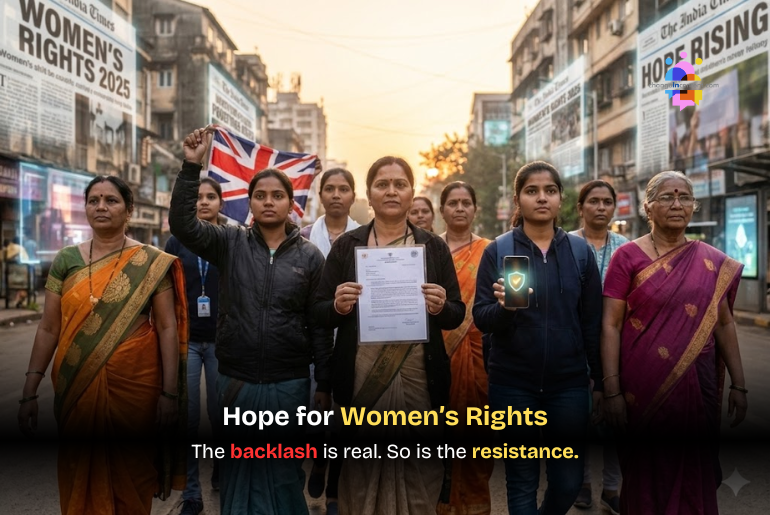
The hope for women’s rights is not a motivational line for end-of-year posts. It is a political and social requirement. As 2025 closes, the headlines have been loud about rollbacks, violence, and backlash.
Yet beneath the noise, something else has been happening: women have been organising, negotiating, striking, building parallel systems of care. Moreover, they are forcing institutions to move. Not everywhere, not evenly, and not fast enough. But enough to prove one thing: patriarchy is resilient, not unbeatable.
The world did not get safer for women in 2025. That is the point.
Let us name the reality before we chase hope. Violence against women remains normalised, and the numbers keep indicting systems, not individual choices. In Europe, a major EU-wide survey again put the scale in plain sight: around one in three women reported experiencing physical or sexual violence, including threats. That is not a marginal crisis. That is a structural condition.
What makes 2025 particularly volatile is not only the violence itself, but the cultural permission around it. The pushback against women’s rights has become more confident, better funded, and increasingly digital.
In India, we observe this as well. As a society, we often frame the policing of women’s mobility, relationships, clothing, and online presence as “safety” or “culture.” However, it functions as control. When rights are constantly negotiated in daily life, the law becomes only one battlefield.
Beijing is 30 years old. The question is whether the world still has the spine for it.
2025 also marked the 30-year milestone of the Beijing Declaration and Platform for Action, the most ambitious global blueprint for gender equality. Anniversaries can become empty theatre, but this one matters because it arrived in a year of visible regression. The UN’s message around Beijing+30 has been blunt: progress exists, but it is too slow, and backlash is real.
It matters for India because Beijing is not “global policy talk”. Its themes are our daily headlines: violence, unpaid care work, workplace parity, political participation, and digital harm. Beijing is the mirror. If we do not like what we see, the answer is not to smash the mirror. It is to change the room.
Hope for Women’s Rights looks like power, not praise
There is a specific kind of hope that is useless: the kind that celebrates women’s resilience while keeping the structures that exhaust them intact. The hope that matters is different. It is when women gain bargaining power, legal leverage, economic security, and a collective voice.
Iceland’s lesson: We can build parity through labour power
One of the most powerful reminders of organised feminism comes from Iceland’s legacy of collective action. The 1975 women’s strike is still cited globally because it made women’s paid and unpaid labour impossible to ignore.
Fifty years later, the story remains relevant because it links gender equality to labour power and union strength, rather than to inspirational leadership speeches alone.
For an Indian reader, this lands sharply. We often discuss women’s workforce participation as a statistic, but we rarely address women’s bargaining power within the workforce. Parity is not only about entry into jobs. It concerns who negotiates wages, who is protected, who is promoted, and who is punished for caregiving.
Rojava’s lesson: Even in conflict, women can design governance differently
If you want “unlikely places”, look at the Democratic Autonomous Administration of North and East Syria (often discussed as Rojava).
Despite a context of conflict, women are pushing models like co-leadership structures, women’s councils, and legal reforms that challenge patriarchal norms around marriage and family structures. These efforts are complex and contested. However, they matter because they show that women’s rights are not a “post-conflict luxury”. They are a design principle for society.
India does not need to copy any governance model to learn the core point: when women have veto power and representation is structural, rights are no longer optional.
The new frontline is the phone screen, and that is where patriarchy is recruiting
Digital spaces are not neutral. They amplify misogyny faster than institutions can respond. The “manosphere” culture is not merely a Western online phenomenon; its language readily permeates Indian comment sections, school corridors, and workplaces.
At the end of 2025, the question is no longer whether digital violence is real. The question is whether law, platforms, and workplaces will treat it as violence rather than “online drama”.
The Indian state has also been speaking more directly about technology-facilitated gender-based violence. We are also discussing the need for stronger frameworks and support systems, particularly through institutions such as the National Commission for Women and Mission Shakti.
Hope here does not come from telling women to “stay safe online”. It comes from accountability. That includes faster takedowns, clearer platform responsibility, and better cyber policing that actually understands gendered harassment. Furthermore, accountability includes workplace policies that treat doxxing, threats, and image-based abuse as safety risks, not reputation issues.
India’s hope for women’s rights is real, but it is uneven and often accidental
In India, progress often arrives in fragments: a court ruling here, a state policy there, one company deciding to do the right thing. At the same time, another performs inclusion like a marketing campaign. That unevenness can feel exhausting. But it also reveals something: patriarchy in India is not a single wall. It is a patchwork of rules that can be dismantled piece by piece.
Hope for Women’s Rights in India, right now, looks like this:
Women demanding workplace dignity without begging for it; survivors pushing systems to convict, not compromise; young women treating financial independence as non-negotiable; feminist lawyers turning “custom” into a question the Constitution must answer; and employees calling out “culture” when someone uses it as a cage.
Conclusion: Hope is not optimism. It is a strategy.
Hope for Women’s Rights is not the belief that things will magically improve. It is the decision to continue building leverage in a world that continues to test women’s limits. 2025 showed us the threat clearly. It also showed us the antidote: collective action, enforceable rights, and institutions that are forced to change because women refuse to disappear.
The following year will not be kind by default. If progress comes, it will come because women organised it into existence.
Changeincontent perspective
At Changeincontent, we do not publish women’s rights as a “cause”. We publish it as an operating system for society and work. If patriarchy is the background code running quietly everywhere, then our job is to expose it, name it, and insist on parity. We do it through policy, workplaces, and public life. Hope, for us, is not a soft ending to a challenging year. It is a blueprint for what we must build next.
Disclaimer: The views expressed in this article are based on the writer’s insights, supported by data and resources available both online and offline, as applicable. Changeincontent.com is committed to promoting inclusivity across all forms of content. We broadly define inclusivity as media, policies, law, and history. It encompasses all elements that influence the lives of women and marginalised individuals. Our goal is to promote understanding and advocate for comprehensive inclusivity.
